
Intel Xeon E5 Version 3: Up to 18 Haswell EP Cores
LRDIMMs: Capacity and Real World Performance
As we have shown that Intel invested a lot of time to improve the support for LRDIMMs, we also wanted to do a few real world tests to understand when capacity or higher speed at high DPC matters.
First we test with our CDN test. We simulate our CDN test with one CDN server and three client machines on a 10 Gbit/s network. Each client machine simulates thousands of users requesting different files. Our server runs Ubuntu 13.04 with Apache.
The static files requested originate from sourceforge.org, a mirror of the /a directory, containing 1.4TB of data and 173,000 files. To model the real world load for the CDN two different usage patterns or workloads are executed simultaneously, one that accesses a limited set of files more frequently and a second that accesses less frequently requested files. This workload simulates users that are requesting both current as well as older or less frequently accessed files. You can read more about our CDN test here. We used the Xeon E5-2695 v3.
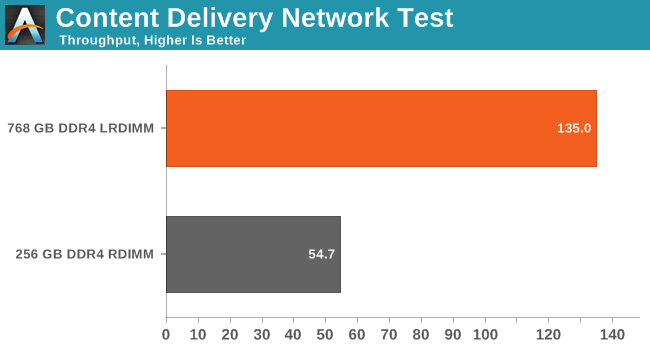
There is no doubt about it: some applications are all about caching and LRDIMMs are incredibly useful in these situations. Some HPC workloads supposedly require a lot of memory as well and can be very sensitive to memory bandwidth. Really? Even with a 35MB L3 cache? We decided to find out.
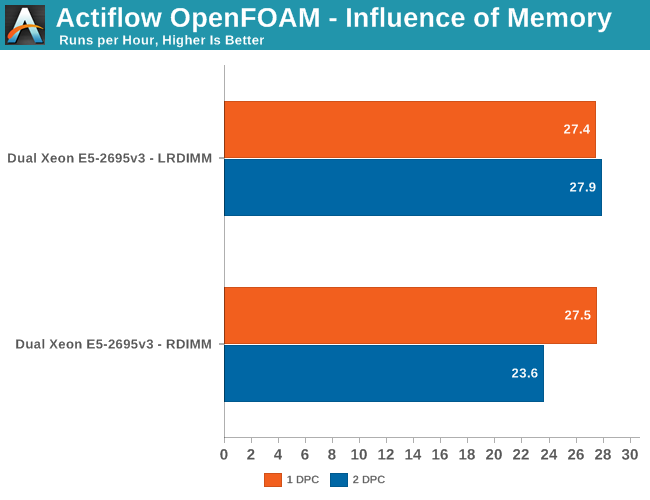
LRDIMMs are just as fast as RDIMM in a 1DPC configuration. Once you plug in two DIMMs per channel, LRDIMMs outperform RDIMMs by 18%. That is quite surprising considering that our CPU is outfitted with an exceptionally large L3. This test clearly shows there are still applications out there craving more memory bandwidth. In the case of OpenFOAM, the amount of bandwidth largely determines how many cores your CPU can keep busy.
Originally published at https://www.anandtech.com/show/8423/intel-xeon-e5-version-3-up-to-18-haswell-ep-cores- (Wayback Machine).