
Seagate's Intel Rangeley NAS Pro 4-bay Review
Multi-Client iSCSI Evaluation
As virtualization becomes more and more popular even in home / power user settings, the importance of the iSCSI feature set of any COTS NAS can't be overstated. Starting with our ioSafe 1513+ review, we have begun devoting a separate section (in the reviews of NAS units targeting SMBs and SMEs) to the evaluation of iSCSI performance. The iSCSI target implementation in the Seagate NAS OS is based on LIO. It is above the LVM, and hence, can be termed as a 'file-level' implementation (similar to what Synology terms as 'regular file LUNs' in DSM).
Depending on the product positioning, Seagate sets soft limits on the number of possible iSCSI LUNs / targets. The list below provides a summary of the limitations:
- NAS 2/4: 10 Targets/10 LUNs
- NAS Pro 2/4/6: 32
- 4-bay Rackmount: 32
- 8-bay Rackmount: 64
The NAS Pro currently doesn't carry any virtualization certifications, but this is going to change shortly. The 4-bay Rackmount (based on the Atom D2701) is already 'VMware Ready' with NAS OS 3.2 and Seagate is working on getting the same for the Rangeley-based NAS Pro units running NAS OS 4. I don't foresee any issues for Seagate in this process, but, until the certification is in place, Seagate's marketing collateral can't carry the logos. The 'Citrix Ready' tests are also passing, so most of these certifications should become part of the marketing push soon.
Coming back to the iSCSI support, Seagate provides only one way to create LUNs / targets, but there are two possible approaches to the configuration. In the first one, users can configure a single LUN / target and enable multiple initiators to connect to it. In the second one, a single LUN / target can be connected to a single initiator (this is the default access mode for newly created LUNs / targets). We benchmarked both approaches. The standard IOMeter benchmarks that we used for multi-client CIFS evaluation were utilized for iSCSI evaluation also. The main difference to note is that the CIFS evaluation was performed on a mounted network share, while the iSCSI evaluation was done on a 'clean physical disk' (from the viewpoint of the virtual machine).
Performance Numbers
The four IOMeter traces were run on the physical disk manifested by mapping the iSCSI target on each VM. The benchmarking started with one VM accessing the NAS. The number of VMs simultaneously playing out the trace was incremented one by one till we had all 25 VMs in the fray. Detailed listings of the IOMeter benchmark numbers (including IOPS and maximum response times) for each configuration are linked below:
- Seagate NAS Pro 4-bay - Multiple LUNs (Regular Files) - 4x 4 TB / RAID-5 / 2x 1G
- Seagate NAS Pro 4-bay - Single LUN (Regular Files) - 4x 4 TB / RAID-5 / 2x 1G
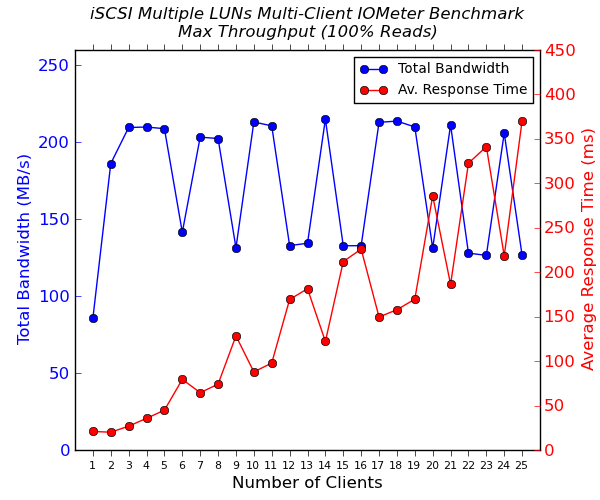
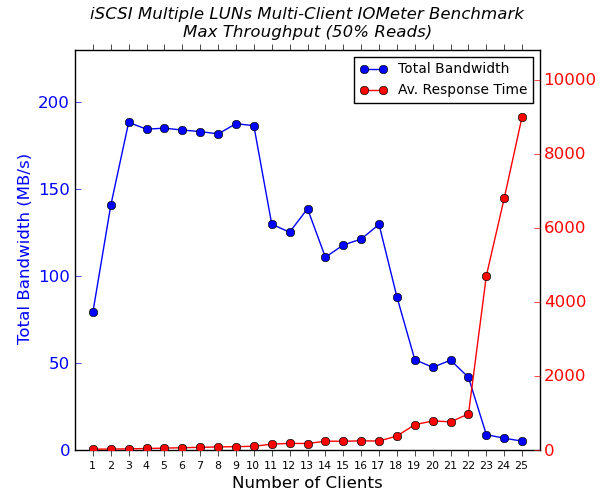
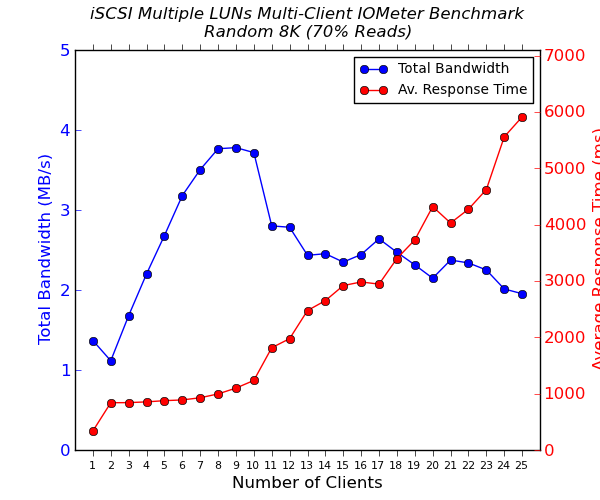
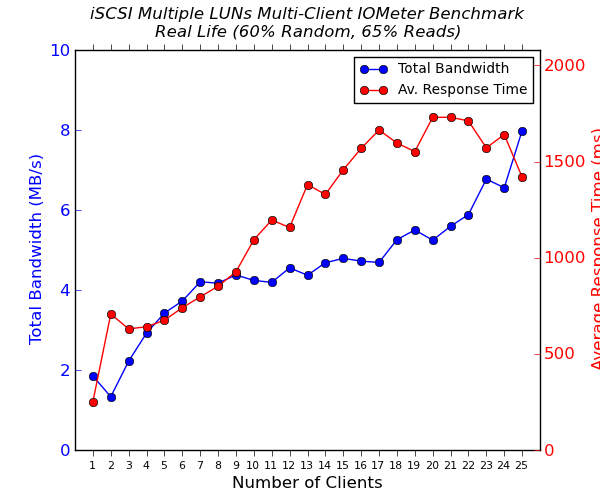
The unfortunate aspect we noted in our evaluation was that the multiple LUNs case suffers from serious issues beyond five simultaneously accessed targets. However, a single LUN being accessed by the equivalent number of initiators doesn't seem to suffer from performance issues. This is definitely worth further investigation by Seagate.
In terms of competing units, we currently have data only from the ioSafe 1513+ for comparison. Given the different number of bonded network links as well as the different number of drive bays, it is not exactly an apples-to-apples comparison. As more NAS units are processed, we hope this section will provide readers with a way to quickly get an idea of the competitive performance of a particular NAS unit when it comes to iSCSI support.
Originally published at https://www.anandtech.com/show/8404/seagate-intel-rangeley-nas-pro-4bay-review (Wayback Machine).