
The NVIDIA SHIELD Tablet Review
WiFi Performance
For the most part these days it seems that the situation for WiFi is much better in mobile than it is anywhere else, but it's still important to test throughput, especially on a device like the Shield tablet that requires low latency, high bandwidth connections in order to support GameStream and GRID. To this end, while NVIDIA hasn't shipped 802.11ac the Shield tablet ships with a 2x2 antenna configuration for a maximum PHY rate of 300 Mbps. Like the Shield portable, this is a BCM43241 chip, likely shared to improve economies of scale. To look at how it performs, we turn to iperf. Before we get into the results of the test, I'd like to thank ASUS for providing the RT-AC68U router to test WiFi perfomance.
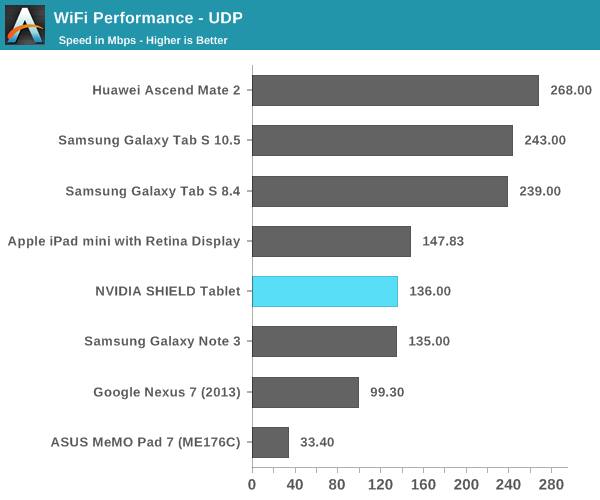
Surprisingly, the Shield tablet performs about as well as some single stream 802.11ac solutions like the one found in the Galaxy Note 3. Performance is generally in line with what we'd expect for such a solution, although it would be nice to see 802.11ac for future products.
Camera

While I currently don't have the means to properly test camera, there are still some things to talk about for camera. Both the front and rear camera modules use OmniVision's OVT5963 sensor, which appears to be a 1/4", 5MP sensor. The rear camera has an F/2.0 aperture with 2.95mm focal length, and the front camera has an F/2.8 aperture, with a claimed 4.76mm focal length, although the field of view appears to be somewhat wider. This is the same sensor as the camera in the Nexus 7 (2013). As a rear facing camera, the quality is nothing special but as a front facing camera it's surprisingly high quality. The photo above is with the rear facing camera, the photo below is from the front facing camera. The stock camera application also doesn't show the correct aspect ratio for the camera, so the preview is cropped.

Audio
While I don't have the equipment available to test audio quality and peak volume quite yet, subjectively the two bass reflex ports and dual front facing speakers make for a great experience. It's definitely a major advantage over other devices when it comes to watching movies and playing games as I don't have to cup my hand around the speaker. The larger size of the tablet formfactor means that the stereo separation is much more obvious. On the headphone jack, the device appears to be using a Realtek RT5639 codec. It seems that NVIDIA has continued to use their own speaker protection system that runs on the SoC, as there isn't any clear evidence of a speaker protection IC connected via I2C.
Originally published at https://www.anandtech.com/show/8296/the-nvidia-shield-tablet-review (Wayback Machine).