
NVIDIA's nForce 420/220: It's finally here
- Posted in
- CPUs
Overall Integrated Video & Gaming Performance
In order to test the integrated GPU of the nForce as well as offer more thorough gaming tests at resolutions greater than 640 x 480, we also ran another set of benchmarks. These numbers used the latest Detonator XP drivers to show you the type of performance you can expect from the two fastest Athlon platforms available today.
These tests made use of a 1.2GHz Athlon for better comparison with the 1.2GHz Palomino based Athlon MP results we will present in the section that follows this one.
Since we've already established that without the integrated video, the nForce 420 and 220 are identical in performance we've thrown out the 220 scores for this section to simplify the graphs somewhat.
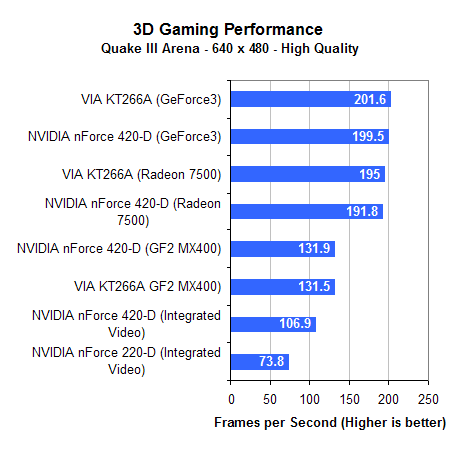
The inclusion of a Radeon 7500 in this test is just to prove that the card is indeed compatible and performs quite well on a NVIDIA based motherboard.
As you can see, the KT266A has a slight lead over the nForce but not enough to make a noticeable performance difference.
In spite of NVIDIA's initial claims that the integrated video of the nForce would be equivalent to or faster than a GeForce2 MX, it's clear that this isn't the case. A GeForce2 MX400 (or a regular GeForce2 MX for that matter) is about 22% faster than the integrated core on the 420-D because of memory bandwidth constraints. Remember that a regular GeForce2 MX has a full 2.7GB/s of memory bandwidth available to it; judging by these performance figures, the integrated GPU does not have a comparable amount.
When the memory bandwidth is cut in half by moving down to the 220-D, the bandwidth limitations even more thoroughly castrate the integrated GPU's performance.
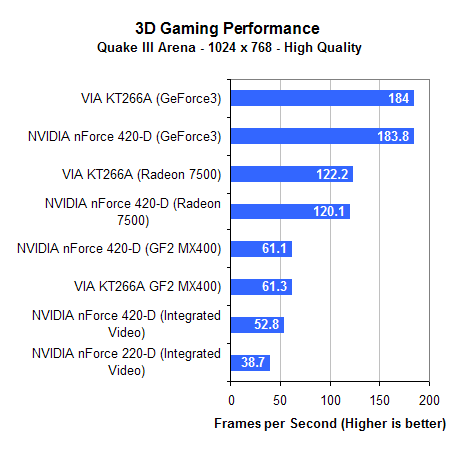
At 1024 x 768 the integrated GPU is not able to even break 60 fps with a 1.2GHz Athlon at the helm. The performance of the 220-D is even more dismal.
Originally published at https://www.anandtech.com/show/828 (Wayback Machine).