
Intel 850 Motherboard Roundup: September 2001
- Posted in
- Motherboards
MSI i850 Pro2

|
MSI 850 Pro2 |
|
|
CPU
Interface
|
Socket-423
|
|
Chipset
|
Intel
850/ICH2
|
|
Form
Factor
|
ATX
2.03
|
|
Bus
Speeds
|
Auto Detect 100 - 120MHz (1MHz increments) |
|
Core
Voltages Supported
|
Auto Detect +0.025 / +0.050 / +0.075 / +0.100V |
|
Memory
Slots
|
4
184-pin RIMM Slots
|
|
Expansion
Slots
|
1
AGP Slot |
|
On-board
Audio
|
N/A
|
|
BIOS
|
Award
Modular BIOS 6.00PG
|
Just before Computex, we got word from MSI that they had developed the first 4-layer i850 motherboard. Before that, all i850 motherboards were 6-layer, which increases manufacturing costs noticeably. Although we haven’t received any other 4-layer designs, a few more are starting to show up in the market. For now, however, the MSI 850 Pro 2 is the easiest to find of those solutions.
The first thing you notice when looking at the board is that one of the RIMM slots is rotated 90 degrees relative to the others. This is actually the key to the 4-layer design and works just fine, without excessive trace lengths, because of the serial nature of RDRAM.
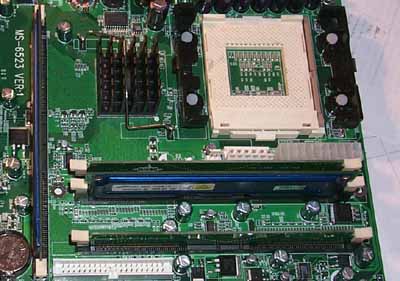
There is one downside with this design. The rotated RIMM slot occupies the space where the AGP slot normally lies, meaning that all the slots are shifted over one notch. The end result is a maximum of 6 expansion slots total with such a design. In this case, MSI went with four PCI slots, 1 CNR, and 1 AGP. The 4 PCI slot design could actually become a hindrance for some users, especially since there is no onboard IDE RAID controller either.
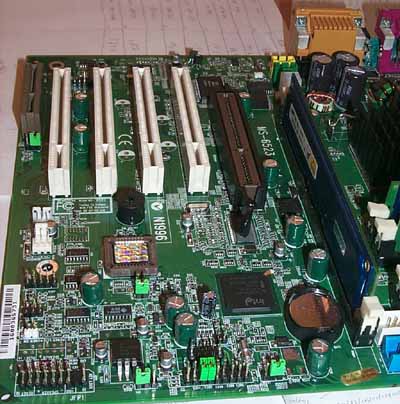
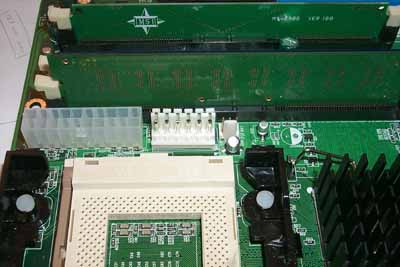
As mentioned previously, the benefit of the 4-layer design is reduced cost. In this case, however, what you’ll notice is that the 850 Pro2 costs about the same as the other boards here, although it is a bit less than MSI’s original 6-layer solution. Unfortunately, this will probably be the case for most 4-layer i850 designs where the savings are really only realized in larger quantities, such as by OEM’s or other system builders.
Regardless, the board does offer the best set of overclocking abilities we have here. You get 1MHz increments on the FSB from 100MHz to 200MHz, which is definitely the most attractive feature of the board. The CPU core voltage tweaks also help boost the performance of the board a little.
Unfortunately, overclocking results weren’t up to par, possibly due to the 4-layer design, which is still brand new and could probably stand to be tweaked a bit. The board was able to run smoothly at 121MHz, but the system would not boot at anything higher.
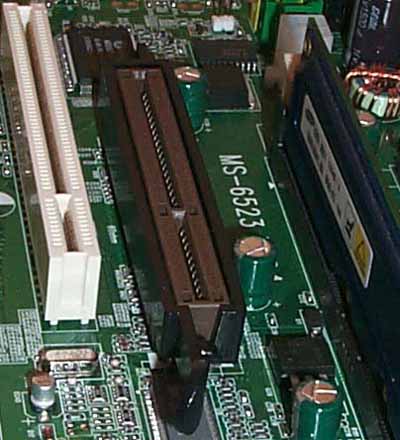
With the 850 Pro2, MSI has shown the industry that they have the ability and resources to put out innovative designs, which in this case lower the production costs noticeably. Unfortunately, the savings are mainly realized when purchased in volume. To really compete around here, MSI needs to improve the overclocking ability of the board, not just in terms of features, but in actual results if they truly want to compete with the ABIT TH7 and the ASUS P4T.
Originally published at https://www.anandtech.com/show/827 (Wayback Machine).