
The OnePlus One Review
WiFi
On the OnePlus One, it's quite surprising to see the retention of 802.11ac WiFi as such features are often the first to be cut to reduce the price of a product. In the case of the OnePlus One, we see Qualcomm Atheros' WCN3680 solution, which is a single spatial stream for a maximum physical link rate of 433 Mbps. While the physical link rate is one thing, practical bandwidth and performance is another. In order to test this, we use iperf on Android with Asus' RT-AC68U for maximum perfomance in this area.
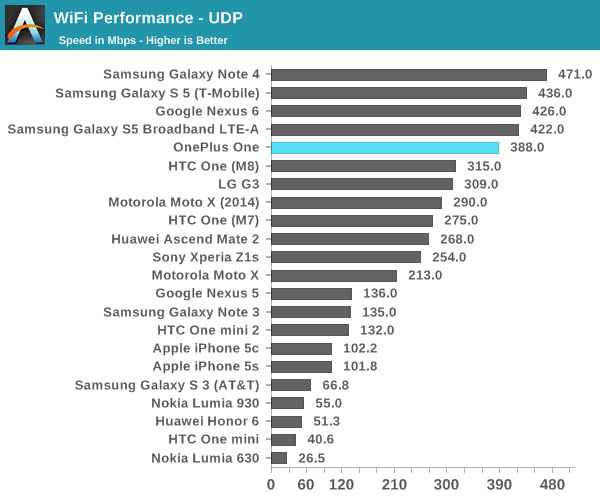
In this test, I saw that the OnePlus One noticeably out-performed the rest of the single stream competition, but I suspect that there are some irregularities here as iperf would report bandwidth above 433 Mbps in certain cases. Subjectively, there are no real issues with WiFi performance and one should have little issue with this on the OnePlus One.
GNSS

As one might have guessed, the OnePlus One leverages the on-die modem for GNSS. This means that one can expect IZat (GPSOne) gen 8B. In general, I haven't found any issues with GPS on this device. With a cold lock (airplane mode on, no assistance data) I found that it took around 50 seconds to first acquire position, then around another 30 seconds to get high accuracy.
Misc
The haptic feedback on the OnePlus One is noticeably different from every other device I've used, with much more noise than vibration. The same TI BQ27541 fuel gauge is shared with the Oppo Find 7A, as is the TI BQ24196 charger chip. Reception, at least for T-Mobile US' band 4/AWS LTE is noticeably worse than most devices that I've tried. The dual speakers are loud and the quality is relatively good, but no better than what one might find on the iPhone 6.
Originally published at https://www.anandtech.com/show/8242/the-oneplus-one-review (Wayback Machine).