
QNAP TS-x51 NAS Series: Intel Quick Sync Gets its Killer App
Virtualization for Home Users
QNAP heavily played up their unique Virtualization Station package when I talked to them at CES earlier this year. At that time, they were focusing on the TVS-x70. Quite frankly, I thought it would be a niche feature targeting very high-end SMB and enterprise customers. Users in that segment have traditionally preferred to separate their virtualization and network storage platforms, and are resistant to change. At that time, my impression was that It might take a couple of generations for Virtualization Station to catch on in that market segment.
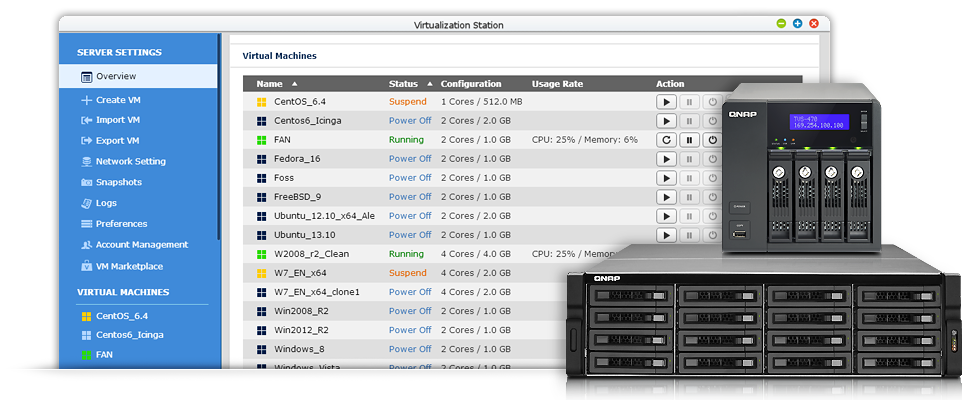
Now that QNAP is playing up Virtualization Station as a trump card for the TS-x51 series (albeit with the restriction that only 1 VM can be run, and the NAS has to have more than 2GB of RAM), I began to think about this more. In their marketing spiel, QNAP portrays using the VM feature for fulfilling functionality available only on certain OSes. The example provided was that of a printer with drivers available only for Windows.
Power users running Windows on their HTPCs often use the unit for other tasks too. In fact, the popularity of the 'multiple concurrent users on a single PC' article on Missing Remote stands testimony to this fact. Others might have a physical PC at home used in a 'headless' manner, i.e, no display attached and just accessed through the 'Remote Desktop' feature. Typical use cases include home automation servers or just running download tasks (say, JDownloader or torrents or anything similar). In the case that users want to run those tasks on a NAS (and avoid the PC altogether), they have usually been forced to rely on 'apps' from the NAS vendor or 'third-party apps' for fulfilling the required functionality.
The availability of a NAS to act as a VM host enables users to run their OS of choice, say Windows. Most required functionality can be implemented / is already available on Windows. The apps can then be run on the VM (and in addition, they have direct local access to the storage too, without going through the network). These type of use-cases make Virtualization Station a very nifty feature.
QNAP's implementation does leave scope for improvements, though. For example, running a VM takes out one of the network ports for NAS usage in the TS-x51 series. While allowing the host OS to share the network port with the guest OS might preclude link aggregation, it could be useful in other scenarios where the NAS is shared between two different networks. Obviously, we also need to see how much performance gets affected while running VMs. All said, QNAP has to be given credit for being the first NAS vendor (to our knowledge) to release a OS with VM host capabilities.
Originally published at https://www.anandtech.com/show/8192/qnap-tsx51-nas-series-intel-quick-sync-gets-its-killer-app (Wayback Machine).