
Huawei Ascend Mate 2 Review: Incredible Battery Life & Value
- Posted in
- Smartphones
- Huawei
- Mobile
- Ascend Mate 2
WiFi
It's self-evident that reaching lower price points will mean that compromises will have to happen. Ultimately, the big issue is where the compromises happen. While most people are willing to give up the niceties that the high-end, high-margin flagships have, far fewer are willing to compromise on fundamental parts of the experience. Unfortunately, WiFi is one of the areas that the average consumer and OEMs alike tend to see little issue with cheaping out on WiFi modules. That is, of course, until one deals with the pain of using a 2.4 GHz-only phone in an area where 5 GHz is the only usable spectrum.
Fortunately, Huawei hasn't done this at all. While the spec sheet doesn't give any immediate indication of the WiFi module in the Mate2, some digging through files such as the build.prop can give clues. The reference to a WCN WiFi part effectively limits the possible controllers to WCN3620, WCN3660, or WCN3680. From there, simply determining the band support and fastest 802.11 standard supported based on PHY rate and other information gives all the necessary information. In the case of the Ascend Mate2, we're looking at a WCN3680 part. This means that 2.4 and 5 GHz are both supported, with a maximum data rate of 433 Mbps via single spatial stream 802.11ac.
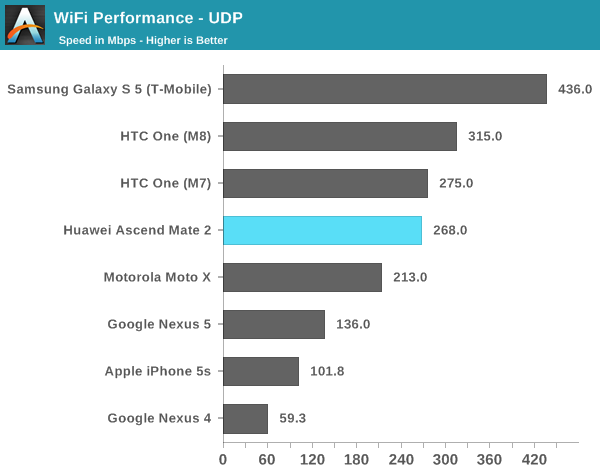
As seen by the graph above, the Ascend Mate2 does respectably well for maximum speed, although it's not quite as fast as the One (M8). Anything that doesn't support 802.11ac would be far slower than the Mate2.
GNSS
As with any MDM9x25 IP block, the Ascend Mate2 uses Qualcomm's GPSOne Gen8B, which supports GPS, GLONASS, and Beidou. I didn't notice any significant issues here, and I managed to acquire an accurate lock in around 10 seconds when doing a cold lock (no WiFi, no assistance data, airplane mode). A cursory search of the FCC documents for the Mate2 seems to lack any specific information on antenna placement for the phablet.

Cellular
Although I haven't had sufficient time to run a ton of speedtests to see the distribution of data speeds, the cellular architecture of the Ascend Mate2 is rather typical. There's receive diversity, but no transmit diversity, which means that this is similar to the Samsung Galaxy S4 in antenna setup. Based upon the FCC test data, this phone supports quad band GSM (850, 900, 1800, and 1900 MHz), and band I (2100 MHz), II (1900 MHz PCS), V (850MHz CLR), and IV (AWS 1700/2100 MHz) for quad band WCDMA. LTE band support is for bands 2, 4, 5, and 17 for AT&T and T-Mobile US LTE support. In short, there shouldn't be any issue getting this phone to work on US/Canada GSM operators.
Originally published at https://www.anandtech.com/show/8031/huawei-ascend-mate-2-review (Wayback Machine).