
IDE RAID Comparison
- Posted in
- Storage
Promise SuperTRAK100
The second IDE hardware RAID controller that we took a look at was the Promise SuperTRAK100. A full length PCI card, the SuperTRAK100 is the same size as the AAA-UDMA but has a few more features.
First off, Promise is a company that has been in the IDE business for some time. As a result of this, the card is a true IDE hardware RAID controller, not a SCSI card modified to read and write to IDE devices. The SuperTRAK100 is much simpler as far as design.
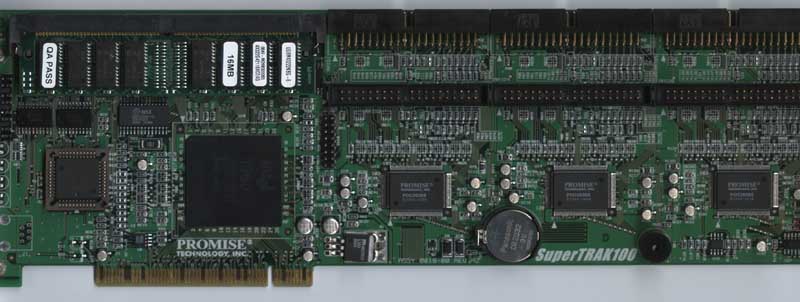
The coprocessor of the SuperTRAK100 is an Intel i960RD which is actually an I/O processor. The chip operates at 66MHz and has a built in PCI-to-PCI bridge, memory controller, and support for the I2O specification. I2O is an architecture that provides support for intelligent I/O and is the standard supported in almost every operating system today and provides the maximum offload of RAID functions from the CPU onto the chip. It is the i960RD that performs the XOR calculations necessary for parity bits as well as other RAID specific functions.
The i960RD chip sends its information to up to six hard drives powered by three Promise PDC20265 chips located on the board. Like the Adaptec solution, each IDE port on the SuperTRAK100 only accepts one master drive to prevent any unnecessary slow down. The PDC20265 also provides support for the ATA100 specification.
For cache memory, the SuperTRAK100 uses a single 72-pin EDO SIMM. Our card came installed with a 16MB stick, but amounts up to 128MB are supported.
The card features a set of 4 LEDs located on the back panel of the card. These lights allow for easy trouble shooting of the RAID array, as the system does not have to be dismantled to find out what is going wrong. During normal operation, the LEDs move in a back and forth fashion to indicate that all is well. Also included for diagnostic purposes is a speaker as well as a connection for an audio source other than the built-in speaker.
Other than that, there is not much else to the SuperTRAK100 hardware wise. There is the standard pin-header for hard drive LED activity lights, a battery to power the BIOS, and a Lattice BIOS chip.
Originally published at https://www.anandtech.com/show/788 (Wayback Machine).