
The Intel Xeon E7 v2 Review: Quad Socket, Up to 60 Cores/120 Threads
Single-Threaded Performance
I admit, the following two benchmarks are almost irrelevant for anyone buying a Xeon E7 based machine. But still, we have to quench our curiosity: how much have the new cores been improved? There is a lot that can be said about all the sophisticated "uncore" improvements (cache coherency policies, low latency rings, and so on) that allow this multi-core monster to scale, but at the end of the day, good performance starts with a good core. And since we have listed the many subtle core improvements, we could not resist the opportunity to check how each core compares.
The results aren't totally meaningless either, as the profile of a compression algorithm is somewhat similar to many server workloads: hard to extract instruction level parallelism (ILP) and sensitive to memory parallelism and latency. The instruction mix is a bit different, but it's still somewhat similar to many server workloads. And as one more reason to test performance in this manner, the 7-zip source code is available under the GNU LGPL license. That allows us to recompile the source code on every machine with the -O2 optimization with gcc 4.8.1.
We've run an additional data point for this particular set of tests. The new Ivy Bridge EX was tested at 2.8GHz and downclocked to 2.4GHz, so that we can do a clock-for-clock comparison with Westmere EX. Since we're only testing single-threaded performance here, other than perhaps slight differences due to having more total L3 cache, it doesn't matter which particular E7 v2 chip we use.
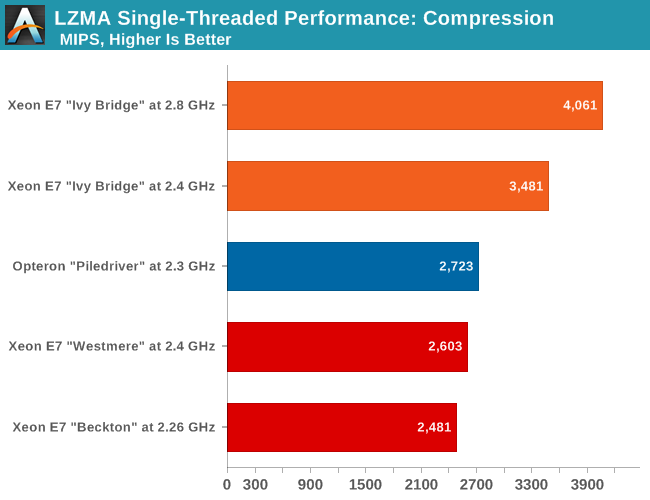
The latest Xeon E7 v2 "Ivy Bridge EX" is capable of extracting 33% more ILP out of the complex compression code than the older Xeon E7 "Westmere-EX" at the same clock speed. That is pretty amazing and shows how all the small micro-architecture improvements have accumulated into a large performance increase. The Opteron core is also better than most people think: at 2.4GHz it would deliver about 2481 MIPs. That is about 80% of Intel's best server core at the moment—not enough, but nothing to be ashamed about.
Also interesting to note is that the Westmere core was indeed a "tick": any performance increase over the Xeon X7560 (Codename "Beckton", 45nm Nehalem core) is simply the result of the higher clockspeed of the 32nm chip.
Let us see how the chips compare in decompression. Decompression is an even lower IPC (Instructions Per Clock) workload, as it is pretty branch intensive and depends on the latencies of the multiply and shift instructions.
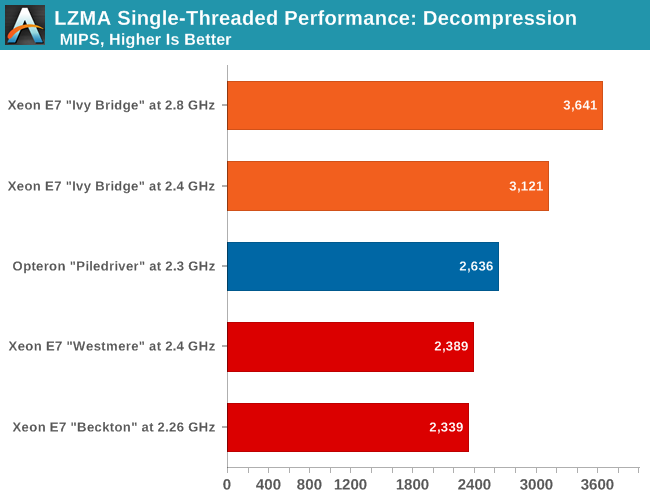
Again, we note a 30% improvement in integer performance going from the Xeon E7 "Westmere" (Xeon E7-4870 at 2.4GHz) to the Xeon E7 v2 "Ivy Bridge EX" (Xeon E7-4890 v2 clocked down to 2.4GHz).
To summarize: the new 15-core Xeon E7 v2 is built upon a strong core architecture that has improved significantly compared to the predecessor.
Originally published at https://www.anandtech.com/show/7757/quad-ivy-brigde-ex-60-cores-120-threads (Wayback Machine).