
The AMD Radeon R7 265 & R7 260 Review: Feat Sapphire & Asus
Battlefield 4
Our latest addition to our benchmark suite and our current major multiplayer action game of our benchmark suite is Battlefield 4, DICE’s 2013 multiplayer military shooter. After a rocky start, Battlefield 4 has finally reached a point where it’s stable enough for benchmark use, giving us the ability to profile one of the most popular and strenuous shooters out there. As these benchmarks are from single player mode, based on our experiences our rule of thumb here is that multiplayer framerates will dip to half our single player framerates, which means a card needs to be able to average at least 60fps if it’s to be able to hold up in multiplayer.
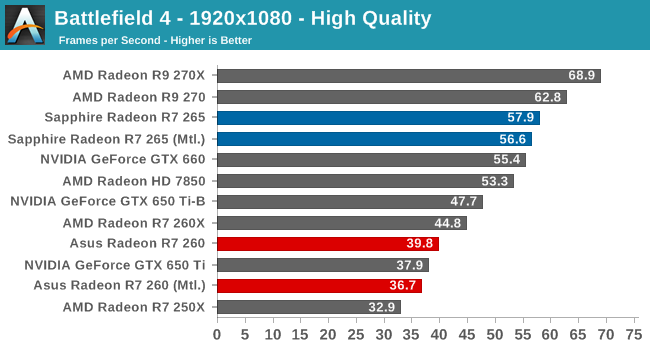
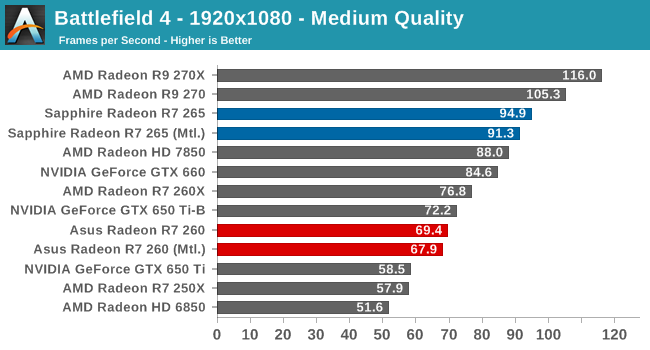
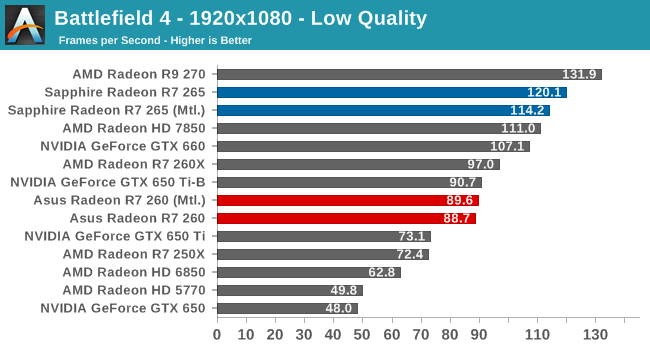
Our first review with Battlefield 4 finds AMD firmly in the driver’s seat, easily surpassing NVIDIA’s closest competitors while often putting more expensive NVIDIA cards in a bind. To this end we see that both the R7 265 and R7 260 are best suited for 1080p at medium quality, as the R7 265’s additional performance comes up a bit short of making high quality playable.
Ultimately we have the R7 260 beating the GTX 650 Ti by 19% and the R7 265 even beating the GTX 660, in the latter case by 12%. Unfortunately for AMD, Mantle is a bust here. In this GPU bound test Mantle is just as likely to cause a minor performance regression as it is to cause a minor performance improvement. Mantle’s strength is in CPU bound scenarios so this isn’t a big surprise, but it does reiterate the fact that Direct3D isn’t dead on AMD cards when you have the CPU power to keep it happy.
Originally published at https://www.anandtech.com/show/7754/the-amd-radeon-r7-265-r7-260-review-feat-sapphire-asus (Wayback Machine).