
ADATA XPG V1.0 Low Voltage Review: 2x8 GB at DDR3L-1600 9-11-9 1.35 V
IGP Compute
One of the touted benefits of Haswell is the compute capability afforded by the IGP. For anyone using DirectCompute or C++ AMP, the compute units of the HD 4600 can be exploited as easily as any discrete GPU, although efficiency might come into question. Shown in some of the benchmarks below, it is faster for some of our computational software to run on the IGP than the CPU (particularly the highly multithreaded scenarios).
Grid Solvers - Explicit Finite Difference on IGP
As before, we test both 2D and 3D explicit finite difference simulations with 2n nodes in each dimension, using OpenMP as the threading operator in single precision. The grid is isotropic and the boundary conditions are sinks. We iterate through a series of grid sizes, and results are shown in terms of ‘million nodes per second’ where the peak value is given in the results – higher is better.
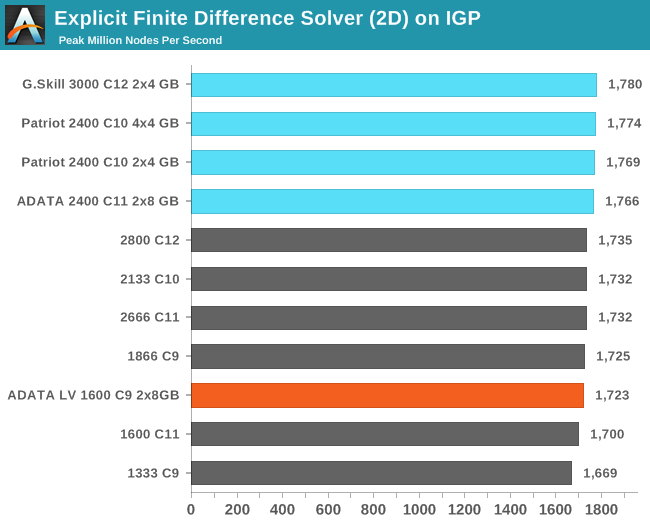
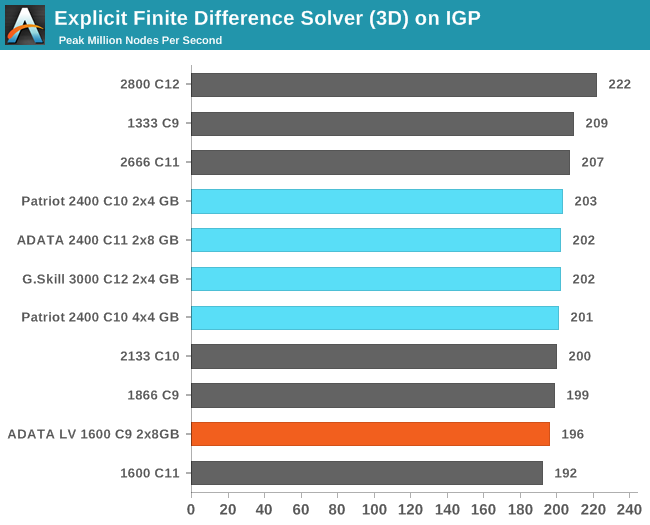
On our IGP compute the 1600 C9 LV takes a bit of a knock in both 2D and 3D simulations when compared to the more powerful kits available - by as much as 10% in 3D.
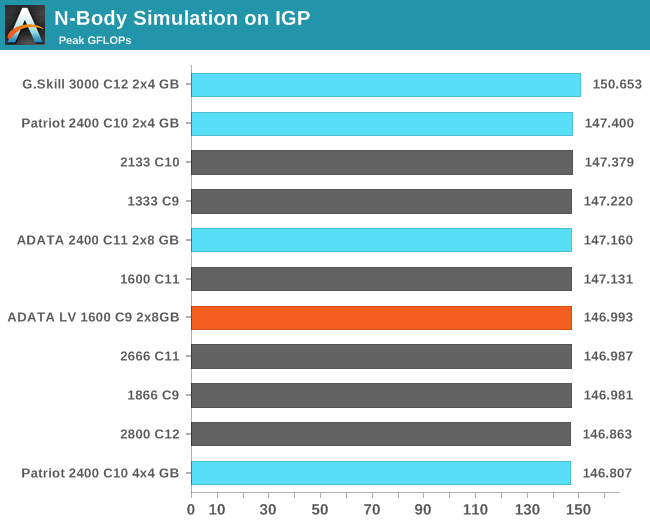
N-Body Simulation on IGP
As with the CPU compute, we run a simulation of 10240 particles of equal mass - the output for this code is in terms of GFLOPs, and the result recorded was the peak GFLOPs value.
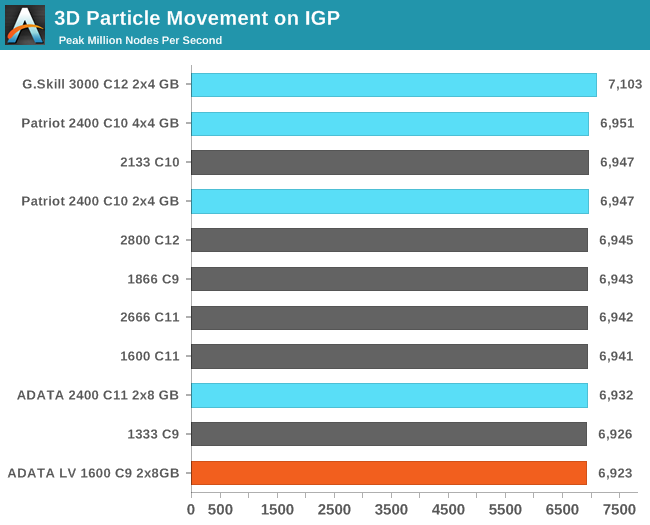
3D Particle Movement on IGP
Similar to our CPU Compute algorithm, we calculate the random motion in 3D of free particles involving random number generation and trigonometric functions. For this application we take the fastest true-3D motion algorithm and test a variety of particle densities to find the peak movement speed. Results are given in ‘million particle movements calculated per second’, and a higher number is better.
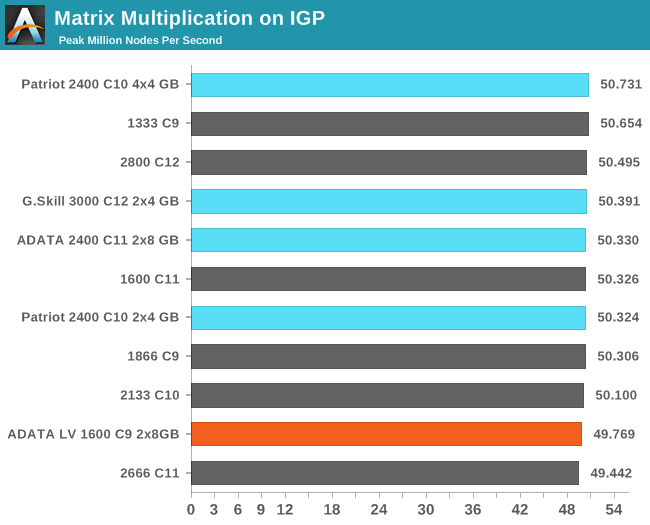
Matrix Multiplication on IGP
Matrix Multiplication occurs in a number of mathematical models, and is typically designed to avoid memory accesses where possible and optimize for a number of reads and writes depending on the registers available to each thread or batch of dispatched threads. He we have a crude MatMul implementation, and iterate through a variety of matrix sizes to find the peak speed. Results are given in terms of ‘million nodes per second’ and a higher number is better.
Originally published at https://www.anandtech.com/show/7565/adata-axdu1600gw8g9b-2g-review (Wayback Machine).