
Netgear ReadyNAS 312 2-bay SMB / SOHO NAS Review
- Posted in
- NAS
- IT Computing
- NetGear
- ReadyNAS
Single Client Performance - CIFS and iSCSI on Windows
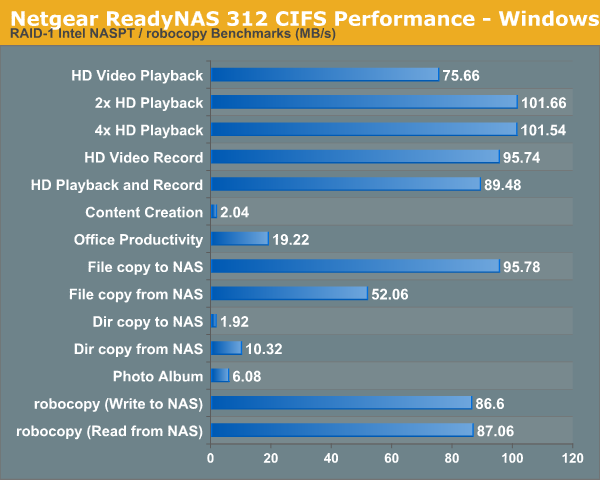
The single client CIFS performance of the Netgear ReadyNAS 312 was evaluated on the Windows platforms using Intel NASPT and our standard robocopy benchmark. This was run from one of the virtual machines in our NAS testbed. All data for the robocopy benchmark on the client side was put in a RAM disk (created using OSFMount) to ensure that the client's storage system shortcomings wouldn't affect the benchmark results
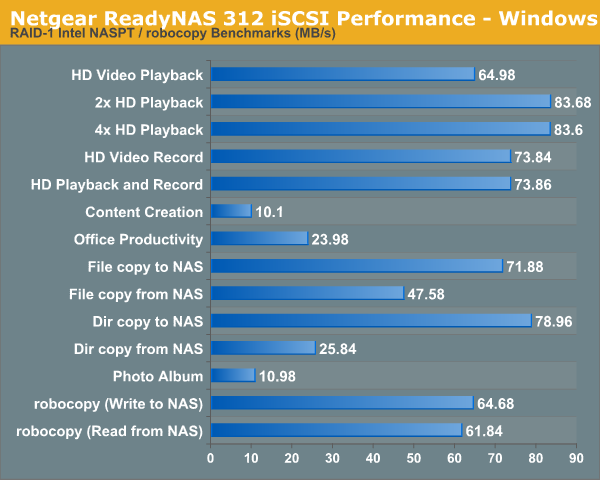
We created a 250 GB iSCSI target and mapped it on the Windows VM. The same benchmarks were run and the results are presented below.
Encryption Support Evaluation:
Consumers looking for encryption capabilities can opt to encrypt a iSCSI share with TrueCrypt or some in-built encryption mechanism in the client OS. However, if requirements dictate that the data must be shared across multiple users / computers, relying on encryption in the NAS is the best way to move forward. Most NAS vendors use the industry-standard 256-bit AES encryption algorithm. One approach is to encrypt only a particular shared folder while the other approach is to encrypt the full volume. Some NAS vendors have support for both approaches in their firmware, but Netegar only opts for the latter. Details of Netgear's encryption strategy can be found in this forum thread, but the summary is that encryption relies on a key created and stored in a mounted USB drive at the time of volume creation (the volume can't be X-RAID, but has to be set up in a manual RAID level). The USB key needs to be present at boot time for the encrypted volume to be mounted, but, can be removed later. This allows for maximum security, as the encrypted data remains safe even if the unit itself is stolen.
On the hardware side, encryption support can be in the form of specialized hardware blocks in the SoC (common in ARM / PowerPC based NAS units). In x86-based systems, encryption support is dependent on whether the AES-NI instruction is available on the host CPU (not considering units based on the Intel Berryville platform). Unfortunately, the Atom D2701 used in the Netgear ReadyNAS 312 doesn't support AES-NI. However, we are dealing only with a RAID-1 volume. Therefore, impact might not be as brutal as it was seen to be on multi-bay RAID-5-capable NAS units.
We enabled encryption on a volume and created a CIFS share to repeat our Intel NASPT / robocopy benchmarks. The results are presented in the graph below (with the unencrypted volume numbers for comparison purposes).
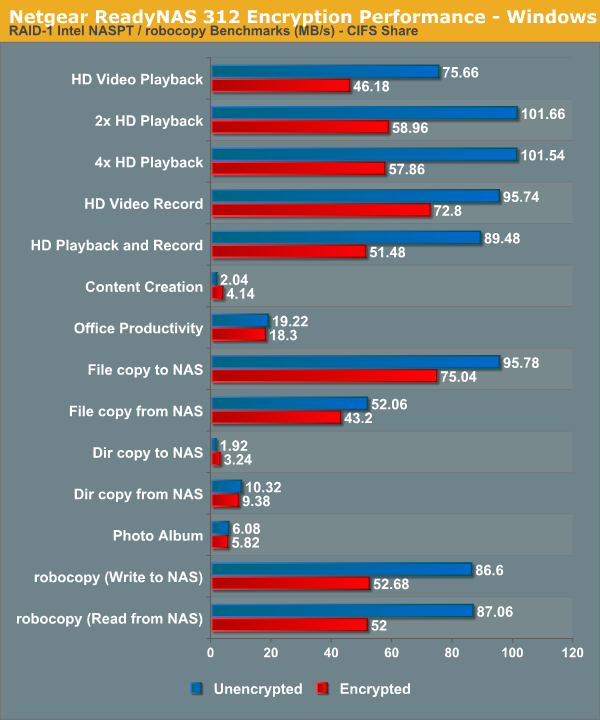
As expected, encryption carries a bit of a performance hit. In a couple of cases, the numbers seem to even favour the encryption case, but these are within the margin of error for measurements. It goes to show that the bottleneck is on the disk or client side for those cases, rather than the RAID and encryption-related computation on the NAS CPU.
Originally published at https://www.anandtech.com/show/7500/netgear-readynas-312-2bay-smb-soho-nas-review (Wayback Machine).