
The AMD Radeon R9 290 Review
- Posted in
- GPUs
- AMD
- Radeon
- Hawaii
- Radeon 200
Bioshock Infinite
Bioshock Infinite is Irrational Games’ latest entry in the Bioshock franchise. Though it’s based on Unreal Engine 3 – making it our obligatory UE3 game – Irrational had added a number of effects that make the game rather GPU-intensive on its highest settings. As an added bonus it includes a built-in benchmark composed of several scenes, a rarity for UE3 engine games, so we can easily get a good representation of what Bioshock’s performance is like.
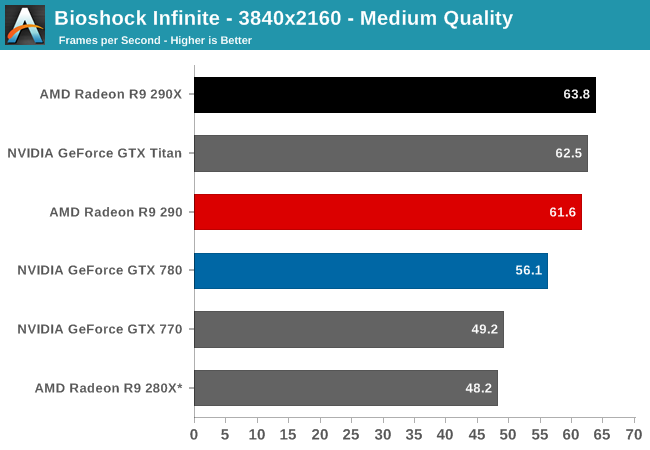
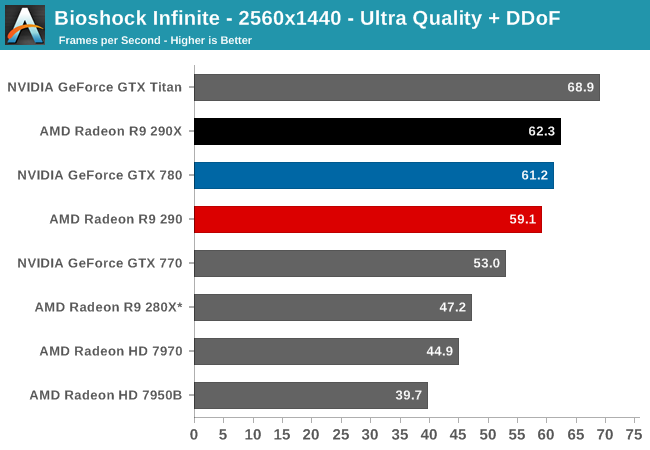
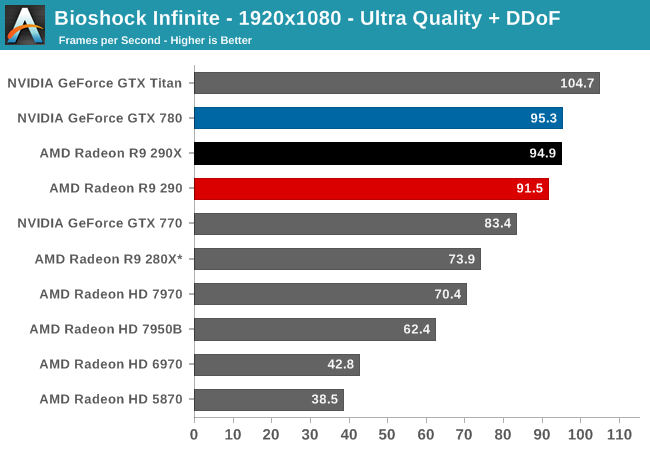
With Bioshock we once again see the 290 trailing the 290X by a small margin, this time of 5%. It’s the difference between technically sustaining a 60fps average at 2560 or just falling short, but only just. Meanwhile compared to the GTX 780 the 290 is handed its first loss, though by an even narrower margin of only 3%. More to the point, on a pure price/performance basis, the 290 would need to lose by quite a bit more to offset the $100 price difference.
Meanwhile, it’s interesting to note not only how much faster the 290 is than the 280X or the GTX 770, but even the 7950B. The 290 series is not necessarily intended to be an upgrade for existing 7900 series, but because the 7950’s performance was set so much lower than the 7970/280X’s, and because 290 performs so closely to the top-end 290X, it creates a sizable gap between the 7950 and its official replacement. With a performance difference just shy of 50%, the 290 is reaching the point where it’s going to be a practical upgrade for 7950 owners, particularly those who purchased it in early 2012 and who paid the full $450 price tag it launched at. It’s nowhere near a full generational jump, but it’s certainly a lot more than we’d expect to see for a GPU that’s manufactured on the same process as 7950’s GPU, Tahiti.
Originally published at https://www.anandtech.com/show/7481/the-amd-radeon-r9-290-review (Wayback Machine).