
Intel's Xeon E5-2600 V2: 12-core Ivy Bridge EP for Servers
Java Server Performance
The SPECjbb 2013 benchmark is based on a "usage model based on a world-wide supermarket company with an IT infrastructure that handles a mix of point-of-sale requests, online purchases and data-mining operations". It uses the latest Java 7 features and makes use of XML, compressed communication and messaging with security.
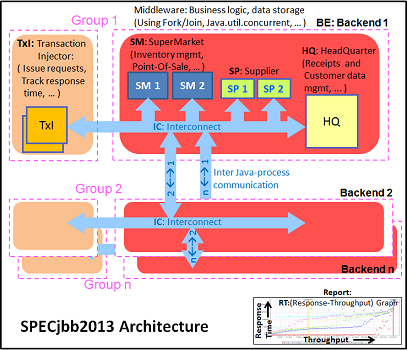
We tested with four groups of transaction injectors and backends. We applied a relatively basic tuning to mimic real world use.
"-server -Xmx4G -Xms4G -Xmn1G -XX:+AggressiveOpts -XX:+UseLargePages-server -Xmx4G -Xms4G -Xmn1G -XX:+AggressiveOpts -XX:+UseLargePages"
With these settings, the benchmark takes about 43GB of RAM. The first metric is basically maximum throughput.
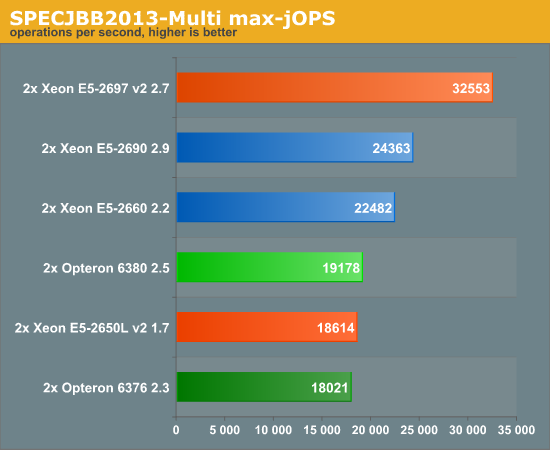
The newest Xeon E5 2697 v2 delivers 33% better performance. The Opteron 6380 needs a 50% clock advantage to stay ahead of the 10-core Xeon E5. This illustrates how large the gap is between the Opterons and even the midrange Xeons. A 10-core Xeon E5-2660 V2 at 2.2GHz costs a bit more than the Opteron 6380 but will deliver a significantely better performance per watt, considering the very low 95W TDP.
The Critical-jOPS metric, is a throughput metric under response time constraint.
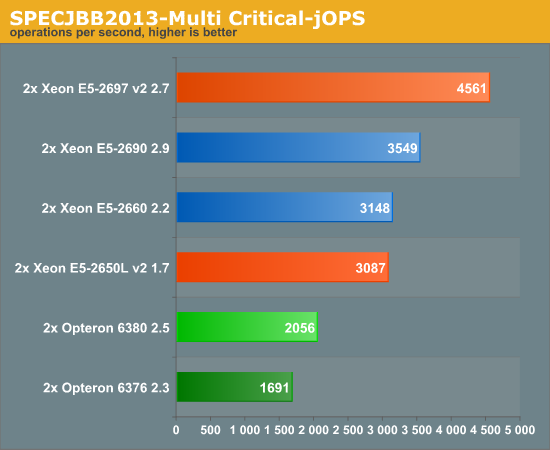
We have to admit we have our doubts. The Critical-jOPS measurements do not seem to be very repeateable and it is not completely clear how it is calculated. However, it confirms earlier measurements of our own that the Xeons are better at responding quickly at a given throughput. Again, the new Xeon 2697 v2 performs about 30% better than the Xeon E5 2690.
SPECJBB®2013 is a registered trademark of the Standard Performance Evaluation Corporation (SPEC).
Originally published at https://www.anandtech.com/show/7285/intel-xeon-e5-2600-v2-12-core-ivy-bridge-ep (Wayback Machine).