
Intel Core i7 4960X (Ivy Bridge E) Review
- Posted in
- CPUs
- Intel
- Ivy Bridge
- Ivy Bridge-E
Visual Studio Compile
Our compile test is back and better than ever. With a much larger and faster SSD (Samsung SSD 830, 512GB), we're able to get more consistent compile times between runs. We're now using Visual Studio 2012 to compile Mozilla's Firefox project. The compile is multithreaded however there are periods of serial operation where performance is bound by the speed of a single core. The end result is a benchmark that stresses both single and multithreaded performance. Compile times are reported in minutes elapsed.
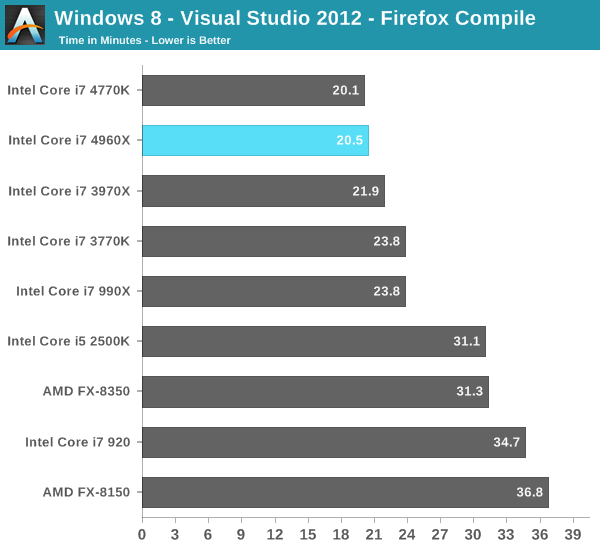
It's clear that IVB-E holds the advantage over Haswell when faced with heavily threaded workloads, but what about those workloads that are a good mix of both light and heavily threaded tasks? A medium-threaded workload if you will. It turns out our Firefox compile test is just that. Haswell's architectural improvements seem to do wonders for this test (under OS X as well), giving the 4770K a 16% lower compile time than Ivy Bridge. IVB-E on the other hand throws more cores at the problem, effectively equaling Haswell's performance but not exceeding it. In this case, if the rest of your applications are better threaded/demand more cores then IVB-E is the right solution for you. If, however, building Visual Studio projects is the most thread heavy thing you do then Haswell is a better option.
Photoshop
To measure performance under Photoshop CS4 we turn to the Retouch Artists’ Speed Test. The test does basic photo editing; there are a couple of color space conversions, many layer creations, color curve adjustment, image and canvas size adjustment, unsharp mask, and finally a gaussian blur performed on the entire image.
Time is reported in seconds and the lower numbers mean better performance. The test is multithreaded.
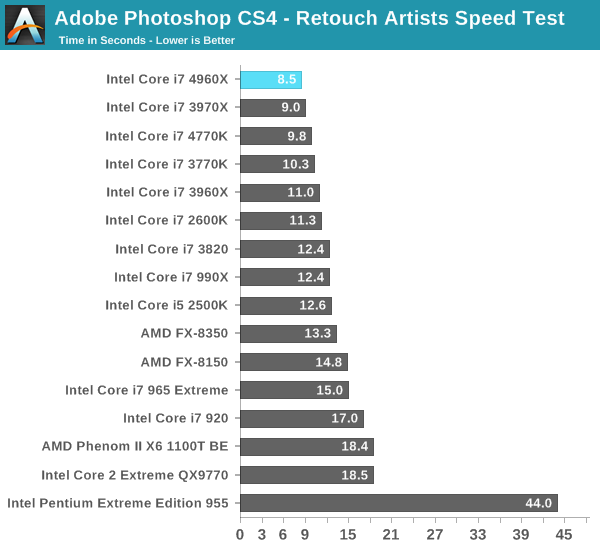
Our Photoshop test provides another example of an application with both lightly and heavily threaded behaviors. In this case, our Photoshop test favors the latter as the 4960X manages a 13% performance advantage over the 4770K. Once again the IVB-E advantage over SNB-E is around 5%.
File Compression/Decompression
The 7-zip benchmark is a CPU bound multithreaded integer workload that looks at 7-zip compression/decompression algorithms where the IO subsystem is removed from the equation:
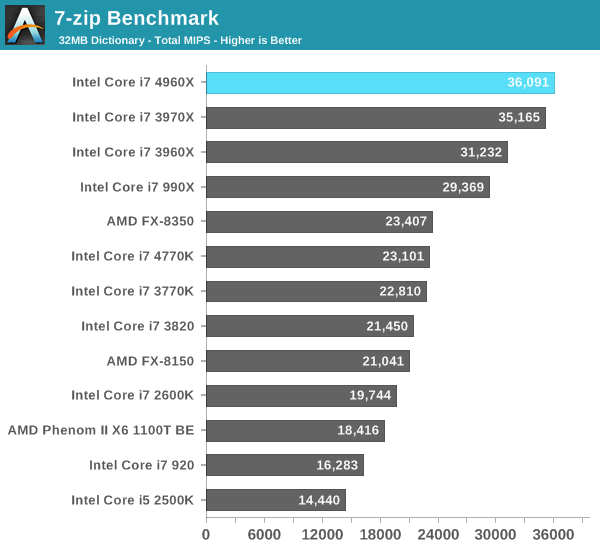
In its biggest advantage so far, the 4960X outperforms the 4770K by 56% in the 7-zip test. The IVB-E performance advantage compared to SNB-E shrinks to under 3% here. Heavily threaded integer workloads are also well suited for AMD's FX architecture. Here the FX-8350 is able to equal Haswell's performance.
Next up is our old Par2 test. Par2 is an application used for reconstructing downloaded archives. It can generate parity data from a given archive and later use it to recover the archive. Chuchusoft took the source code of par2cmdline 0.4 and parallelized it using Intel’s Threading Building Blocks 2.1. The result is a version of par2cmdline that can spawn multiple threads to repair par2 archives. For this test we took a 708MB archive, corrupted nearly 60MB of it, and used the multithreaded par2cmdline to recover it. The scores reported are the repair and recover time in seconds.
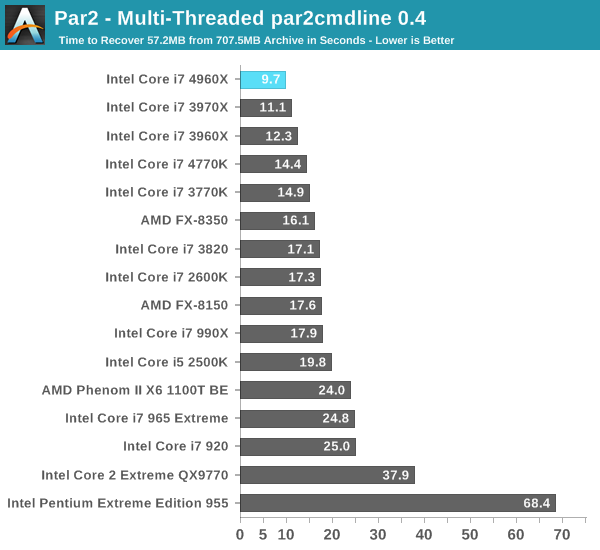
Here's another heavily threaded workload that does very well on the 4960X. We also see a rare situation where IVB-E increases performance over SNB-E by more than 10%.
Excel - Heavy Math
In our final CPU centric test we're running a monte carlo simulation on a large Excel spreadsheet. The process is well threaded.
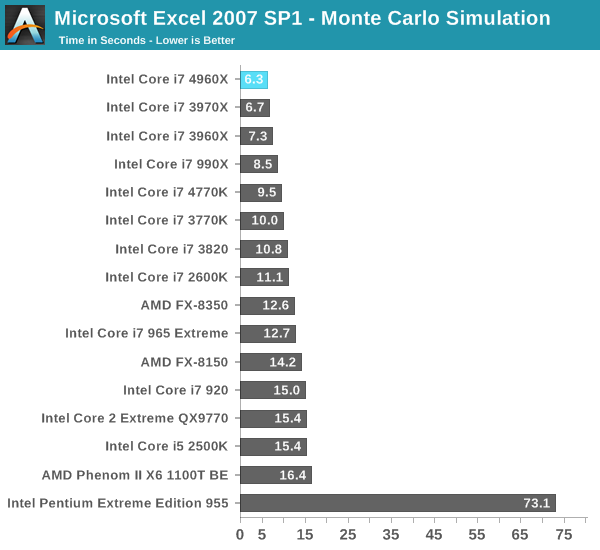
With 50% more cores, the 4960X delivers 33% better performance than the 4770K. If running multithreaded math workloads is up your alley, there's no alternative to the 6-core extreme edition parts.
Originally published at https://www.anandtech.com/show/7255/intel-core-i7-4960x-ivy-bridge-e-review (Wayback Machine).