
AMD Frame Pacing Explored: Catalyst 13.8 Brings Consistency to Crossfire
Bioshock Infinite
Bioshock Infinite is Irrational Games’ latest entry in the Bioshock franchise. Though it’s based on Unreal Engine 3 – making it our obligatory UE3 game – Irrational had added a number of effects that make the game rather GPU-intensive on its highest settings. As an added bonus it includes a built-in benchmark composed of several scenes, a rarity for UE3 engine games, so we can easily get a good representation of what Bioshock’s performance is like.
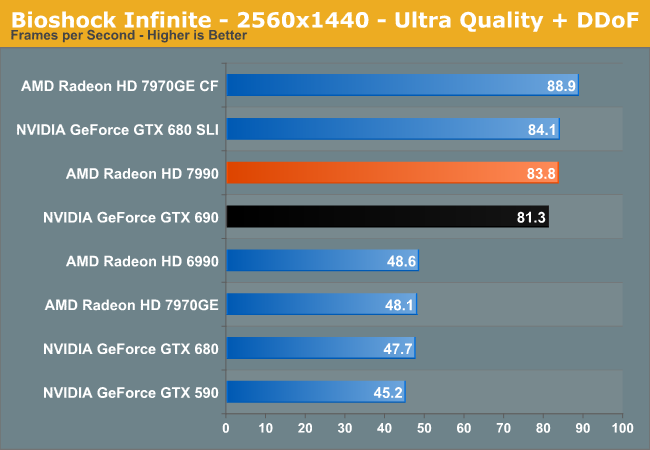
AMD and NVIDIA exchange places once more, with the 7990 taking a small lead over the GTX 690.
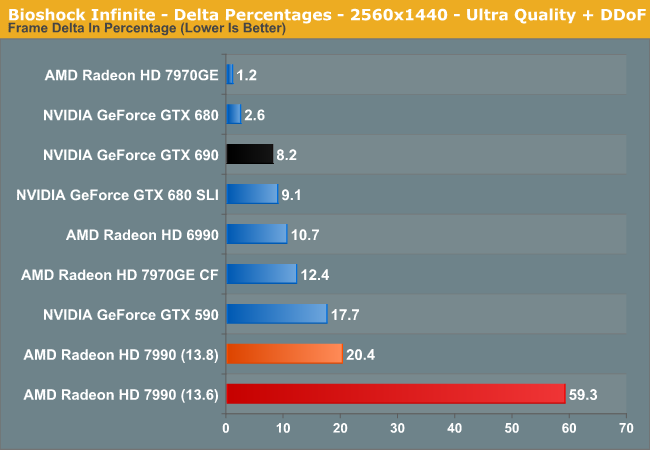
AMD’s initial situation with Bioshock was not as dire as it was in say Battlefield 3, but with deltas approaching 60% it wasn’t pretty either. Once more they’ve managed to get their delta percentages to around 20%, a level that is acceptable for now while leaving clear room for improvement. Especially as once more the 7990 delivers deltas more than twice those of the GTX 690.
Though on a side note, this game is a great reminder of just how much better single-GPU cards are at consistency. The best multi-GPU setup is at 8.2%; the worst single-GPU setup is 2.6%.

Graphically things are roughly as expected. It’s interesting to note that NVIDIA has some significant frame time spikes that AMD doesn’t encounter, though a single-GPU setup would shortcut the issue entirely.
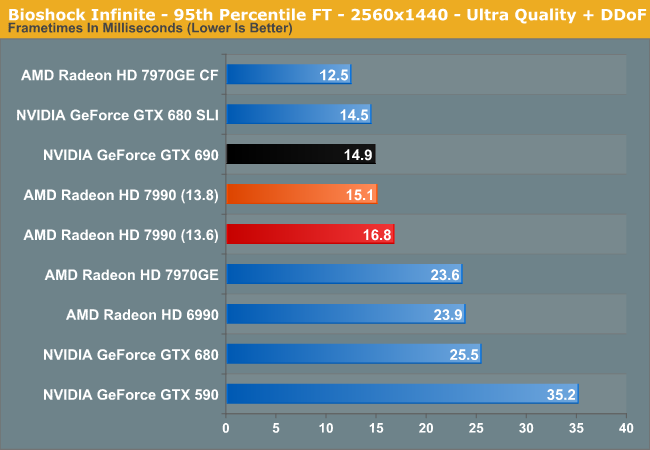
AMD’s 95th percentile improvement isn’t nearly as pronounced in Bioshock. Meanwhile the higher variability does cost them just enough to have the 7990 fall behind the GTX 690 here.
Originally published at https://www.anandtech.com/show/7195/amd-frame-pacing-explorer-cat138 (Wayback Machine).