
Intel's Haswell - An HTPC Perspective: Media Playback, 4K and QuickSync Evaluated
Testbed and Software Setup
Instead of going for the usual high end CPU (77W / 95W TDPs), we have opted for the Core i7-4765T for today's review. This is a 35W TDP CPU with four cores / eight threads, expected to retail with a MSRP of $303. Intel has a number of GPU configurations doing the rounds at Haswell launch. The i7-4765T sports the HD 4600 GPU, and it is the best GPU available in a LGA 1150 configuration (The Iris Pro 5200 GPUs are reserved for BGA configurations and unavailable to system builders).
The table below presents the hardware components of our Haswell HTPC testbed
| Haswell HTPC Testbed Setup | |
| Processor | Intel Core i7-4765T - 2.00 GHz (Turbo to 3.0 GHz) |
| Intel HD Graphics HD4600 - Up to 1200 MHz | |
| Motherboard | ASRock Z87E-ITX mITX |
| OS Drive | Seagate 600 SSD ST240HM000 240GB |
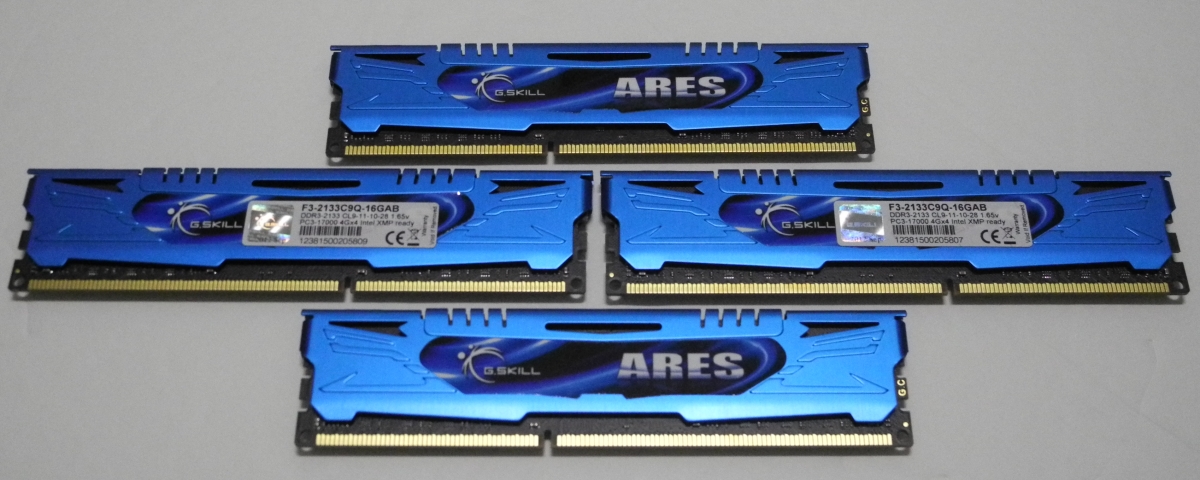
| Memory | G.SKILL Ares Series 8GB (2 x 4GB) SDRAM DDR3 2133 (PC3 17000) F3-2133C9Q-16GAB CAS 9-11 -10-28 2N |
| Optical Drive | ASUS 8X Blu-ray Drive Model BC-08B1ST |
| Case | Antec Skeleton ATX Open Air Case |
| Power Supply | Antec VP-450 450W ATX |
| Operating System | Windows 8 Professional x64 |
| Displays / AVRs | Onkyo TX-SR606 + Acer H243H |
| Pioneer Elite VSX-32 + Sony Bravia KDL46EX720 | |
| Sony XBR-84X900 | |
| Seiki Digital SE50UY04 | |
The ASRock Z87E-ITX board comes with a Broadcom-based 802.11ac 2T2R solution. Connected to a Buffalo WZR-D1800H 802.11ac router, I was able to consistently obtain 173 Mbps of practical throughput. Streaming Blu-ray ISOs over Wi-Fi from a NAS worked without issues. The board was very simple to get up and running and given its form factor and the CPU currently installed, I hope to migrate it to a passive HTPC build soon.

The Haswell platform officially supports DDR3-1600. Towards this, we obtained a 16 GB DDR3-2133 Ares kit from G.Skill for our testbed. The Ares kit supports XMP 1.2 and the ASRock Z87E-ITX had it running at 2133 MHz flawlessly on first boot. However, we made sure to run the memory at the suggested 1600 MHz in order to obtain results consistent with what an average system builder (non-overclocker) would obtain. The Ares kit makes it possible to study HTPC behaviour from a memory bandwidth perspective, but we will not cover that aspect in this launch piece.
The software setup for the Haswell HTPC testbed involved the following:
| Haswell HTPC Testbed Software Setup | |
| Intel Graphics Driver | 9.18.10.3107 (Version on ASRock Motherboard DVD) |
| Blu-ray Playback Software | CyberLink PowerDVD 13 |
| Media Player | MPC-HC v1.6.7.7114 |
| Splitter / Decoder | LAV Filters 0.57 |
| Renderers | EVR / EVR-CP (integrated in MPC-HC v1.6.7.7114) |
| madVR v0.86.1 | |
The madVR renderer settings were fixed as below for testing purposes:
- Decoding features disabled
-
Deinterlacing set to:
- automatically activated when needed (activate when in doubt)
- automatic source type detection (i.e, disable automatic source type detection is left unchecked)
- only look at pixels in the frame center
-
Scaling algorithms were set as below:
- Chroma upscaling set to SoftCubic with softness of 100
- Luma upscaling set to Lanczos with 4 taps with anti-ringing filter left deactivated and scale in linear light left unchecked / DXVA2
- Luma downscaling set to Lanczos with 4 taps with anti-ringing filter left deactivated and scale in linear light left unchecked / DXVA2
-
Rendering parameters were set as below:
- Automatic fullscreen exclusive mode was used
- CPU and GPU queue sizes were set to 32 and 24 respectively
- Under exclusive mode settings, the seek bar was enabled, switch to exclusive mode from windowed mode was delayed by 3 seconds and 16 frames were configured to be presented in advance. The GPU flushing modes were set to default
- Smooth motion was left disabled
- The 'trade quality for performance' settings were left at default (i.e, linear light was left disabled for smooth motion frame blending and custom pixel shader results were stored in 16-bit buffers instead of 32-bit)
Unlike our Ivy Bridge setup, we found the windowed mode to be generally bad in terms of performance compared to exclusive mode.
MPC-HC and LAV Filters settings were altered from the defaults as below for testing purposes:
- DirectShow Video Output was configured as EVR / EVR-CP / madVR under Options > Playback > Output
- All internal source and transform filters were disabled under Options > Internal Filters
- Under Options > External Filters, LAV Splitter, LAV Audio Decoder and LAV Video Decoder were added as Preferred filters
- LAV Audio Decoder was set to bitstream all applicable formats
-
LAV Video Decoder were altered from the defaults as below
- Hardware Acceleration was set to DXVA2 Native / QuickSync / None depending on the aspect being tested. UHD (4K) was enabled in all the cases
- Deinterlacing mode was set to 'Aggressive'
Originally published at https://www.anandtech.com/show/7007/intels-haswell-an-htpc-perspective (Wayback Machine).