
NVIDIA GeForce GTX 770 Review: The $400 Fight
Synthetics
As always we’ll also take a quick look at synthetic performance, though as GTX 780 is just another GK110 card, there shouldn't be any surprises here. These tests are mostly for comparing cards from within a manufacturer, as opposed to directly comparing AMD and NVIDIA cards. We’ll start with 3DMark Vantage’s Pixel Fill test.
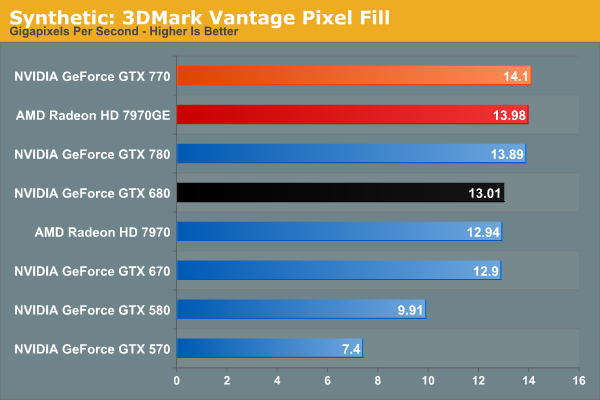
Thanks to the combination of core clock and memory clock increases, GTX 770 doesn’t just pass GTX 680, but even GTX 780. This is a bit paradoxical at first, but it’s worth keeping in mind that this is a pixel throughput test, and GTX 770’s ROPs are clocked a good 200MHz+ higher than GTX 780’s. In real games GTX 780 is still going to have the edge, but in edge cases having such a clockspeed gap can lead to some unusual outcomes.
Moving on, we have our 3DMark Vantage texture fillrate test, which does for texels and texture mapping units what the previous test does for ROPs.
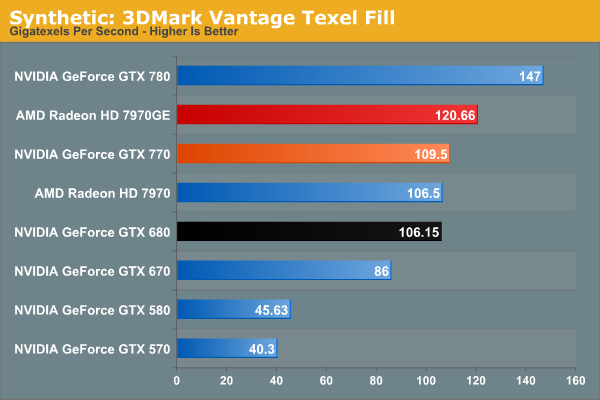
Texel throughput on the other hand is all about the core clocks; the improvement over the GTX 680 is barely at 3%, and GTX 770 is well behind GTX 780.
Finally we’ll take a quick look at tessellation performance with TessMark.
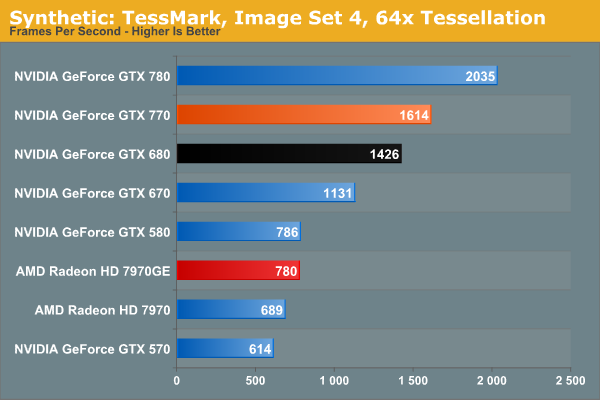
GTX 770 pulls ahead in TessMark by more than we would expect given the fact that this test should be largely GPU limited. This may be a case of GTX 770 squeezing out a bit more performance due to GPU Boost 2.0.
Originally published at https://www.anandtech.com/show/6994/nvidia-geforce-gtx-770-review (Wayback Machine).