
NZXT H630 Silent Case Review
- Posted in
- Cases/Cooling/PSUs
- NZXT
- ATX
Conclusion: Different Beast
I'm of a hundred different minds when it comes to evaluating the NZXT H630. When I saw the prototype illustrations toward the end of March, I immediately envisioned an amazing enclosure. Yet like any great imaginary love affair, my ideal for the H630 was very different from the reality. That's not to denigrate the H630, but it can be difficult to separate the product that is from the product that could have been.
Keeping with tradition, we'll evaluate the product that is on its own merits. First, I'm incredibly taken just by the way the H630 looks. From any vendor this aesthetic would be a pleasant surprise, but from NZXT? The "stormtrooper" styling of the Phantom cases has always been just this side of gaudy (though it does shrink down amusingly for the 430), and though the Switch 810 has been a solid performer for NZXT it's still had a hard time reconciling asymmetry with genuine style. The H630 gets it.
Build quality is, drive sleds notwithstanding, uniformly excellent. The case is 30 pounds to begin with, I can't in good conscience ding them for using a plastic shell that keeps it from being any more needlessly heavy. That, and again, it's obviously not a major detriment or even really a minor one. It's how good plastic should look and feel. This is a strong, sturdy case, with smart material choices all around, and outside of the excessively difficult front panel that came with my pre-production model, it's easy to build in and has almost all of the features I could ask for. (Cue gripe about the lack of an integrated fan controller.)
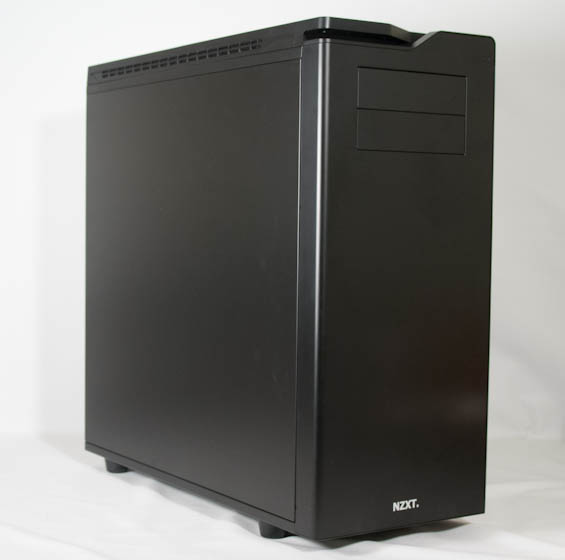
Where the H630 runs into trouble is the same place most acoustically-geared cases tend to: cooling. Thermal performance is good, but acoustics could actually be greatly improved. I'm not ready to suggest closing off the top ventilation to try and keep noise from escaping, but I think the H630 really brings to light the same problem that plagues NZXT's Kraken coolers: NZXT fans are kind of middling. The fans Nanoxia uses on the Deep Silence 1 and 2 are extremely efficient, but they're also so quiet that fan control isn't really needed on those cases (though it's available.) Running a 200mm intake fan in the H630 is a smart idea, but it needed to be slower and less audible.
Alternatively I'd almost suggest NZXT take the hit to the wallet and include two 200mm intakes at lower speeds, as I imagine it could only improve performance, potentially substantially. Good airflow is in many ways key to keeping noise levels down, as it keeps internal cooling from having to work too hard. Really, though, NZXT needs to source or design more efficient fans for all of their product lines. They don't need to start courting Noctua, but this is one place where there's real room for improvement.
As for the chassis itself, it's a very strong first outing for what's actually a somewhat unconventional approach to silent cooling. The H630 doesn't feel like quite the knockout that the Phantom 630 was, but there's a tremendous amount of potential here. NZXT needs to figure out a proper balancing act for this case, as I can see a revision being an absolute terror to compete with.
At $149 the H630 isn't bargain priced, but it's not at all unreasonable for what you get either. Until the Deep Silence 1 becomes more readily available in the United States again, you're looking at an unusual split of recommendations. For most users I think the still readily available Deep Silence 2 is going to be the value champion; at $89, it's practically a steal for what you get. The H630's real competitor may be the Fractal Design Define XL R2, and I can see arguments for going in either direction. Personally, I think the H630 is more forward thinking and has more potential than the XL R2, though the XL R2 definitely has its own merits. Evaluate your own needs, but if you think the H630 is what you're looking for, I'd say buy it with confidence.
Originally published at https://www.anandtech.com/show/6951/nzxt-h630-silent-case-review (Wayback Machine).