
QNAP's TS-EC1279U-RP 12-bay Flagship Rackmount NAS Review
- Posted in
- Enterprise
- Storage
- NAS
- QNAP
Encryption Support Evaluation
Consumers looking for encryption capabilities can opt to encrypt a iSCSI share with TrueCrypt or some in-built encryption mechanism in the host OS. However, if requirements dictate that the data must be shared across multiple users / computers, relying on encryption in the NAS is the best way to move forward. Most NAS vendors use the industry-standard 256-bit AES encryption algorithm. One approach is to encrypt only a particular shared folder while the other approach is to encrypt the full volume. Some NAS vendors have support for both approaches in their firmware, but QNAP only opts for the latter. Details of the QNAP's encryption key management mechanism and other caveats are available here.
On the hardware side, encryption support can be in the form of specialized hardware blocks in the SoC (common in ARM / PowerPC based NAS units). In x86-based systems, encryption support is dependent on whether the AES-NI instruction is available on the host CPU (not considering units based on the Intel Berryville platform). Current generation Atom CPUs (and even the Core i3 CPUs) don't support AES-NI. Fortunately, the Xeon E3-1225 used by QNAP in the TS-EC1279U-RP supports AES-NI. The impact of enabling encryption should be minimal.
We created an encrypted volume and reran our Intel NASPT / robocopy benchmarks on a CIFS share. The results are presented in the graph below (with the unencrypted volume numbers for comparison purposes).
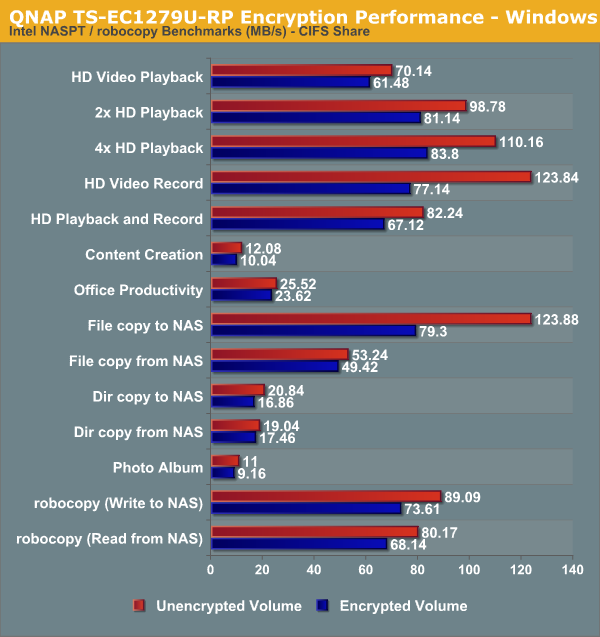
As expected, encryption does carry a performance hit, but the impact is not very extensive. Depending on the type of workload, the penalty varies between 7.2% and 38%. We will be shortly carrying out a review of an Atom-based NAS where we will see that the penalty is much bigger.
Originally published at https://www.anandtech.com/show/6922/qnaps-tsec1279urp-12bay-flagship-rackmount-nas-review (Wayback Machine).