
OPPO Find 5 Review
The Find 5 was noted to be using Sony’s Exmor RS branded 13MP camera sensor pretty early on, with OPPO releasing preview images taken on a preproduction device way back in December of last year. This sensor, the Sony IMX135, is the next generation version of the IMX091PQ sensor found in devices like the Optimus G and the Galaxy S4, and can also be seen in Sony’s own Xperia Z. The two sensors basically cover the who’s who of current flagship smartphones between them, other than the HTC One. IMX135 is a 1/3.06” stacked CMOS with 13.13 effective megapixels and on-sensor HDR. The stacked structure part means that the pixel and circuit sections of the sensor are layered, as seen in the Sony-provided diagram below.
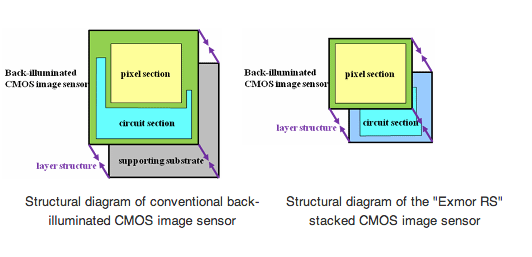
This layering replaces the supporting substrates used in conventional backside-illuminated CMOS sensors, allowing for a much more compact overall image sensor size. It’s definitely an interesting piece of tech, though the use of this sensor definitely points to an emphasis on megapixel count. As Brian has covered many times in the past, sensors with more densely packed pixels have less light sensitivity and dynamic range than sensors with larger pixels, so the presence of on-sensor HDR capability for both stills and video is definitely an important one given the 1.12um pixels in IMX135. The front facing camera uses the Samsung S5K6A3 sensor, which can also be found in the Galaxy S3 and Galaxy Note 2.

Optically, the Find 5 also has an F/2.2 lens and a focal length of 3.85mm. It shares a lot of the imaging characteristics of the Galaxy S4, which makes sense given the hardware-level similarities. The image processing is different, but it’s still a sensor with a very high spatial resolution that does a great job in well lit situations and seems to suffer when light sensitivity or dynamic range is important.

I took the Find 5 with me on a spring break trip to Hawaii and used it as my primary camera. It was pretty solid, but low light is a problem, particularly when objects are far enough away to not be impacted by flash. It’s impressive, when you look casually at the pictures coming out of modern smartphones in the right situations, to consider how far we’ve come in the last few years.


Compared to the HTC One, the OPPO is pretty competitive in bright outdoor shots, and definitely better when looked at 1:1. The low light story is a bit different - the One is just a lot better, and the lack of a night mode on the OPPO hamstrings it even further. Even shooting with HDR, the OPPO isn’t close. The dual LED flash is okay indoors and particularly with nearby subjects (within 5 feet) it does quite well, but relying on it outdoors in the dark will result in a near-useless picture.

Taken at night with the OPPO Find 5, Normal shooting mode with flash.
The lack of advanced camera settings really doesn’t help here. The camera interface is pretty simple, with a brushed metal feel and clearly laid out controls, but you don’t get access to critical functions like shutter speed, white balance, ISO, etc. The exposed settings are resolution, self-timer, face detection, geotagging, and a grid overlay for the UI. Other than that, you get the three shooting modes (normal, HDR, and panorama), as well as a flash control and toggles for front/rear camera and photo/video recording. It’s pretty light on settings, though for the purposes of most smartphone camera users it’s adequate. From a camera control perspective, this is not much better than Apple in terms of how little of it you actually get. The other disappointing thing about the camera interface is that the preview image runs at roughly 20 fps, which is a noticeable but mild annoyance while taking stills.
Originally published at https://www.anandtech.com/show/6920/oppo-find-5-review (Wayback Machine).