
Origin Genesis Review: Triple Titan Terror
Final Thoughts
Though it didn’t go as initially intended, our time evaluating Origin’s Genesis ended up being enlightening for entirely different reasons. It’s one thing to look at a tri-SLI system, but it’s extremely rare that we get to look at any kind of liquid cooled GPU system, let alone one packing 3 cards as fast as NVIDIA’s GTX Titan. NVIDIA told us that they wanted to showcase tri-SLI Titan in an interesting manner, and though this isn’t quite what they had planned Origin has unquestionably done just that.
The Genesis, simply put, is obscene. With a heavily overclocked Core i7 processor, 3 overclocked GTX Titans, RAID-0 SSDs, liquid cooling throughout, and a number of other smaller touches, the performance of the Genesis is on a level all its own. Which almost presents us with a problem, since so much of the review process is comparative. The Genesis is essentially the fastest thing you can build in an ATX form factor, packing some of the most powerful components available today and built in a case heavy-duty enough to flatten someone ACME style. What can you even begin to meaningfully compare that to?
At nearly $9,000 for our system as equipped, the Genesis stands alone in every possible way. Perhaps it’s fitting then that it’s a lot like the GTX Titan itself: expensive, powerful, and impressive. With Titan NVIDIA set out to create a luxury video card, and the Genesis is the logical conclusion of that process, bringing Titan into a luxury computer. A $9000 gaming computer isn’t economical by any definition of the word, but for the few that can afford such a toy, there simply aren’t any other toys like this.
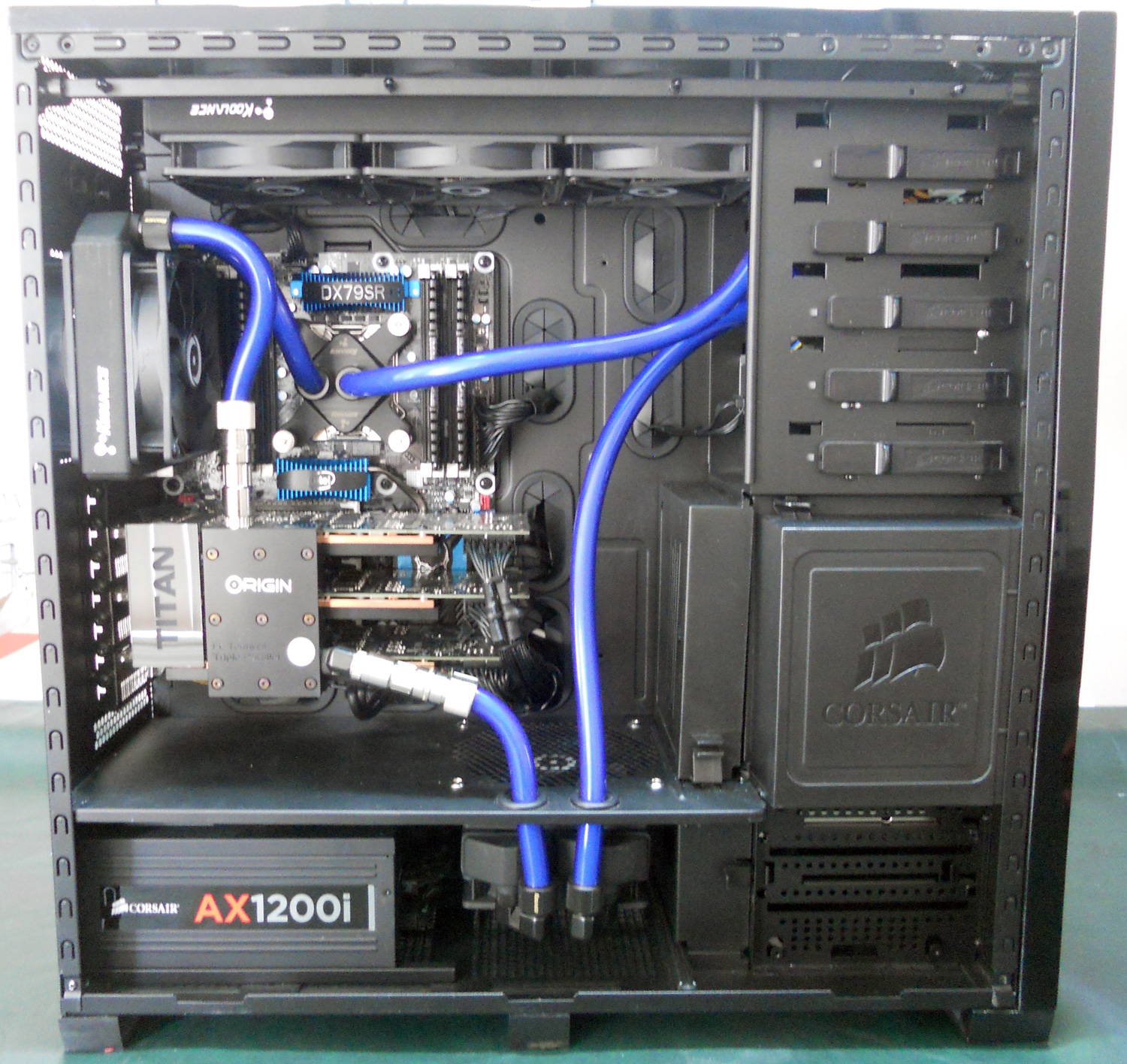
Ultimately in evaluating the Genesis it’s not a question of value for its potential customers, but rather a question of needs and tradeoffs. 3 Titans in tri-SLI offers a level of gaming performance that exceeds all but the most challenging games, and while even 2 Titans may be necessary to drive a single display, with 3 Titans it’s simply a foregone conclusion that it’s intended to drive surround gaming. It takes something this powerful to unlock the ability to run at the highest quality settings at the highest resolutions.
The tradeoff for all of this is that powerful systems consume a lot of power themselves, and the Genesis is no exception. The Genesis is built to consume 1200W in power and expel it as 1200W in heat, something it does extremely well thanks to the liquid cooling system. That liquid cooling system is always active however, so if the Genesis does have one drawback it’s that while it sings under load, that cooling system is singing under idle, too.
As for Titan itself, though Anand and I agreed in our look at Falcon Northwest’s Tiki that the SFF is the most interesting application of Titan right now in this age of power efficiency and quiet computing, tri-SLI Titan is a stark reminder that there are benefits for going big, too. Once you get past the hump of SLI versus the multi-monitor performance penalty, SLI scaling is at least solid on everything we’ve tested. And despite our concerns about being CPU limited, at multi-monitor resolutions and backed by a bleeding edge CPU there’s still plenty of room for Titan to soar. Tri-SLI Titan can handle everything we throw at it and then-some. Ultimately it’s serving a niche of a niche (of a niche), but the performance is there for a price.
Originally published at https://www.anandtech.com/show/6910/origin-genesis-review-triple-titan-terror (Wayback Machine).