
Samsung Galaxy Note 8.0 Review
NAND Performance
Given one of my obsessions over the past 5 years, focusing on NAND performance in modern smartphones and tablets is an obvious fit. For these tests we turn to Androbench, using a modified version of the default performance settings. By upping the read/write buffer to 100MB we get more repeatable results, which is always nice to have. Just as in our PC SSD reviews, we focus on large block sequential read/write performance as well as small file random access. For Windows 8 tablets, we use Crystal Disk Mark as a rough comparison point. Note that we are looking at peak performance here and not sustained write speeds. I don't even want to know how slow these things will get if exposed to prolonged random writes. I've toyed with worst case performance on modern iOS and Android mobile devices and it's not pretty. For now, just try not to fill these things up.
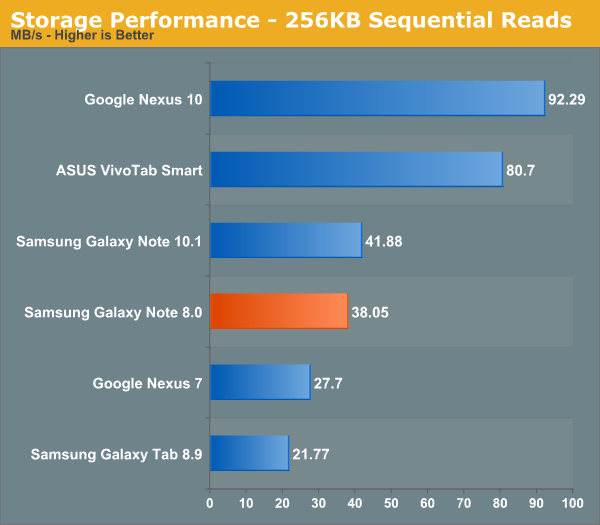
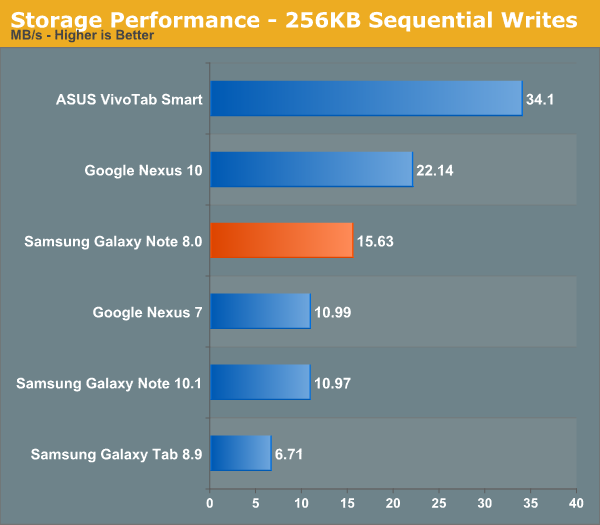
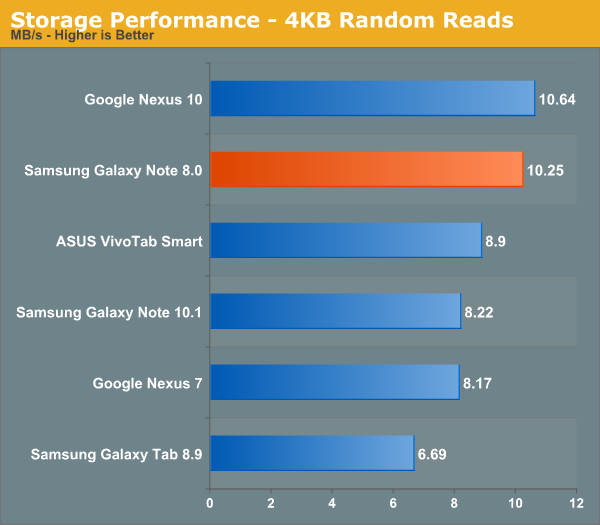
The Galaxy Note 8.0's peak sequential performance is ok, the Nexus 10 does far better. Random IO performance however is great (for an ARM based tablet). The latter is very important for IO heavy multitasking workloads, which could be why we're seeing a mild focus on it here. Random write performance is still lower than I'd like to see (realistically we need to be about an order of magnitude better than where we are for real IO intensive multitasking), but the Note 8.0 at least ends up near the top of these charts.
If you look at the Note 10.1's performance you'll notice a big difference in random IO performance. It's entirely possible that Samsung is using a better controller/firmware combination in the Note 8.0, or it could be that my review sample happened to source a better eMMC solution. NAND based storage is typically treated like a commodity by most OEMs, so I wouldn't be too surprised to see wide variation in performance depending on how well you do in the eMMC lottery.
Originally published at https://www.anandtech.com/show/6893/samsung-galaxy-note-80-review (Wayback Machine).