
NVIDIA’s GeForce GTX Titan Review, Part 2: Titan's Performance Unveiled
Crysis: Warhead
Up next is our legacy title for 2013, Crysis: Warhead. The stand-alone expansion to 2007’s Crysis, at over 4 years old Crysis: Warhead can still beat most systems down. Crysis was intended to be future-looking as far as performance and visual quality goes, and it has clearly achieved that. We’ve only finally reached the point where single-GPU cards have come out that can hit 60fps at 1920 with 4xAA.
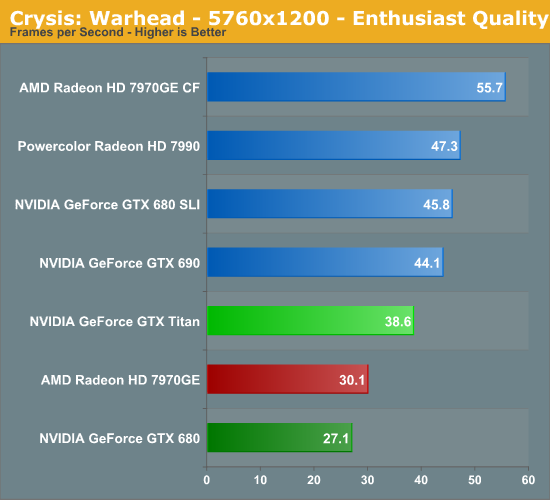
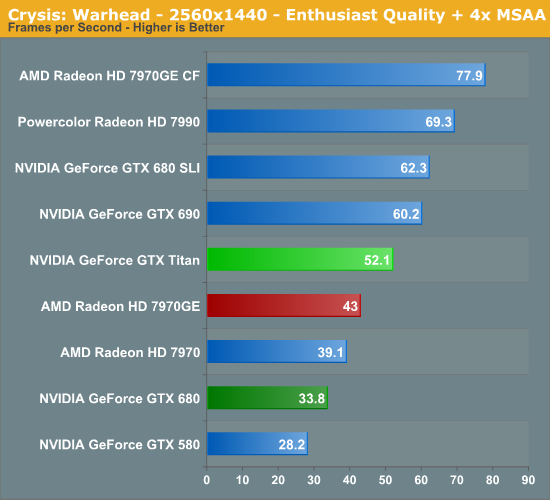
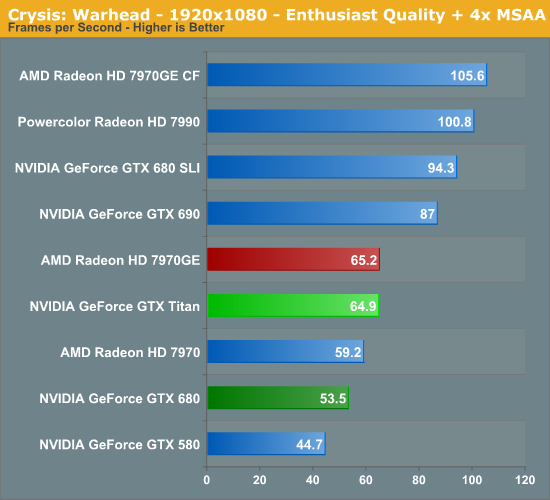
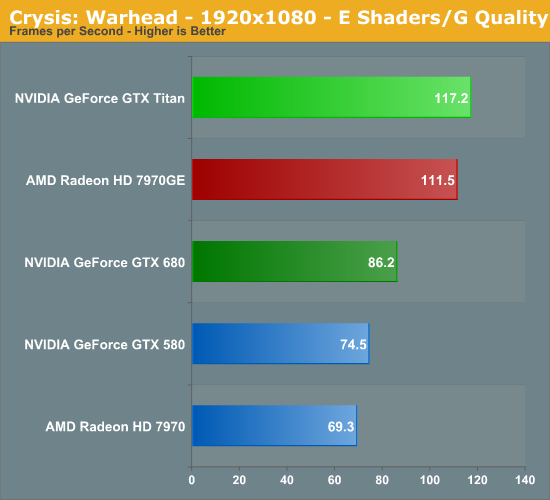
At 2560 we still have a bit of a distance to go before any single-GPU card can crack 60fps. In lieu of that Titan is the winner as expected. Leading the GTX 680 by 54%, this is Titan’s single biggest win over its predecessor, actually exceeding the theoretical performance advantage based on the increase in functional units alone. For some reason GTX 680 never did gain much in the way of performance here versus the GTX 580, and while it’s hard to argue that Titan has reversed that, it has at least corrected some of the problem in order to push more than 50% out.
In the meantime, with GTX 680’s languid performance, this has been a game the latest Radeon cards have regularly cleared. For whatever reason they’re a good match for Crysis, meaning even with all its brawn, Titan can only clear the 7970GE by 21%.
On the other hand, our multi-GPU cards are a mixed bag. Once more Titan loses to both, but the GTX 690 only leads by 15% thanks to GK104’s aforementioned weak Crysis performance. Meanwhile the 7990 takes a larger lead at 33%.
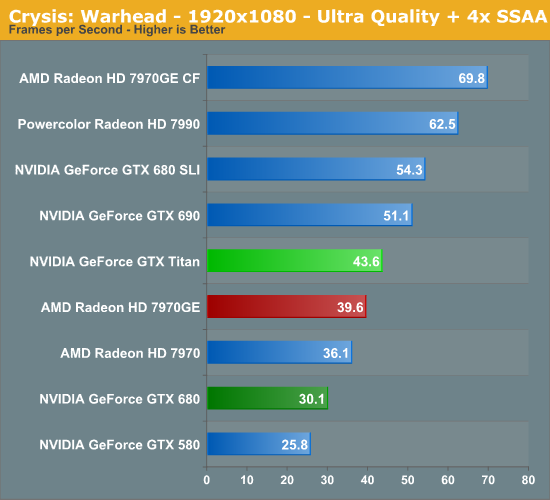
I’d also note that we’ve thrown in a “bonus round” here just to see when Crysis will be playable at 1080p with its highest settings and with 4x SSAA for that picture-perfect experience. As it stands AMD multi-GPU cards can already cross 60fps, but for everything else we’re probably a generation off yet before Crysis is completely and utterly conquered.
Moving on, we once again have minimum framerates for Crysis.
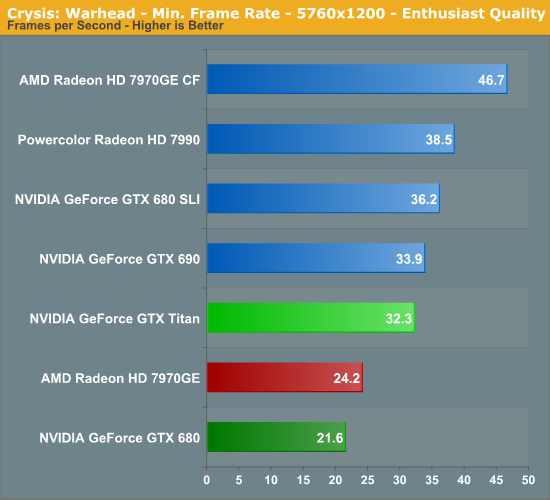
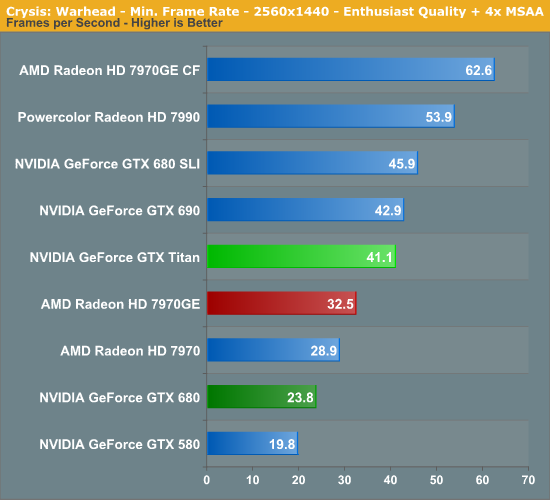
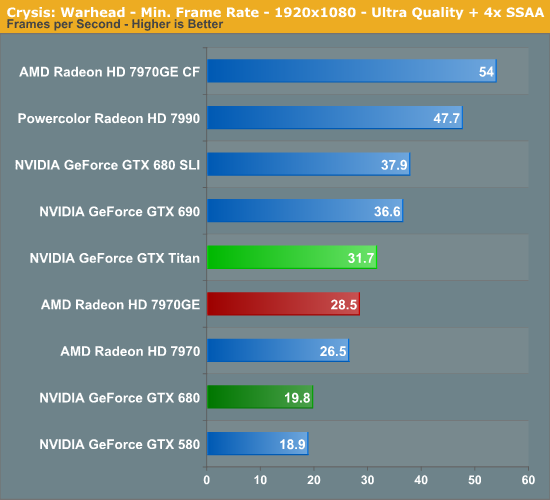
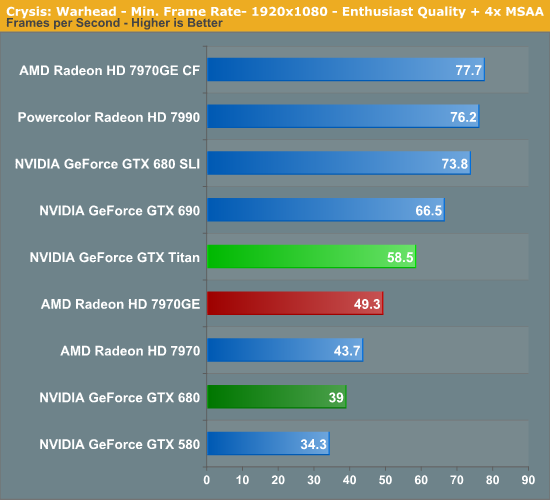
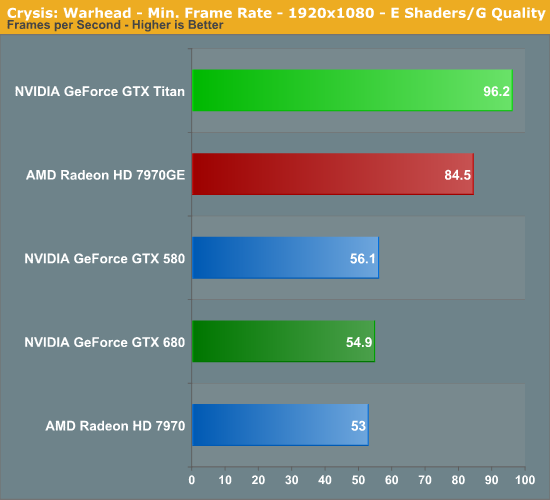
When it comes to Titan, the relative improvement in minimum framerates over GTX 680 is nothing short of obscene. Whatever it was that was holding back GTX 680 is clearly having a hard time slowing down Titan, leading to Titan offering 71% better minimum framerates. There’s clearly much more going on here than just an increase in function units.
Meanwhile, though Titan’s gains here over the 7970GE aren’t quite as high as they were with the GTX 680, the lead over the 7970GE still grows a bit to 26%. As for our mutli-GPU cards, this appears to be a case where SLI is struggling; the GTX 690 is barely faster than Titan here. Though at 31% faster than Titan, the 7990 doesn’t seem to be faltering much.
Originally published at https://www.anandtech.com/show/6774/nvidias-geforce-gtx-titan-part-2-titans-performance-unveiled (Wayback Machine).