
Calxeda's ARM server tested
Benchmark Configuration
First of all, a big thanks to Wannes De Smet, who assisted me the benchmarks. Below you can read the configuration details of our "real servers". The Atom machines are a mix of systems. The Atom 230 is part of a 1U server featuring a Pegatron IPX7A-ION motherboard with 4GB of DDR2-667. The N450 is found inside an ASUS EeePC netbook, and the Atom N2800 is part of Intel's DN2800MT Marshalltown mainboard. The latter has 4GB of DDR3-1333 while the former only has 1GB of DDR2-667.
| Supermicro SYS-6027TR-D71FRF Xeon E5 server (2U Chassis) | |
| CPU |
Two Intel Xeon processor E5-2660 (2.2GHz, 8c, 20MB L3, 95W) Two Intel Xeon processor E5-2650L (1.8GHz, 8c, 20MB L3, 70W) |
| RAM | 64/128GB (8/16x8GB) DDR3-1600 Samsung M393B1K70DH0-CK0 |
| Motherboard | X9DRT-HIBFF |
| Chipset | Intel C600 |
| BIOS version | R 1.1a |
| PSU | PWS-1K28P-SQ 1280W 80 Plus Platinum |
The Xeon E5 CPUs have four memory channels per CPU and support DDR3-1600, and thus our dual CPU configuration gets eight DIMMs for maximum bandwidth. Each core supports Hyper-Threading, so we're looking at 16 cores with 32 threads.
| Boston Viridis Server | |
| CPU | 24x ECX-1000 4c Cortex-A9 1.4GHz |
| RAM | 24x Netlist 4GB (96GB) low-voltage ECC PC3L-10600W-9-10-ZZ DRAM |
| Motherboard | 6x EC-cards |
| Chipset | none |
| Firmware version | ECX-1000-v2.1.5 |
| PSU | SuperMicro PWS-704P-1R 750Watt |
Common Storage System
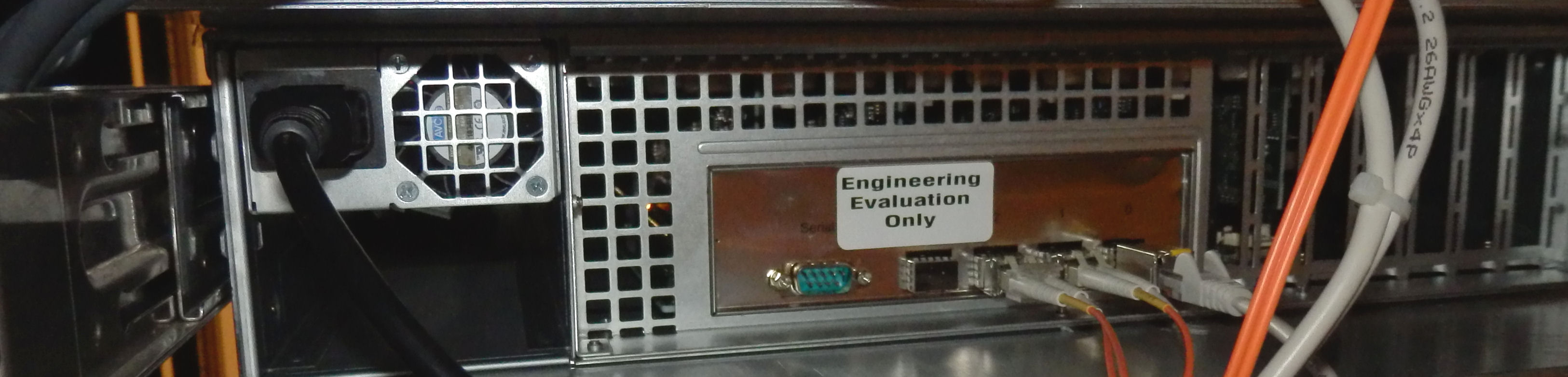
An iSCSI LIO Unified Target accesses a DataON DNS-1640 DAS. Inside the DAS we have set up eight Intel SSDSA2SH032G1GN (X25-E 32GB SLC) in RAID-0.
Software Configuration
The Xeon E5 server runs VMware ESXi 5.1. All vmdks use thick provisioning, independent, and persistent. The power policy is "Low Power". We chose the "Low Power" policy as this enables C-states while the impact on performance is minimal. All other systems use Ubuntu 12.10. The power management policy is "ondemand". This enables P-states on the Atom and Calxeda ECX-1000.
Originally published at https://www.anandtech.com/show/6757/calxedas-arm-server-tested (Wayback Machine).