
MSI Z77 MPower Review: The XPower’s Little Brother
- Posted in
- Motherboards
- MSI
- Z77
- Overclocking
MSI Z77 MPower
When building a top of the range product, each motherboard manufacturer has to decide on intended audience, features, and price point. Some companies like ASUS, ASRock and Gigabyte split up their high end products, with one side to focus on gamers and the other for overclocking. There is often a large amount of overlap between the two, as a motherboard specifically for extreme overclockers would not sell, but gaming oriented boards are not what overclockers are after in terms of components and stability. Another stringent factor comes in when dealing with the cost to build the motherboard, and the features that are put in or left out can make or break the product. The MSI Z77 MPower tries to take on all sides, being a lower-cost, extreme overclocking and gaming oriented product, attempting to undercut the competition.
Back at Computex 2012, we were told that the MPower will also come with an overclocking warranty, whereby if the board fails due to an overclock, then MSI will replace it (but not the CPU or any other equipment). Since then there has been no mention of this since that time, and I cannot find any information relating to it, it stands to reason that the MPower has a standard (location dependent) three-year warranty. I was hoping that this overclocking warranty would actually pull through as part of the package.

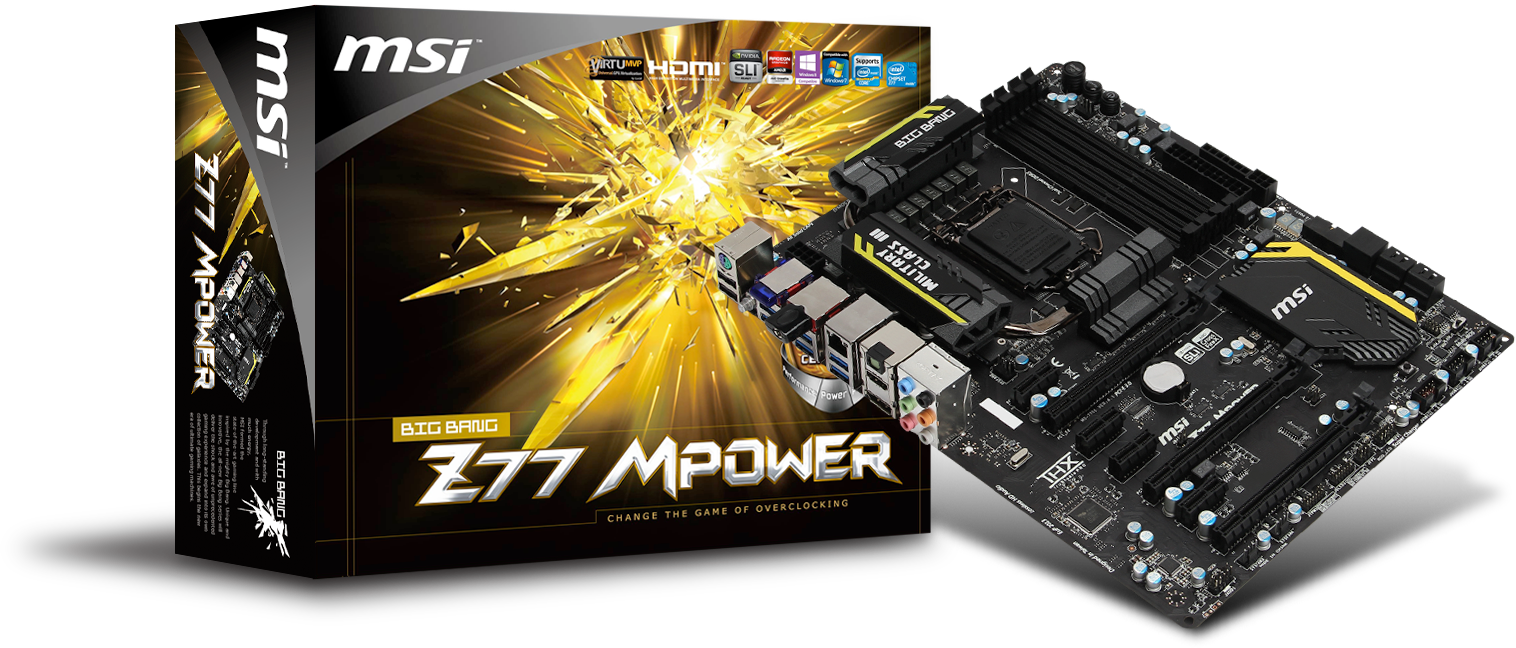
MSI’s main prowess with the Z77 MPower comes from different directions. Firstly the visuals, which are designed to match with the MSI Lightning series of graphics cards with the blocky black and representative yellow decals. We then get MSI’s testing procedure with the Z77 MPower, which gives each board off the production line a 24-hour Prime95 stress test using a 30% overclocked CPU and an all-in-one liquid cooler, though no indication of explicitly what CPU was used. An August 2012 press release on the MSI website states 4.6 GHz, suggesting an i7-3770K, though on the product page and box it does not explicitly state this for some unknown reason.
For gamers, the MSI Z77 MPower gives an ideal PCIe layout for dual setups with a three slot gap between the first to full-length PCIe slots, and the overall PCIe lane allocation from the CPU suitable for three-way CrossFireX, compared to some other Z77 boards that borrow four PCIe 2.0 lanes from the chipset. The addition of the OC Genie button lets a user give an instant 4.2 GHz overclock on an i7-3770K, meaning more performance at the touch of a button. The onboard WiFi and Bluetooth is fairly standard, along with the Realtek NIC and audio – in all cases we would have preferred upgraded versions to push this high end MSI board above equivalent priced products.
For extreme overclockers there is a flat socket area suitable for sub-zero insulating, as well as power/reset/ClearCMOS/Go2BIOS buttons for ease of use when the board is outside a case. The two-digit debug is a must-have on a board this price, and the MSI one doubles up as a temperature sensor when in the operating system. Unfortunately the BIOS is a little buggy, and the overclocking section is more of a mess than a well-structured part of the package. Nevertheless we were able to hit 5.0 GHz stable in our testing, albeit in cold air and a peak load temperature of 99ºC – the memory was also able to jump from 2666 C11 to 2800 C11 with no more than a bump in the memory strap.
Performance wise the MSI Z77 MPower ran around average in our benchmarking tests due to the inclusion of a form of MultiCore Turbo, giving the CPU maximum turbo no matter the loading. The only major fault was in the USB 2.0 speeds, whereby like the Z77A-GD65 the system achieved 26 MBps read and write, rather than the usual 30-34 Mbps seen on other Z77 motherboards.
The software package on the Z77 MPower is coming together nicely, with Live Update 5 keeping sure that users are up to date on all the latest versions. MSI Control Center gets skinned for the Big Bang range, and the upgraded fan controls on the board are easy to use, even if it doesn’t fully encompass the non-linearity of the natural power-RPM curve of a fan.
The MSI Z77 MPower is a jack of all trades, yet master of none. It sits looking nice, and those willing to dive into the settings should be able to get something good to work in a home system. But for a home system there is plenty of competition at the $210 price point, and extreme overclockers who want the best will only consider the MSI based on brand loyalty or funds (despite fierce competition +/- $30).
What MSI need to do is bring out a specific gaming SKU, and another SKU that works for overclocking but can also be gaming oriented, for example with an add-in card with audio/network, suitable numbers of USB/SATA ports, and on-the-fly adjustment buttons. With these in place, they can then look to lower cost versions of each to hit various price points. The other three main motherboard manufacturers have recognized and done this, and I look forward to MSI’s entry for Haswell and Z87.
Originally published at https://www.anandtech.com/show/6694/msi-z77-mpower-review-the-xpowers-little-brother (Wayback Machine).