
The new Opteron 6300: Finally Tested!
Virtualization Performance: Linux VMs on ESXi
We introduced our new vApus FOS (For Open Source) server workloads in our review of the Facebook "Open Compute" servers. In a nutshell, it is a mix of four VMs with open source workloads: two PhpBB websites (Apache2, MySQL), one OLAP MySQL "Community server 5.1.37" database, and one VM with VMware's open source groupware Zimbra 7.1.0. Zimbra is quite a complex application as it contains the following components:
- Jetty, the web application server
- Postfix, an open source mail transfer agent
- OpenLDAP software, user authentication
- MySQL is the database
- Lucene full-featured text and search engine
- ClamAV, an anti-virus scanner
- SpamAssassin, a mail filter
- James/Sieve filtering (mail)
All VMs are based on a minimal CentOS 6 setup with VMware Tools installed. All our current virtualization testing is on top of the hypervisor which we know best: ESXi (5.0). We have changed two things in our vApusMark FOS setup: we upgradeded the guestOS from 5.6 to 6.0 and increased the number of vCPUs of the OLAP VM from 2 to 4. This small upgrade means that our latest results should not be compared to the results in our older articles. We test with four tiles (one tile = four VMs). Each tile needs nine vCPUs, so the test requires 36 vCPUs.
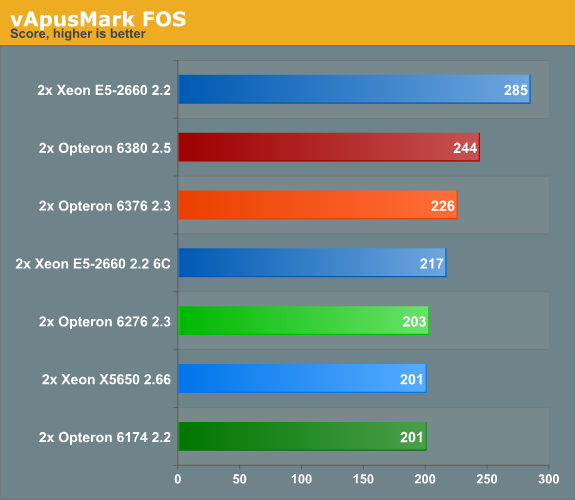
For being just a minor update, the new Piledriver core does pretty well. Clock for clock performance goes up by 11%. The total performance gain (IPC+clock) is 20%, which is significant. The Opteron 6376 performs only 4% better than its direct competitor the E5-2630 (as the latter will perform very similar to our E5-2660 with 6 cores), but that is not bad at all: you get slightly better performance for a lower (server) price.
The top of the line 6380 cannot keep up with the best Xeons. Offering 86% of the more expensive Xeon E5-2660 is hardly a disaster, however. Note "maximum amount of affordable memory" is on top of many virtualization hosts shopping lists followed by price/performance. For those buyers, considering that a server based upon the Opteron cost less, the Opteron is once again a potent virtualization host if the power usage is similar.
With the lack of c-states, the Opteron 6174 did pretty poorly. The Opteron 6276 consumed a lot less at idle than its predecessor, but consumed a lot more when pressured to perform at high load. So we were very keen to learn whether AMD has improved power consumption too. Did AMD finally get that part right?
Originally published at https://www.anandtech.com/show/6508/the-new-opteron-6300-finally-tested (Wayback Machine).