
Aleutia Relia Industrial PC Review: Ivy Bridge & Q77 in a Fanless Chassis
- Posted in
- Industrial PC
- HTPC
- Ivy Bridge
- Aleutia
Performance Metrics:
In our HTPC reviews, we devote a section to general performance metrics and multiple sections to various HTPC aspects. The Aleutia Relia review unit's Core i7-3770T has the HD4000 GPU inside, and its HTPC performance with respect to rendering and decoding is well known. For this review, we will have a section devoted to performance metrics at room temperature (72 F) and just one additional section for the HTPC aspects (given the target market for the system).
Windows Experience Index and SSD Performance
This metric is often considered meaningless, but we feel it serves as an indicator of what could be the bottleneck in the system. Surprisingly, it was not the HD4000 GPU, but the primary hard disk (Crucial 128 GB mSATA SSD) which initially gave a score of 5.9 to the system.
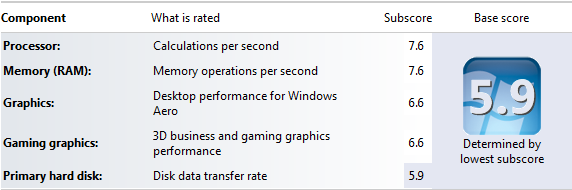
The Crucial mSATA SSD is supposed to deliver much better performance (since it is based on a comparatively higher end Marvell controller, unlike the cheaper mSATA SSDs based on Phison). To make sure that the SSD was performing to its full potential, we created a partition on the SSD and ran our 4-corner IOMeter benchmark.
| IOMeter Performance | |
| Test | Transfer Rate (MBps) |
| 4 KB Random Write | 125.90 |
| 4 KB Random Read | 60.49 |
| 128 KB Sequential Read | 218.68 |
| 128 KB Sequential Write | 154.18 |
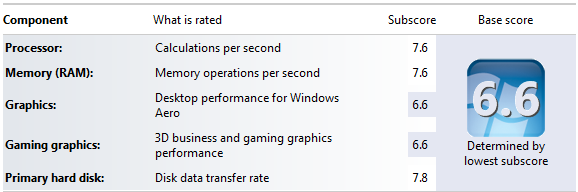
These figures are certainly not bad enough to give a score of 5.9 in the Windows Experience Index. A quick check revealed that the Intel Rapid Storage Technology driver hadn't been installed in the first run. After installation, the score for the primary drive moved on to 7.8, and the system score, as expected, was pulled down by the HD4000 GPU to 6.6.
Futuremark Benchmarks
We pit the Aleutia Relia against other low power industrial / enterprise PCs that have been reviewed on our site earlier.
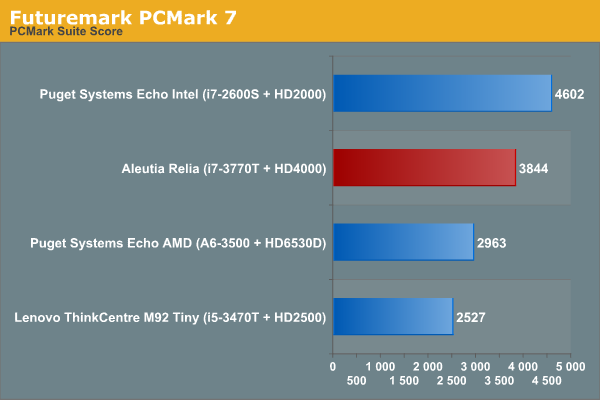
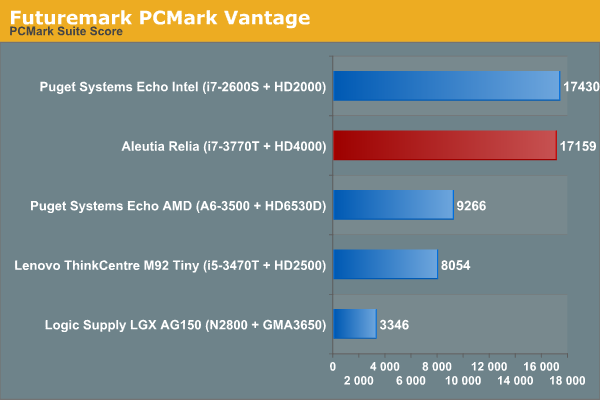
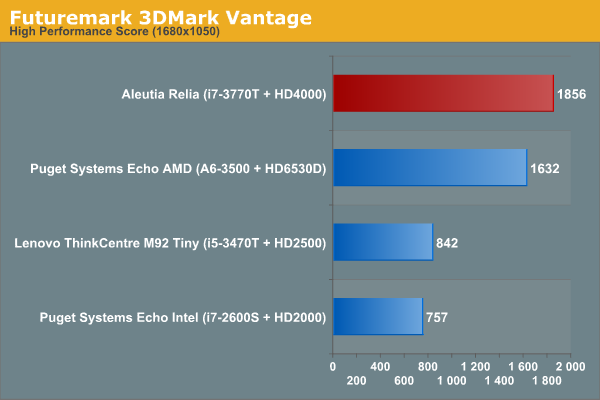
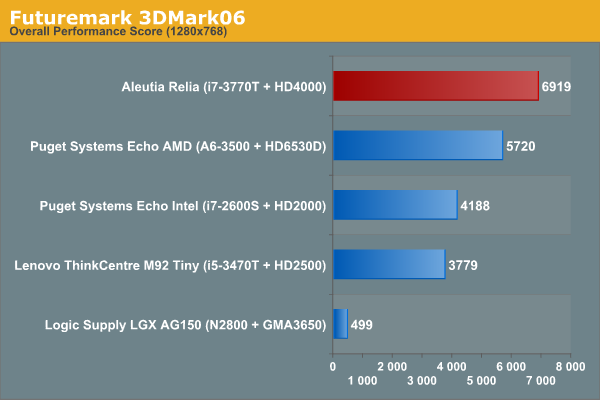
The Aleutia Relia performs consistently well, thanks to its SSD and upgraded HD4000 GPU. It loses out to the i7-2600S based Puget Systems Echo in some benchmarks, but that is because the i7-3770T is a 45W TDP CPU running at 2.5 GHz in comparison to the i7-2600S which is a 65W TDP CPU running at 2.8 GHz.
Miscellaneous Benchmarks
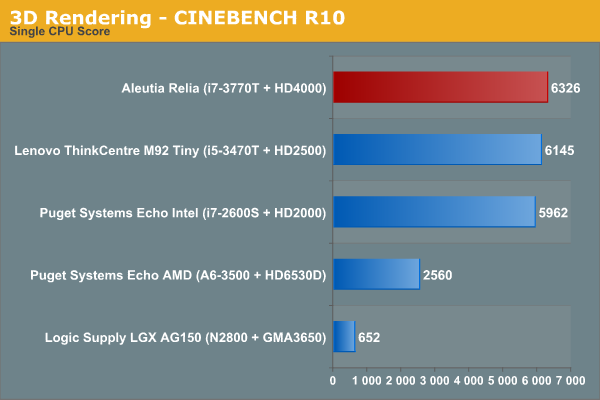
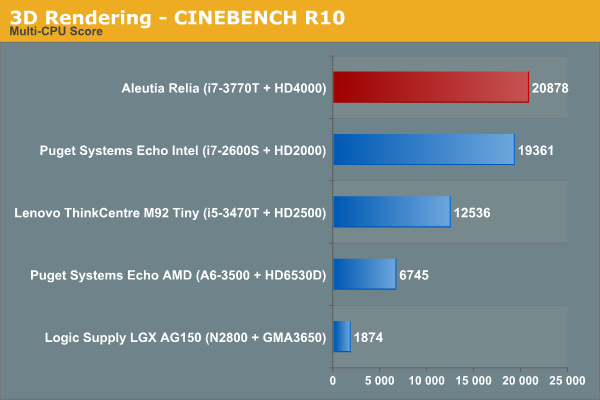
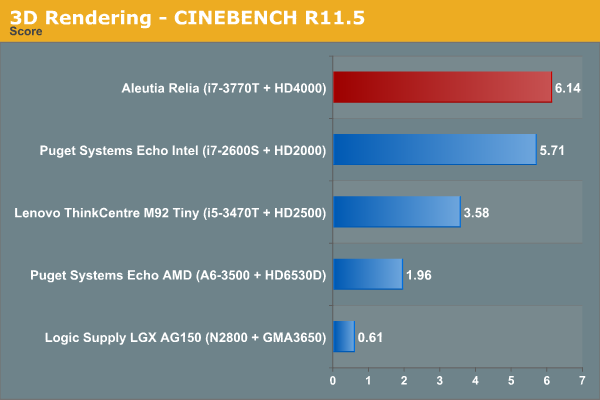
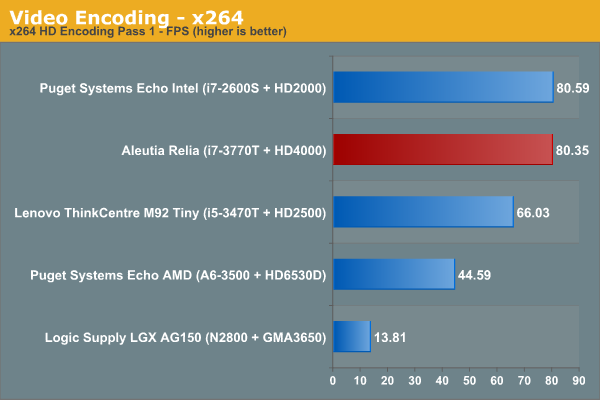
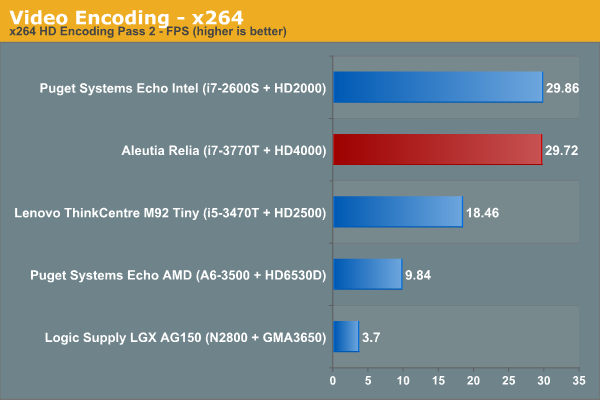
Ivy Bridge brings us strong single-threaded performance and the Aleutia Relia is impressive enough. As more cores are brought into the picture and the CPU loads up, throttling sets in and causes a drop in performance (not quite visible in the above benchmarks, but quite obvious when the FPS figures for each x264 run are observed - ranging from 86 fps in the first run to less than 70 fps in the fourth). That said, the i7-3770T should be adequate for most industrial PC tasks.
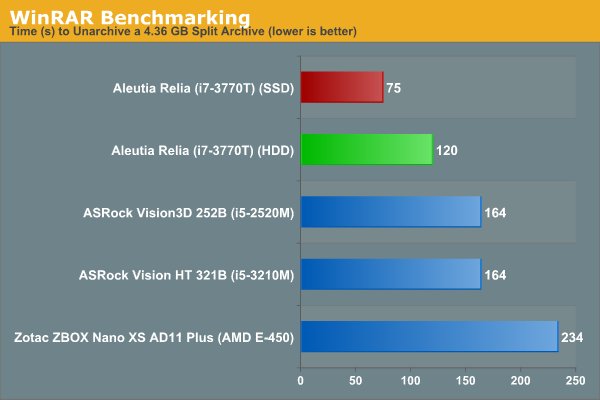
An estimate of how well WinRAR performs, particularly with respect to processing split archives, wraps up this section. To evaluate this, we take a 4.36 GB MKV file, compress it in the 'Best' compression mode into a split archive (97.1 MB each), which results in 44 files on the hard disk. The time taken to decompress this split archive is then recorded. The performance in this benchmark is heavily influenced by the disk in the system. For comparison, we use our HTPC review systems. In order to get an idea of how the disk influences the results, we repeated the run with the source and destination being the SSD as well as the HDD.
Originally published at https://www.anandtech.com/show/6494/aleutia-relia-industrial-pc-review-ivy-bridge-q77-in-a-fanless-chassis (Wayback Machine).