
ASRock Vision HT: Ivy Bridge Carries the SFF HTPC Forward
- Posted in
- Home Theater
- ASRock
- HTPC
- Ivy Bridge
General Performance Metrics
The ASRock Vision HT 321B is basically a notebook solution. It wouldn't make sense to compare it with full blown desktop Ivy Bridge solutions (or for that matter, any system with a power consumption of more than 100 W). In the comparative benchmarks provided in the rest of this review, we will provide the scores obtained by the Vision HT 321B and other similar SFF HTPC solutions.
Windows Experience Index
This metric is often considered meaningless, but we feel it serves as an indicator of what could be the bottleneck in a system for pre-built HTPCs. Surprisingly, it is not the HD 4000 GPU which is responsible for the score of the system. Both the RAM and the hard disk weigh in at 5.9.
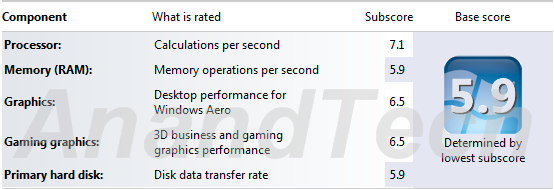
Compared to the CoreHT 252B, the graphics department moves up from 6.4 to 6.5, but the rest of the scores (including that of the primary hard disk) remain the same.
Miscellaneous Performance Metrics
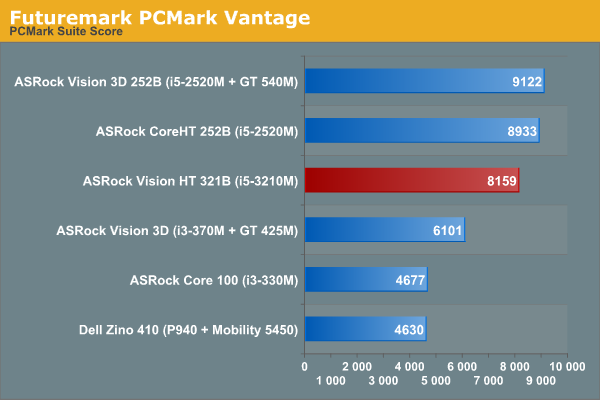
The graphs below give an idea of where the ASRock CoreHT 252B stands with respect to performance when compared with other SFF HTPCs. PCMark Vantage's PCMark score gives a general idea of the system's capability.
We also ran the 3D Mark Vantage and 3D Mark 06 benchmarks and the graphs below show how the Intel HD Graphics 4000 fares when compared to the GPU capabilities of other pre-built SFF HTPCs.
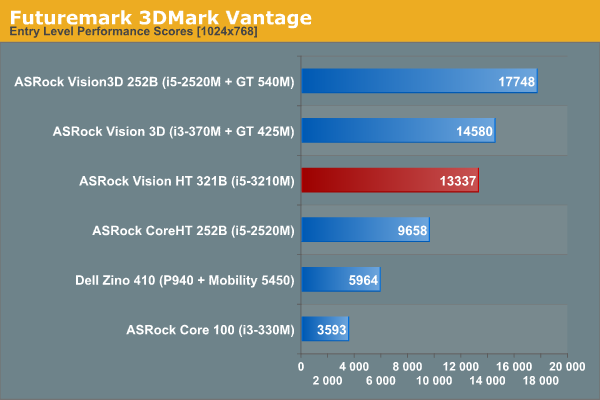
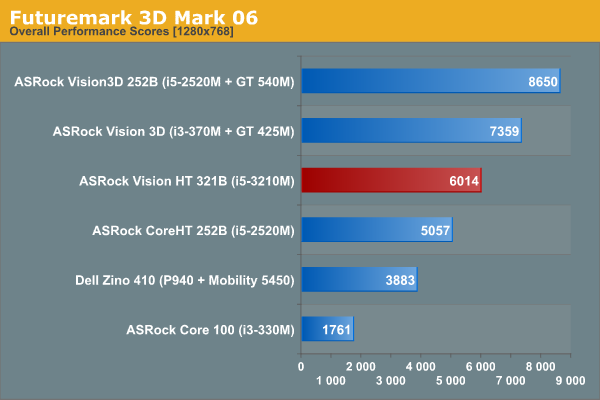
Intel HD Graphics 4000 is quite an upgrade over the HD Graphics 3000 in the CoreHT 252B, but it still doesn’t manage to beat the GT 425M in the first generation Vision 3D. In terms of the PC-centric scores, the Vision HT scores slightly less than the CoreHT 252B from last year, mainly because of the 5400 rpm drive which has replaced the 7200rpm version.
In addition to the above synthetic benchmarks, a couple of common HTPC workloads were also benchmarked. We have some data on the x264 encoding performance using the i5-3210M. Note that we are unable to utilize QuickSync for this test because QuickSync is unable to provide any support for accelerating x264 encode.
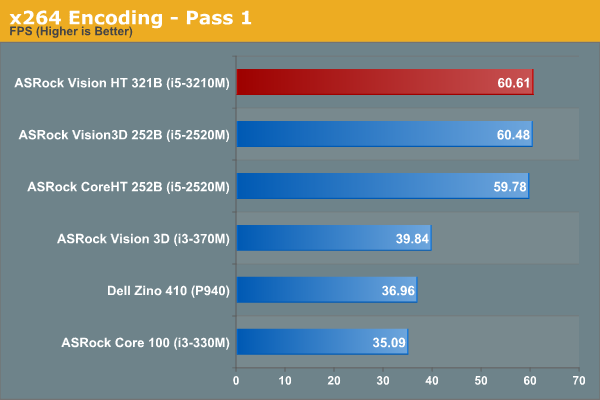
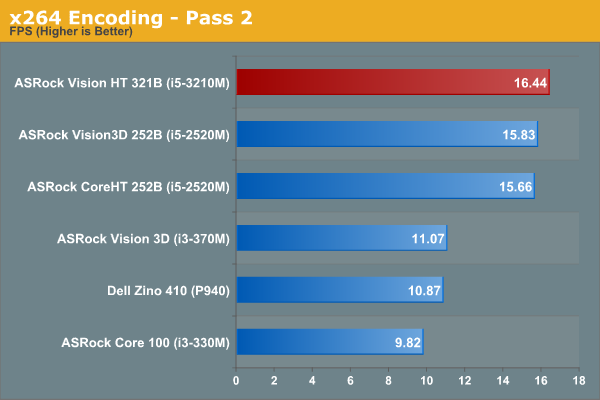
Given the similarities between the Sandy Bridge and Ivy Bridge architectures, and the fact that the Core i5-2520M and Core i5-3210M operate at the same clock speeds, it is not surprising to find that there is almost no difference in the x264 benchmark results for the CoreHT 252B / Vision3D 252B and the Vision HT 321B.
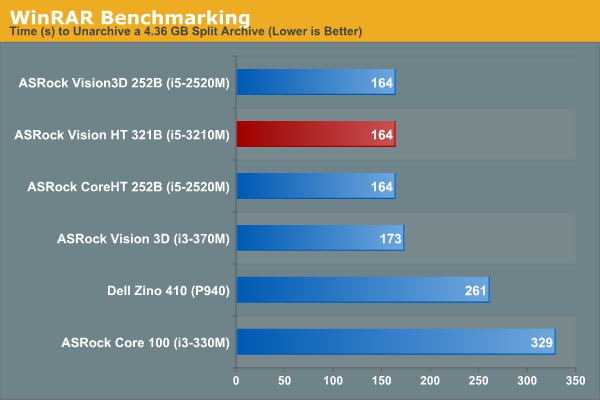
An estimate of how well WinRAR performs, particularly with respect to processing split archives, wraps up this section. To evaluate this, we take a 4.36 GB MKV file, compress it in the 'Best' compression mode into a split archive (97.1 MB each), which results in 44 files on the hard disk. The time taken to decompress this split archive is then recorded. The performance in this benchmark is heavily influenced by the hard disk in the system. Despite the 5400rpm disk, the Vision HT actually manages to deliver results similar to what we got for the last generation HTPCs with 7200rpm disks.
We have deliberately refrained from dealing with gaming benchmarks in this review. Serious gaming enthusiasts know that Intel's integrated GPU is not going to pass muster. For readers interested in finding out how good Intel's HD Graphics 4000 fares in our gaming benchmark, I would suggest looking at Jarred's mobile Ivy Bridge launch piece.
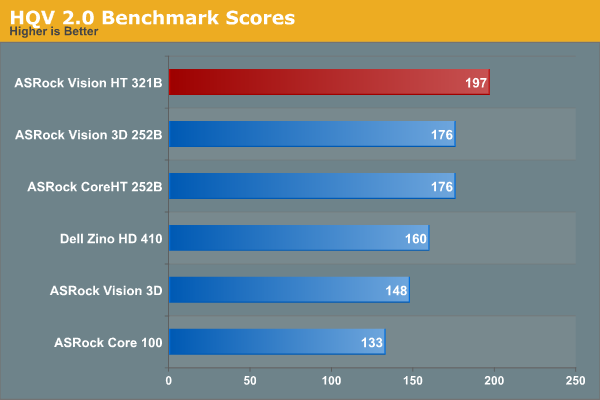
In terms of video quality, we reran the HQV 2.0 benchmarks, but found no discernible differences when compared with what was obtained with the Ivy Bridge launch drivers.
Originally published at https://www.anandtech.com/show/6443/asrock-vision-ht-ivy-bridge-carries-the-sff-htpc-forward (Wayback Machine).