
DigitalStorm Bolt Gaming System Review: It's Little But It's Fierce
Conclusion: Generally Good, With Major Caveats
It's an unusual feeling as a reviewer to look at a system and feel like many of your old pet peeves were addressed, to get the sense that maybe someone's paying attention. My pet peeves stem at least somewhat from good enthusiast sense, though: offset voltage, reasonable overclocks, don't push the daylights out of Ivy Bridge. DigitalStorm has done a fine job with the Bolt in producing a system that hits one of my major sweet points: balance. It doesn't run too hot, the parts are well suited to each other, and outside of the SSD caching the configuration at least feels somewhat sensible.
I think it's also important to note that the Bolt takes advantage of most of the technologies at hand to produce a machine that's incredibly efficient for the performance. You can argue that these are NVIDIA and Intel's achievements, but DigitalStorm still benefits, and they're careful not to rock the boat. As a result we see dynamite performance-per-watt from the Bolt. I've seen too many boutiques just shrug and effectively say "to hell with the client's power bill, to hell with longevity" not to single them out for finally doing what I've incessantly harped on boutiques to do.
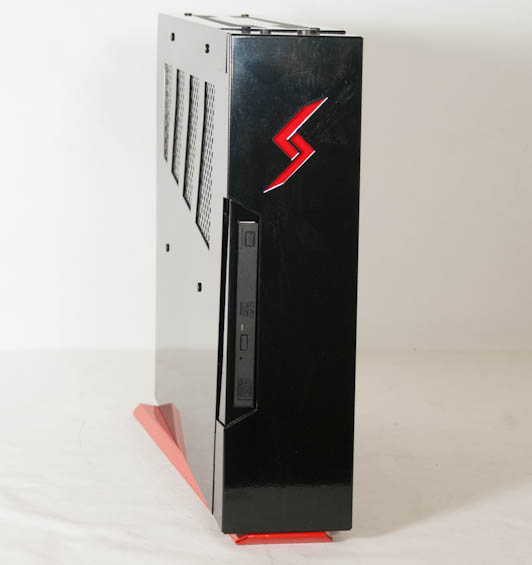
Unfortunately, the Bolt has three major issues. The chassis itself may allow them to claim the thinnest gaming desktop available, but the glossy black finish is fingerprint and dirt prone, and the single large shroud is actually remarkably aggravating to remove and replace. That issue is compounded somewhat by the fact that the interior is essentially running damage control on the cable spaghetti coming out of the PSU. That PSU in turn leads to the second problem, which is noise. I can't help but feel like the PSU is at least partly responsible for the noise, definitely responsible for the mess of cables, and probably should've been replaced by an SFX unit, even if it meant rejiggering the interior.
Those two issues can be tolerable depending on the end user, but where DigitalStorm loses the race is the price tag. The Level 1 configuration at $999 just plain isn't competitive, full stop. It's a dual core i3 and GTX 650 Ti, when $50 more gets you the vertically smaller, substantially quieter Alienware X51 with a quad-core i5-3330 and an OEM GeForce GTX 660 with 1.5GB of GDDR5. The Level 2 configuration gets a bit better at $1,249 by introducing an i5-3570K and moving up to a consumer GTX 660 with 2GB of GDDR5, but I still think the X51 is a better buy. It's only when you get to the Level 3 at $1,599 that the Bolt starts to break away and starts offering components the X51 can't really match, with the overclock on the 3570K and the GTX 660 Ti. The problem is that when you start getting into these high prices, you're really paying for the form factor. The $1,949 Level 4 configuration is a beast to be sure, but the components themselves only total about $1,200 on the free market.
Ultimately I think the chassis needs a redesign and DigitalStorm needs to be more aggressive with their pricing. I like that they're going with a custom build and trying to do something unique, and credit where credit is due, while I think it's overpriced it still beats the tar out of Falcon Northwest's grossly overpriced Tiki. The Tiki starts at a ludicrous $1,689 for a much worse configuration than our review unit and only goes up from there. This isn't a bad first draft and if the noise isn't an issue for you and you're not planning on upgrading anytime soon, I can't complain too much about it. I'm just not sure the Bolt is worth the expense when Alienware of all companies is willing to sell you a quieter, slightly less powerful system for much cheaper.
Originally published at https://www.anandtech.com/show/6407/digitalstorm-bolt-gaming-system-review-its-little-but-its-fierce (Wayback Machine).