
Intel SSD 335 (240GB) Review
Testing Endurance
We've mentioned in the past that NAND endurance is not an issue for client workloads. While Intel's SSD 335 moves to 20nm MLC NAND, the NAND itself is still still rated at the same 3,000 P/E cycles as Intel's 25nm MLC NAND. Usually we can't do any long-term endurance testing on SSDs for the initial review because it simply takes way too long to wear out an SSD. Even if you're constantly writing to a drive, it will take weeks, possibly even months for the drive to wear out. Fortunately Intel reports total NAND writes and percentage of lifespan remaining as SMART values that can be read using the Intel SSD Toolbox. The variables we want to pay attention to are the E9 and F9 SMART values, which represent the Media Wearout Indicator (MWI) and total NAND writes. Using those values, we can estimate the long-term endurance of an SSD without weeks of testing. Here is what the SMART data looked like before I started our endurance test:
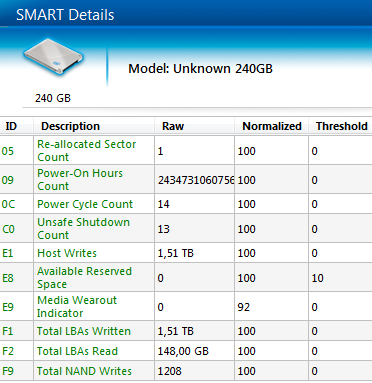
This screenshot was taken after all our regular tests had been run, hence there are already some writes to the drive, although nothing substantial. What surprised me was that the MWI was already at 92, even though I had only written 1.2TB to the NAND. Remember that the MWI begins at 100 and then decreases down to 1 as the drive uses up its program/erase cycles. Even after it has hit 1, it's likely the drive can still withstand additional write/erase cycles thanks to MLC NAND typically behaving better than the worst-case estimates.
We've never received an Intel SSD sample that started with such a low MWI, indicating either a firmware bug or extensive in-house testing before the drive was sent to us.
To write as much as possible to the drive before the NDA lift, I first filled the drive with incompressible data and then proceeded with incompressible 4KB random writes at queue depth of 32. SandForce does real-time data compression and deduplication, so using incompressible random data was the best way to write a lot of data to NAND in a short period of time. I ran the tests in about 10-hour blocks, here is the SMART data after 11 hours of writing:
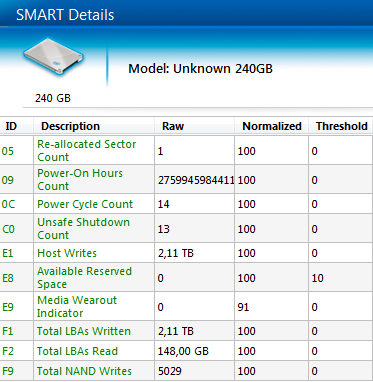
I had written another ~3.8TB to the NAND in just 11 hours but what's shocking is that the MWI had dropped from 92 to 91. With the SSD 330, Anand wrote 7.6TB to the NAND and the MWI stayed at 100, and that was a 60GB model; our SSD 335 is 240GB and thus it should be more durable (more NAND to write to). It's certainly possible that the MWI was at the edge of 92 and 91 after Intel's in-house testing, but I decided to run more tests to see if that was the case. Let's fast-forward 105 hours that I spent writing to the drive in total:
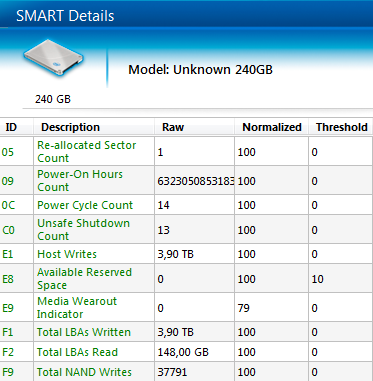
In a few days, I managed to write a total of 37.8TB to the NAND and during that time, the MWI had dropped from 92 to 79. In other words, I used up 13% of the drive's available P/E cycles. This is far from being good news. Based on the data I gathered, the MWI would hit 0 after around 250TB of NAND writes, which translates to less than 1,000 P/E cycles.

I showed Intel my findings and they were as shocked as I was. The drive had undergone their validation before shipping and nothing out of the ordinary was found. Intel confirmed that the NAND in SSD 335 should indeed be 3,000 P/E cycles, so my findings contradicted with that data by a fairly significant margin. Intel hadn't seen anything like this and asked me to send the drive back for additional testing. We'll be getting a new SSD 335 sample to see if we can replicate the issue.
It's understandable that the endurance of 20nm NAND may be slightly lower compared to 25nm even though they are both rated at 3,000 P/E cycles (Intel does have 25nm with 5,000 cycles as well) because 25nm is now a mature process whereas 20nm is very new. Remember that the P/E cycle rating is the minimum the NAND must withstand; in reality it can be much more durable as we saw with the SSD 330 (based on our tests its NAND was good for at least 6,000 P/E cycles). Hence both 20nm and 25nm MLC NAND can be rated at 3,000 cycles, although their endrudance in real world may vary (but both should still last for at least 3,000 cycles).
It's too early to conclude much based on our sample size of one. There's always the chance that our drive was defective or subject to a firmware bug. We'll be updating this section once we get a new drive in house for additional testing.
Originally published at https://www.anandtech.com/show/6388/intel-ssd-335-240gb-review (Wayback Machine).