
ASUS VivoTab RT Review
- Posted in
- Asus
- Mobile
- Tablets
- Windows RT
- Vivo Tab
Tegra 3 is a pretty known quantity at this point, we’ve seen quite a few tablets and smartphones based on this chip and it’s been quite solid in all of them. Nvidia has done a good job executing with their mobile SoCs, and Microsoft choice of T30 to be the heart of their launch platform is a pretty significant hardware win for Nvidia.
So with that said, how does the Tegra 3-Windows RT combination hold up versus the who’s who of the tablet world today? Well, that’s a bit complicated. As far as Windows RT benchmarks, we’ve got relatively few, so we’ll stick to some of our cross-platform JavaScript benchmarks, all of which happen to be browser-based.
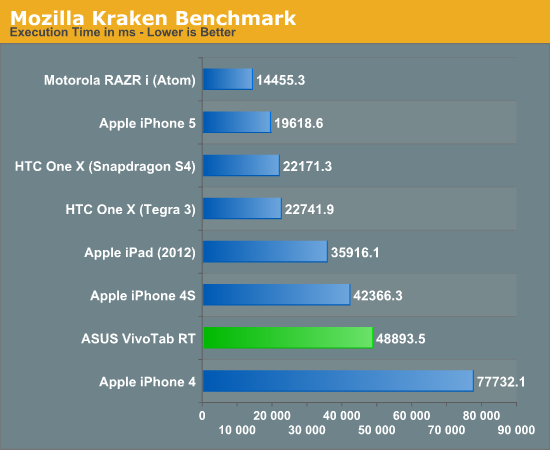
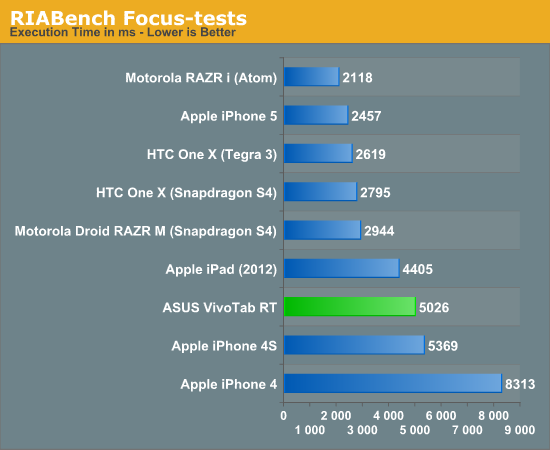
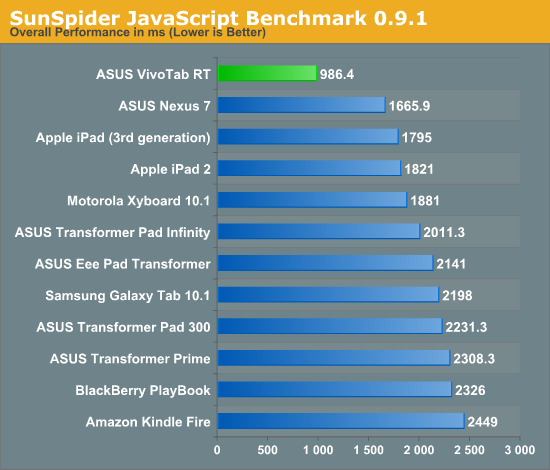
This is important to note, because in Windows 8 and Windows RT, there are of course two browsers. Both run the same IE10 engine, so performance is actually essentially the same - I had some margin of error level differences (~2%) that aren’t really worth reporting in the graphs. Compared to the third generation iPad, performance is a bit low due to to IE10’s JavaScript performance, and the A6X-based fourth generation iPad should only extend that lead (significantly) based on the performance of the A6-based iPhone 5. But trying to make cross-platform performance comparisons are kind of a waste here.
Tegra 3 is fast enough to run Windows RT, but until we get some other comparison points and better ways to benchmark it, there’s not too much else to say here. Tegra 3 is adequate, but anything less and I could see parts of the UI (particularly in the desktop) becoming a drag. But given how well RT runs on quad-core Cortex A9, I’m just eager to see shipping devices with faster SoCs - Krait and Clover Trail in the coming weeks, A15 in the not-too distant future.
Originally published at https://www.anandtech.com/show/6387/asus-vivotab-rt-review (Wayback Machine).