
GeIL Evo Veloce Review: 2x8GB at DDR3-2400 C11-12-12 1.65 V
- Posted in
- Memory
- Ivy Bridge
- DDR3
- GeIL
Synthetic testing has a way of elevating what may be a minor difference between hardware into a larger-than-life comparison, despite the effect on the usage of the system being near minimal. There are several benchmarks which straddle the line between synthetic and real world (such as Cinebench and SPECviewperf) which we include here.
SPECviewperf
The mix of real-world and synthetic benchmarks does not get more complex than SPECviewperf – a benchmarking tool designed to test various capabilities in several modern 3D renders. Each of these rendering programs come with their own coding practices, and as such can either be memory bound, CPU bound or GPU bound. In our testing, we use the standard benchmark and report the results for comparison.

In most circumstances the 2x8 GB 2400 C11 kit performs near or better than the 2133 C9 kit (Lightwave, Maya, tcvis). For a lot of these results, MHz is more important than command rate, and in terms of catia, having denser modules also seems to help.
Cinebench x64
A long time favourite of synthetic benchmarkers the world over is the use of Cinebench, software designed to test the real-world application of rendering software via the CPU or GPU. In this circumstance we test the CPU single core and multi-core performance, as well as the GPU performance using a single GTX 580 at x16 PCIe 2.0 bandwidth. Any serial factors have to be processed through the CPU, and as such any memory access will either slow or speed up the benchmark.
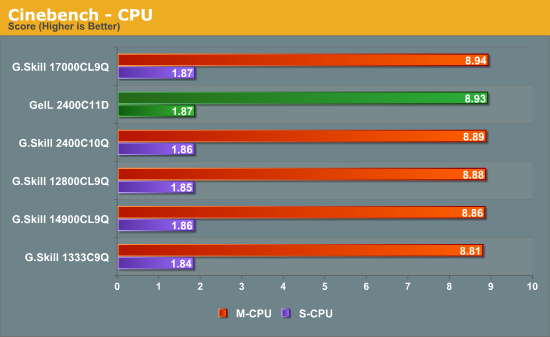
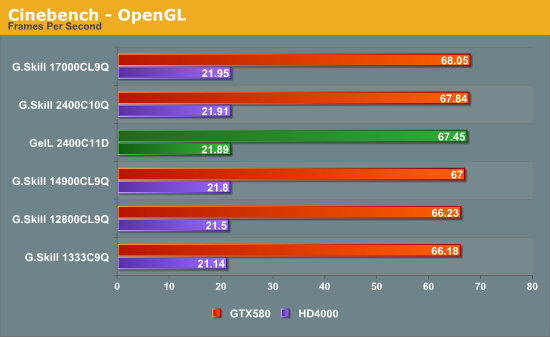
Not much differentiates any of the memory kits - the main difference is using a GTX 580 for the OpenGL test interestingly enough.
Originally published at https://www.anandtech.com/show/6374/geil-evo-veloce-review-2x8gb-at-ddr32400-c111212-165-v (Wayback Machine).