
GeIL Evo Veloce Review: 2x8GB at DDR3-2400 C11-12-12 1.65 V
- Posted in
- Memory
- Ivy Bridge
- DDR3
- GeIL
Market Positioning
As mentioned in the previous page, this memory kit has some immediate challengers in and around the price range for the capacity:
$145: Corsair Vengence 4x4GB DDR3-1600 7-8-8 (8.75ns / 13.125ns)
$150: Kingston HyperX 4x4GB DDR3-2400 11-13-13 (9.17ns / 12.08ns)
$150: Corsair Vengeance 4x4GB DDR3-2400 10-12-12 (8.33ns / 11.25 ns)
$150: Mushkin Redline 4x4GB DDR3-2400 10-12-12 (8.33ns / 11.25 ns)
$150: G.Skill Trident 4x4GB DDR3-2400 10-12-12 (8.33ns / 11.25 ns)
$145: G.Skill TridentX 2x8 GB DDR3-2133 9-11-11 (8.43ns / 11.72ns)
$150: Crucial Ballistix 2x8 GB DDR3-1866 9-9-9 (9.65ns / 13.40ns)
$150: GeIL Evo Veloce 2x8 GB DDR3-2400 11-12-12 (9.17ns / 12.08ns)
$150: Kingston HyperX 2x8 GB DDR3-1866 9-10-9 (9.65ns / 13.40ns)
$155: G.Skill TridentX 2x8 GB DDR3-2400 10-11-11 (8.33ns / 11.25 ns)
The $145 and $155 2x8 GB kits from G.Skill really shoot across the bow of the GeIL ship Evo Veloce in the same capacities, but most of the 4x4 GB $150 DDR3-2400 C10 kits also offer better XMP sub-timings for the same price, meaning the advantage of the Evo Veloce is obviously memory density per module.
Test Bed
| Test Bed | |
| Processor |
i7-3770K @ 4.4 GHz 4 Cores / 8 Threads |
| Motherboard | ASUS P8Z77-V Premium |
| Memory |
G.Skill 1333 MHz 9-9-9-24 1.5V 4x4GB Kit G.Skill 1600 MHz 9-9-9-24 1.5V 4x4GB Kit G.Skill 1866 MHz 9-10-9-28 1.5V 4x4GB Kit GeIL 2400 MHz 11-12-12-30 1.65V 2x8GB Kit G.Skill 2133 MHz 9-11-10-28 1.65V 4x4GB Kit G.Skill 2400 MHz 10-12-12-31 1.65V 4x4GB Kit |
| CPU Cooler | Intel Stock Cooler |
| Graphics Cards |
Intel HD4000 ECS GTX580 |
| Power Supply | Rosewill SilentNight 500W Platinum |
| Storage | OCZ Vertex3 240GB |
| SATA 6Gbps to USB 3.0 | Thermaltake BlacX 5G Docking Station |
| Thunderbolt Device | Lacie Little Big Disk 240GB |
| Test Bench | Coolermaster Test Bed |
| Operating System | Windows 7 x64 Ultimate |
Many thanks to...
We must thank the following companies for kindly donating hardware for our test bed:
OCZ for donating the USB testing SSD
ASUS for donating the IO testing kit
ECS for donating NVIDIA GPUs
Rosewill for donating the Power Supply
ASUS MemTweakIt
With our overview of the ASUS Republic of Gamers range of products, one piece of software caught my eye while I was testing. The ASUS MemTweakIt allows for almost complete control of the memory subtimings while in the OS, such that users can optimize their settings for memory reads, memory writes, or for pushing the boundaries. The upshot of this software in our context is that it takes all the sub-timings and settings and condenses them into a score. As the memory kits we test contain XMP profiles, these profiles determine a large majority of the sub-timings on the kit and how aggressive a memory manufacturer is. We should see this represented in our MemTweakIt score.
As we do not know the formula by which ASUS calculates this value, it has to be taken with a pinch of salt. It could be weighted in favor of one of the settings versus the other. Normally I would not put such an non-descript benchmark as part of our testing suite, but the MemTweakIt software does give us one descriptor – it gives us a theoretical rate of improvement across the range of kits we test, and allows us to order them in the way they should perform. With this being said, the results for our kits are as follows:
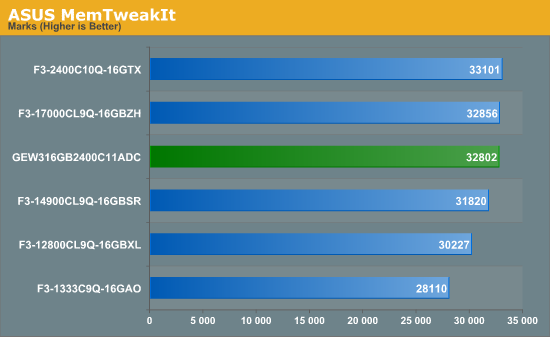
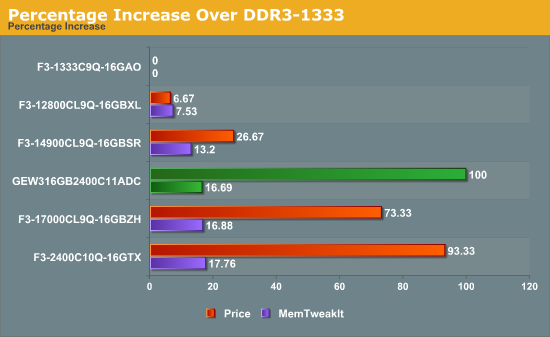
In terms of MemTweakIt scores, the Geil 2400 C11 kit pulls in just behind the G.Skill 2133 C9 kit. The price between these two kits is $150 for the GeIL and $130 for the G.Skill, meaning if the benchmarks pan out like the MemTweakIt scores, the extra $20 on the GeIL kit is the ‘module differentiation’ between having a 4x4GB kit and a 2x8GB kit.
Originally published at https://www.anandtech.com/show/6374/geil-evo-veloce-review-2x8gb-at-ddr32400-c111212-165-v (Wayback Machine).