
The NVIDIA GeForce GTX 660 Review: GK106 Fills Out The Kepler Family
Crysis: Warhead
Kicking things off as always is Crysis: Warhead. It’s no longer the toughest game in our benchmark suite, but it’s still a technically complex game that has proven to be a very consistent benchmark. Thus even four years since the release of the original Crysis, “but can it run Crysis?” is still an important question, and the answer continues to be “no.” While we’re closer than ever, full Enthusiast settings at a 60fps is still beyond the grasp of a single-GPU card.
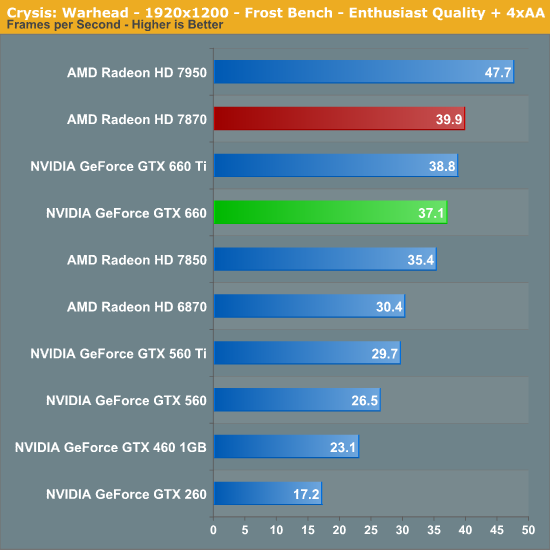
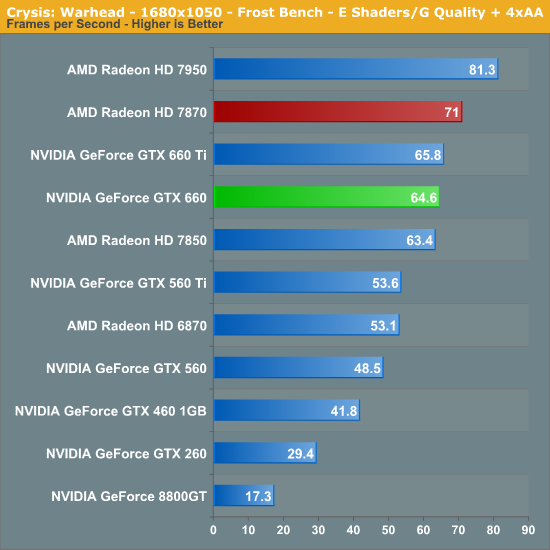
Crysis has been a game that has consistently penalized Kepler for its lack of memory bandwidth. Nowhere was this more evident than the GTX 660 Ti, which thanks to its memory bus reduction took a significant hit. But as we alluded to in our introduction, there’s a corner case where the GTX 660 is going to be able to easily keep up with the GTX 660 Ti: ROP and memory bandwidth-bound situations. As a result we’re looking at the best case scenario for the GTX 660 when held up against the GTX 660 Ti, which sees the GTX 660 offer 95% of the performance of the GTX 660 Ti. Most games aren’t going to be like this, but in this one case the GTX 660 may as well be as good as the GTX 660 Ti as far as performance goes, which goes to prove just how bottlenecked Crysis is by memory bandwidth.
Looking at a more meaningful comparison, because the GTX 660 doesn’t take a memory bandwidth hit compared to the GTX 660 Ti, the resulting card is much more resource balanced which in turn impacts AMD’s ability to lead in this benchmark. AMD once again wins here with the 7870 taking the lead, but only by a relatively modest 7% margin. This is the first time we haven’t seen a comparable AMD card lead by a significant margin in this generation, which for NVIDIA is an improvement though still not a reversal of fortunes. At the same time however NVIDIA isn’t doing too much better than the 7850 here, beating AMD’s lesser 7800 by an even more modest 5%.
As for NVIDIA’s older cards, the generational performance gains are in-line with what we’ve already seen out of the other GTX 600 cards. Compared to the GTX 460 1GB for example, a card that launched over 2 years ago at the same price, performance is up by 50-60%. But unsurprisingly this is less than the performance gain going from the 8800GT to the GTX 460, a similar timeline jump that saw performance more than double. At the very least NVIDIA certainly has the 8800GT licked at this point (by nearly a factor of 4x), but this means they’re also at risk of perpetuating longer upgrade cycles for current GTX 460 owners.
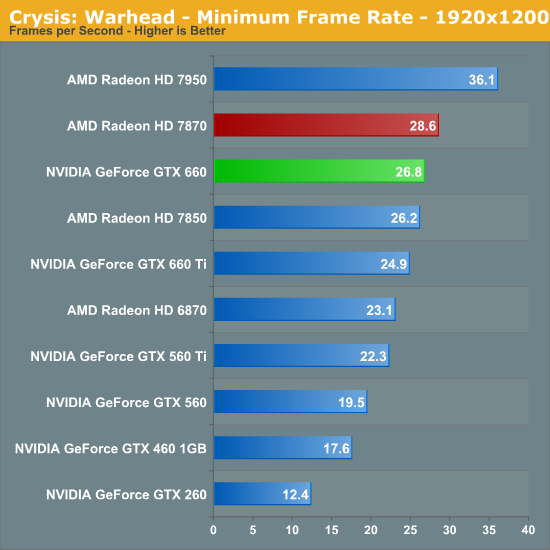
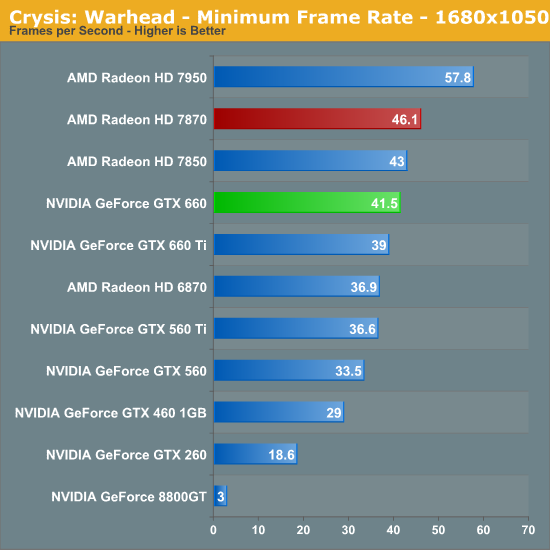
Moving on to minimum framerates, our results are almost the same with one interesting twist: the GTX 660 is now beating the more expensive GTX 660 Ti. Why? As we mentioned earlier, because of the higher core clock the ROPs on the GTX 660 actually have a greater theoretical throughput than the ROPs on the GTX 660 Ti. Since we’re not seeing any other factors that would explain this difference (i.e. drivers) it’s very likely that the GTX 660’s faster ROPs are giving it the advantage here.
Though while this is enough to push the GTX 660 ahead of the GTX 660 Ti, it’s not improving the GTX 660’s situation relative to the 7800 series at all. The GTX 660 is still closer to the 7850 than it is the 7870 here.
Originally published at https://www.anandtech.com/show/6276/nvidia-geforce-gtx-660-review-gk106-rounds-out-the-kepler-family (Wayback Machine).