
Four Multi-GPU Z77 Boards from $280-$350 - PLX PEX 8747 featuring Gigabyte, ASRock, ECS and EVGA
Conclusion: ECS Z77H2-AX
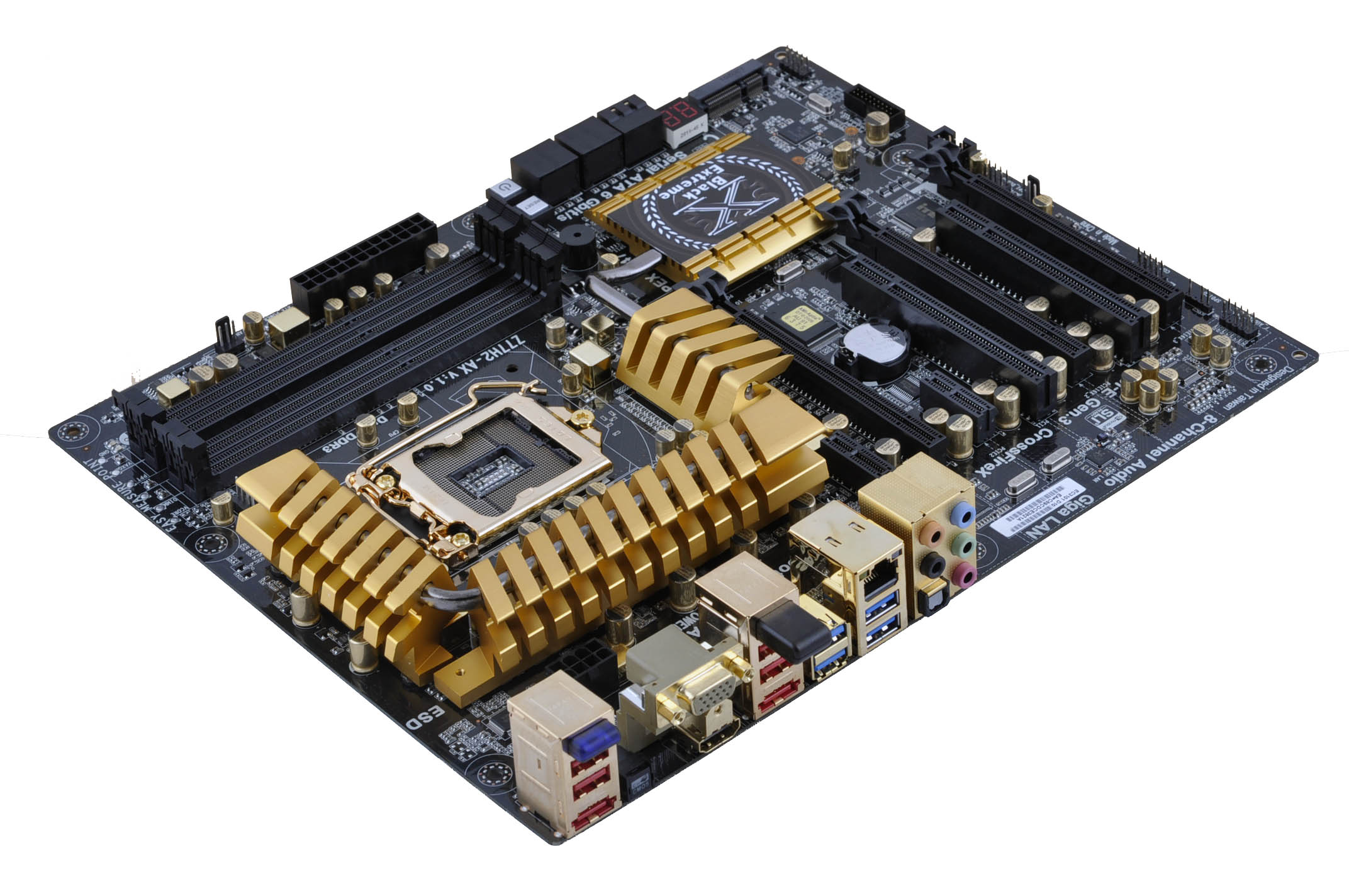
The ECS Z77H2-AX comes straight out of the box in a bedazzling gold sheen. If you want a gold colored motherboard and do not feel like spray painting heatsinks and capacitors yourself, then the ECS Z77H2-AX has you covered. It is just a shame that the rest of the package does not live up to that expectation.
If we start from the top, we have a PLX PEX 8747 motherboard that is retailing at the time of writing on Newegg for $310. The ECS Z77H2-AX offers something a little different than the other motherboards such that instead of having four full-length PCIe slots for multiple GPU action, ECS have gone down to three (which takes it away from a very small minority of users) and thus x16/x8/x8 connectivity. With this setup, we get space between the first and second full sized GPU, or space for two three-slot GPUs in an x16/x16 configuration.
On board we get built in WiFi and Bluetooth, as well as an mSATA port and the first motherboard in our Z77 reviews to use a Texas Instruments branded USB 3.0 controller. Unfortunately, the buck stops there.
The system uses only six of the twelve USB 2.0 ports supported by the chipset, and only six USB 3.0 total compared to other motherboards in this review that offer up to twelve USB 3.0. We have access to six SATA ports on board and an mSATA, where ECS decide to leave one of the SATA ports supported by the chipset unconnected. To save costs we have a Realtek combination of NIC and Audio, but even then we only get the ALC892 audio rather than the ALC898. The ECS Z77H2-AX has only one NIC, rather than the other motherboards in this review which have two each. For video outputs, we get VGA and HDMI, which remove the use of any display above 1920x1200 due to Ivy Bridge limitations.
In terms of performance, ECS have decided not to go down the MultiCore Enhancement route. It goes a little further than that, in the sense that our multithreaded testing on the ECS Z77H2-AX seemed a little sluggish compared to some other boards. It should also be noted that our USB 2.0 sequential testing resulted in a 20% speed loss compared to every other Z77 motherboard we have ever tested. For our real world copy test this meant an increase from 60 seconds to 75 seconds.
Overclocking was a little unusual, with the motherboard offering its own interpretation of Load Line Calibration causing a positive bias on the CPU voltage when at load by as much as 0.075 volts. Nevertheless we did hit 4.7 GHz with ease. Memory on the other hand was a little tricky to navigate, with the motherboard refusing our XMP setting or any attempt to set XMP timings. In the end, we settled for testing on 2133 10-12-12 rather than 2400 9-11-11.
The BIOS needs a little work, particularly to correct the ClearCMOS issue and resetting to defaults, as well as adjusting the SATA configuration from IDE to AHCI by default. Also, the BIOS seems to manipulate the video output of the GPUs to the physically lowest card plugged in, which is also an unusual situation. We also cannot update the BIOS through the BIOS.
The software also needs polish, with the Live Update on the drivers and utilities not working properly. The one redeeming feature despite the lack of fan headers on board is the use of hysteresis on the fan header control, which I rather like.
For $310, the ECS Z77H2-AX is way out of its league. My gut feeling is that ECS have overpaid for the PLX chip, or are thinking that a lick of gold paint can bring in the big money. Even if it was brought down to $250, it would be a hard sell. In comparison to the Gigabyte Z77X-UD5H which retails at $180, the Gigabyte board runs rings around the ECS in functionality and benchmarks. Anyone that wants to argue otherwise has not compared the two.
Originally published at https://www.anandtech.com/show/6170/four-multigpu-z77-boards-from-280350-plx-pex-8747-featuring-gigabyte-asrock-ecs-and-evga (Wayback Machine).