
Four Multi-GPU Z77 Boards from $280-$350 - PLX PEX 8747 featuring Gigabyte, ASRock, ECS and EVGA
Gaming Benchmarks
Clarification of Lane Counts
In this review, we are dealing with motherboards that utilize the PLX PEX 8747 chip differently, such that the PCIe lanes that power each of these boards can come from either the CPU or the PLX chip depending on routing. The following describes the behavior of the four motherboards in this review, along with the ASUS P8Z77-V Premium reviewed previously that also utilized the PLX chip.
ASUS: 16x CPU to PLX, x8/x8/x8/x8
Gigabyte: 16x CPU to PLX, x8/x8/x8/x8
EVGA: 8x CPU to PCIe 1, 8x CPU to PLX for overall x8/x16/x8/x8
ASRock: 16x CPU to PLX, x8/x8/x8/x8
ECS: 16x CPU to PLX, x16/x8/x8
Dirt 3
Dirt 3 is a rallying video game and the third in the Dirt series of the Colin McRae Rally series, developed and published by Codemasters. Using the in game benchmark, Dirt 3 is run at 2560x1440 with full graphical settings. Results are reported as the average frame rate across four runs.
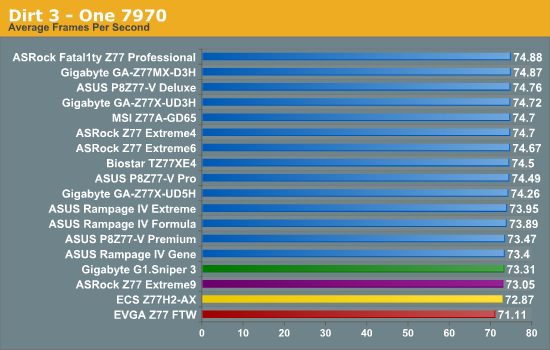
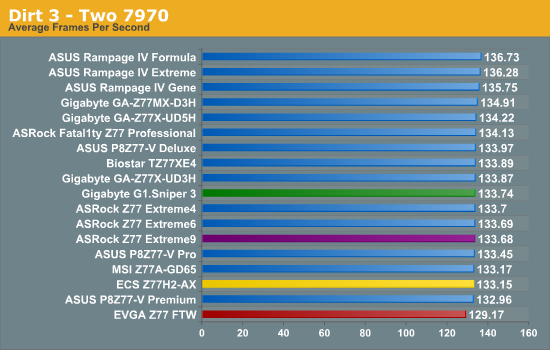
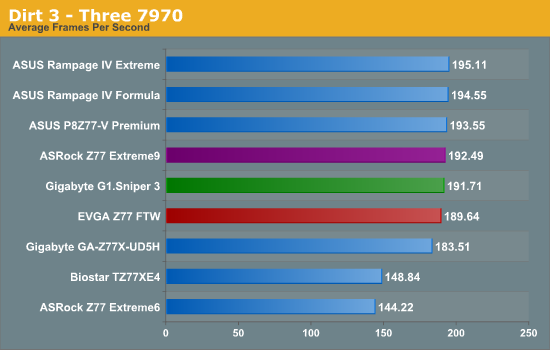
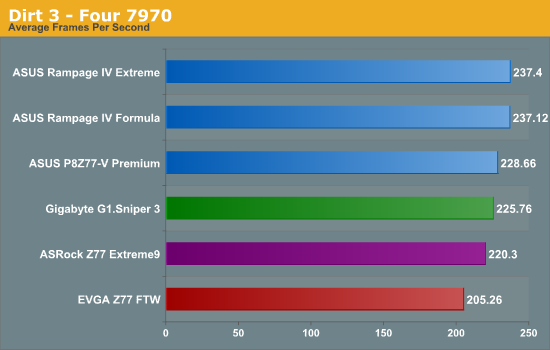
Despite the lane adjustment for EVGA to improve single GPU performance over the other boards, this does not materialize in Dirt3 which ends up being very power and memory hungry. When looking at a fully loaded setup, the eight lane uplink from the EVGA looks to be a limiting factor also.
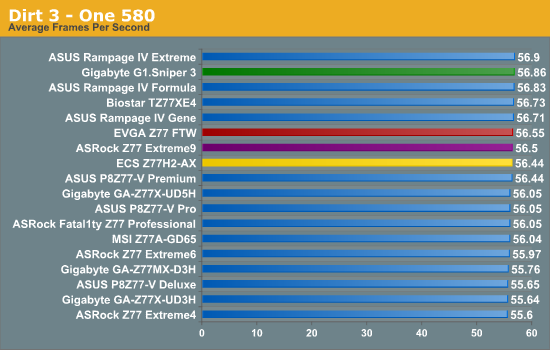
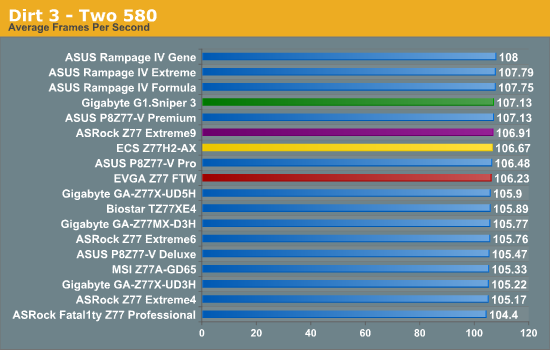
In comparison, there does not seem to be much to stretch apart the motherboards when NVIDIA cards are used.
Metro2033
Metro2033 is a DX11 benchmark that challenges every system that tries to run it at any high-end settings. Developed by 4A Games and released in March 2010, we use the inbuilt DirectX 11 Frontline benchmark to test the hardware at 2560x1440 with full graphical settings. Results are given as the average frame rate from 10 runs.
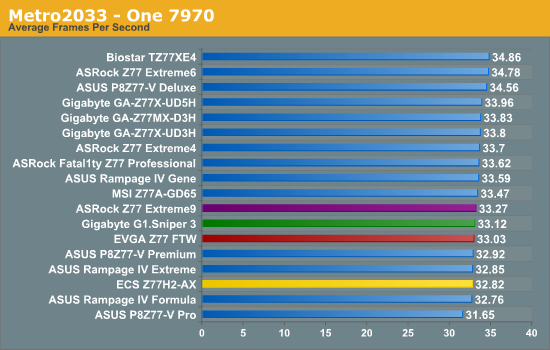
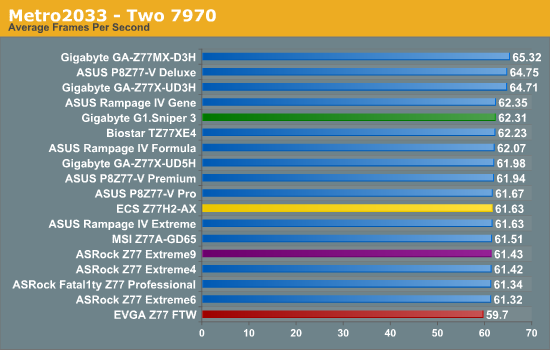
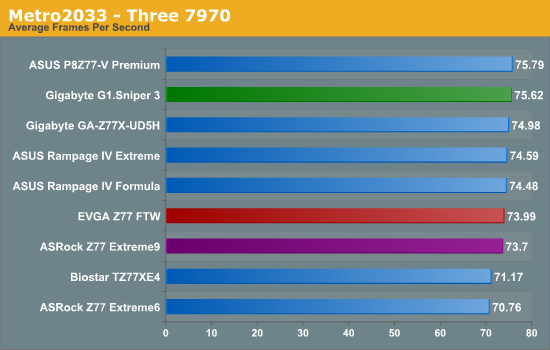
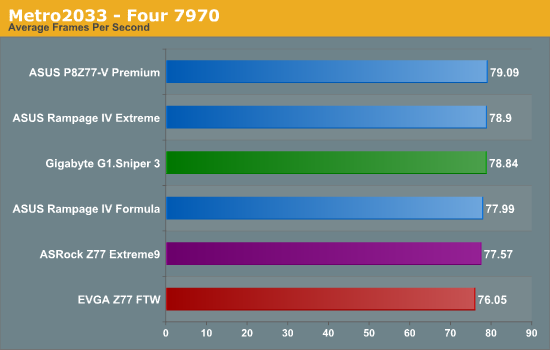
For single card setups in Metro2033, the routing via the PLX produces a 4.7% to 6.2% difference in frame rates compared to the top results.
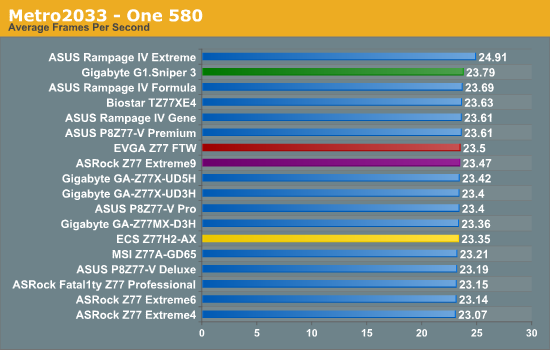
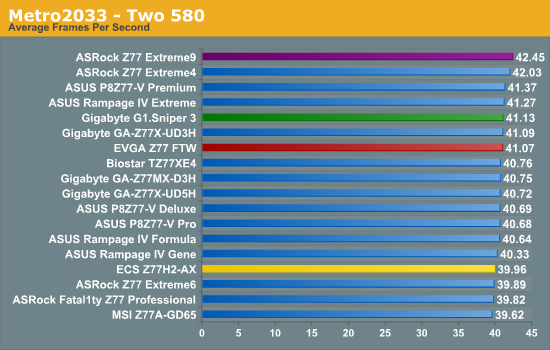
Whereas for NVIDIA cards, Metro2033 shows indifference between PLX enabled motherboards and non-PLX motherboards.
Originally published at https://www.anandtech.com/show/6170/four-multigpu-z77-boards-from-280350-plx-pex-8747-featuring-gigabyte-asrock-ecs-and-evga (Wayback Machine).