
The Intel SSD 910 Review
- Posted in
- Storage
- SSDs
- Intel
- Intel SSD 910
The Test
For our tests we looked at combined performance of all two/four NAND partitions on the Intel SSD 910. We created a two/four drive RAID-0 array from all of the active controllers on the card to show aggregate performance. If you're going to dedicate one partition to each VM in a virtualized environment, you can expect performance to be roughly a quarter of what you see here per drive.
| CPU | Intel Core i7 2600K running at 3.4GHz (Turbo & EIST Disabled) |
| Motherboard: | Intel H67 Motherboard |
| Chipset: | Intel H67 |
| Chipset Drivers: | Intel 9.1.1.1015 + Intel RST 10.2 |
| Memory: | Qimonda DDR3-1333 4 x 1GB (7-7-7-20) |
| Video Card: | eVGA GeForce GTX 285 |
| Video Drivers: | NVIDIA ForceWare 190.38 64-bit |
| Desktop Resolution: | 1920 x 1200 |
| OS: | Windows 7 x64 |
Random Read/Write Speed
The four corners of SSD performance are as follows: random read, random write, sequential read and sequential write speed. Random accesses are generally small in size, while sequential accesses tend to be larger and thus we have the four Iometer tests we use in all of our reviews. For our enterprise suite we make a few changes to our usual tests.
Our first test writes 4KB in a completely random pattern over all LBAs on the drive (compared to an 8GB address space in our desktop reviews). We perform 32 concurrent IOs (compared to 3) and run the test until the drive being tested reaches its steady state. The results reported are in average MB/s over the entire time. We use both standard pseudo randomly generated data for each write as well as fully random data to show you both the maximum and minimum performance offered by SandForce based drives in these tests. The average performance of SF drives will likely be somewhere in between the two values for each drive you see in the graphs. For an understanding of why this matters, read our original SandForce article.
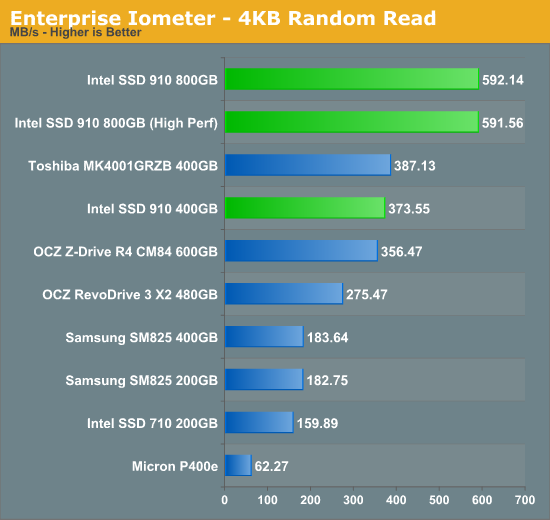
Intel was one of the first mainstream SSD vendors to prioritize random read performance, and it applies just as much to its enterprise offerings. The 800GB Intel SSD 910 delivers gobs of performance in our random read test. The 400GB version is also good but it's interesting to note Toshiba's 400GB 2.5" SAS drive does just as well here.
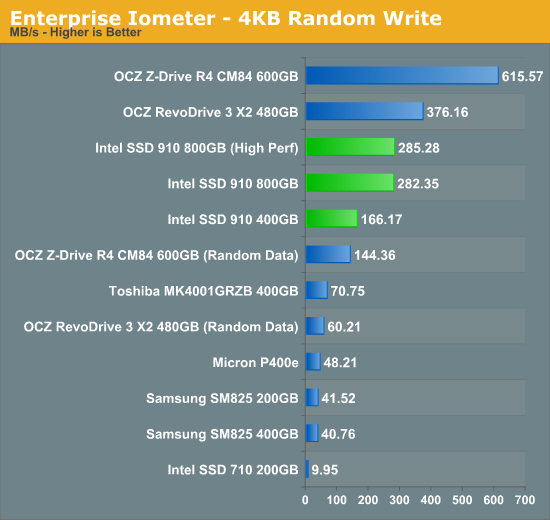
Random write performance is good, although still far away from what the SandForce based solutions from OCZ are able to deliver with compressible data. Throw anything other than pure text into your database however and Intel's drives become the fastest offerings once again.
Sequential Read/Write Speed
Similar to our other Enterprise Iometer tests, queue depths are much higher in our sequential benchmarks. To measure sequential performance I ran a 1 minute long 128KB sequential test over the entire span of the drive at a queue depth of 32. The results reported are in average MB/s over the entire test length.
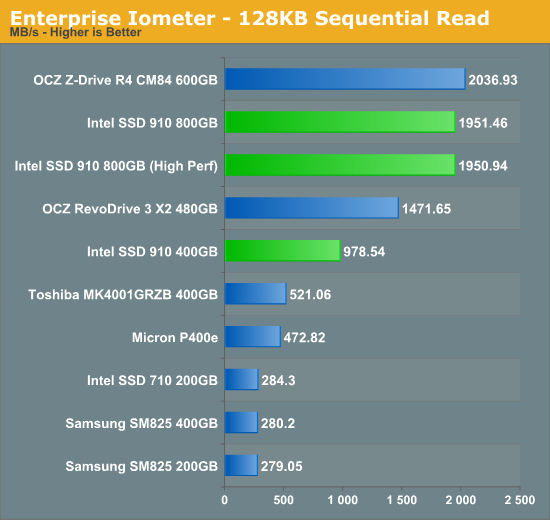
Sequential read performance of the 800GB 910 is nearly 2GB/s and competitive with OCZ's 600GB Z-Drive R4. This is really where PCIe based SSDs shine, there's simply no way to push this much bandwidth over a single SATA/SAS port. The 400GB cuts performance in half but we're still talking about nearly 1GB/s. Of the single drives, Toshiba's 400GB SAS drive does the best at 521MB/s. Micron's P400e is a close second among 2.5" drives.
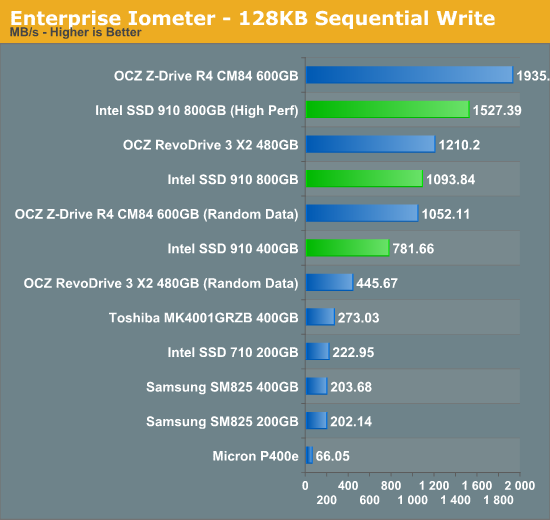
Here we finally see a difference between running the 800GB 910 in standard and high performance modes. In its max performance state the 800GB 910 is good for 1.5GB/s. OCZ's Z-Drive R4 is still a bit quicker with compressible data, but if you throw any incompressible (or encrypted) data at the drive performance is cut in half. Without the TDP cap removed, we can write sequentially to the 910 at 1GB/s.
Originally published at https://www.anandtech.com/show/6124/the-intel-ssd-910-review (Wayback Machine).