
Dell Precision T1650 Workstation Review: Ivy Bridge Xeons Bring Performance
Build Quality
Where I do think the Dell Precision T1650 betrays its entry level roots is in the build quality. It's hard not to be disappointed with the T1650 when the T3600 and its brethren have such a vastly superior design. In fact, this is where it's clear just how incremental the T1650's build really is.
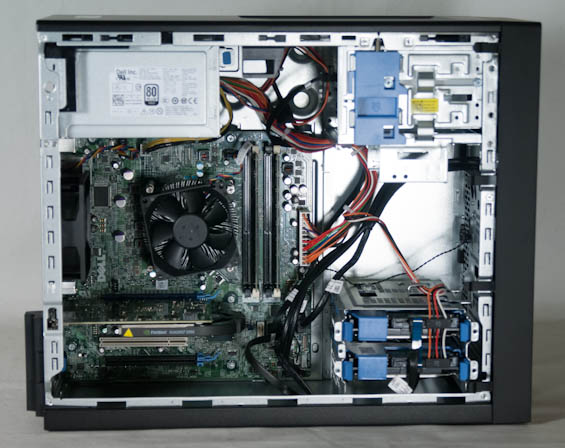
So above, we have the interior of the T1650 with everything in its very standard ATX position. This isn't a bad design, necessarily, but I chastised HP for recycling the previous year's chassis with the Z420 and now it's Dell's turn. The front fascia may be different for the T1650, but...
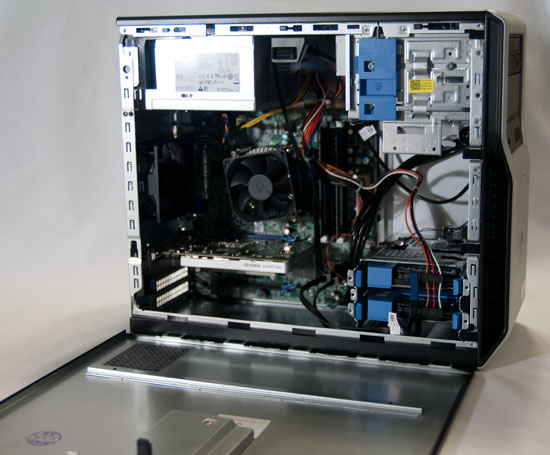
The picture above is the last generation T1600. What's changed? They moved the I/O cluster and swapped out the fascia. That's all. That's it. Compared to the brilliant design decisions and language of the T3600 (seen below)...
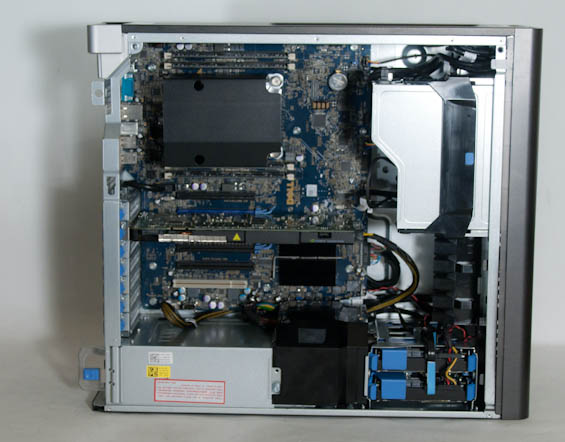
...it's very hard not to be disappointed. This isn't a design that can't be shrunk down to suit the T1650, but hitting a price point seems to have been more important. As a result, you lose the smarter airflow and easily replaceable power supply. Worse, you're still stuck paying $50 for an upgrade to an 80 Plus Gold power supply, something that comes standard in the bigger models. HP ships their competing Z220 desktop with 80 Plus Gold power supplies standard.


This isn't a bad internal design, but it shows just how mild a refresh the T1650 winds up being. Something could've been done here to improve the product and it wasn't. Dell even has the price latitude to do so; HP's Z220 starts $400 more expensive (and indeed a comparable configuration to our review unit winds up being $300 more expensive), so why not take a small sliver out of that to deliver a more compelling product?
Noise, Heat, and Power Consumption
Whatever my disappointment with the aging internal design of the T1650, it's pretty tough to argue with the thermals, power, and acoustics. At idle the T1650 is beneath the noise floor of my sound meter (30dB), and even under load it only goes up to ~33dB. Is it a silent machine? No, but it's remarkably quiet and is going to be a perfectly fine citizen of any workplace.
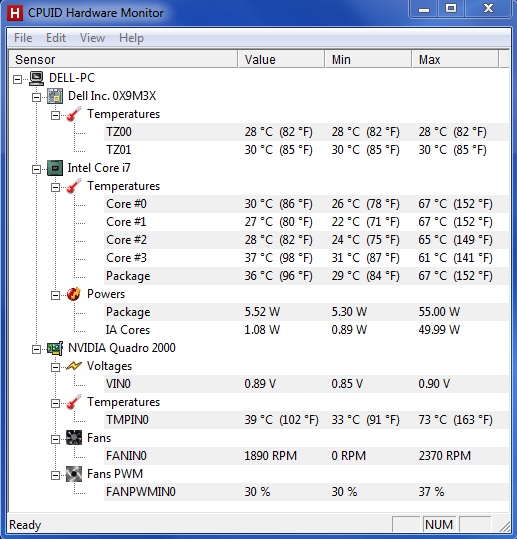
Ivy Bridge may get hot in a hurry when overclocked, but as a workstation processor running at spec it's remarkably frosty. While I think the T1650's chassis still has room to improve thermals, a core peak of 67C under sustained load really isn't bad (especially when that core is peaking at 4GHz), and the Quadro 2000's 73C is perfectly reasonable for a GPU using a single-slot cooler.
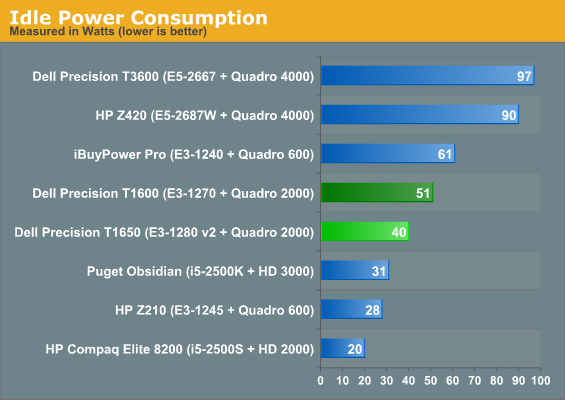
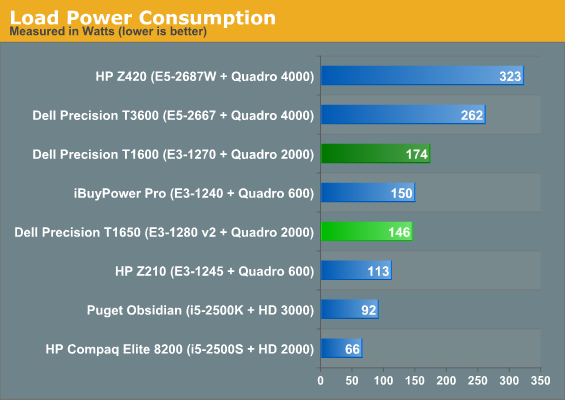
Of course, the power consumption is where the T1650's new processor gets really exciting. The new Xeon helps it idle at just 40W, 11W lower than the outgoing E3-1270. That's a much faster processor pulling a lot less power under both idle and load. You'd basically have to get rid of the dedicated graphics hardware to get power consumption any lower, making the T1650 and its Ivy Bridge-based Xeon a very attractive option for offices looking to deploy a substantial number of workstations. The power consumption savings most definitely adds up.
Originally published at https://www.anandtech.com/show/6119/dell-precision-t1650-workstation-review-entry-level-catches-up-to-the-pack (Wayback Machine).