
Fractal Design Define R4 Case Review: Evolution, Not Revolution
Conclusion: Iterative, But Still Needs Work
With the Define R4, Fractal Design has again produced a solid case that has a lot to offer end users. I'm very fond of case designs like this one and the AZZA Genesis 9000 that give the user a great deal of flexibility in how they want to assemble their system, and I like that Fractal Design lets you optimize for acoustics or for thermal performance. The included three-channel, three-setting fan controller is also greatly appreciated and a marked improvement over the R3.
As a general rule it's good to continually reward improvement and innovation from vendors, and the Define R4 is absolutely a better case than the R3. The problem is that enclosures are one of the places where a lot of innovation is occurring on a regular basis as companies continually revise existing designs and introduce radical new ones in a bid to further optimize system cooling. System cooling is a science that is still miles away from being perfected and probably never will be if for no other reason than that there are simply too many variables to take into account. Engineers have to find the right balance for their product and plant the flag there.
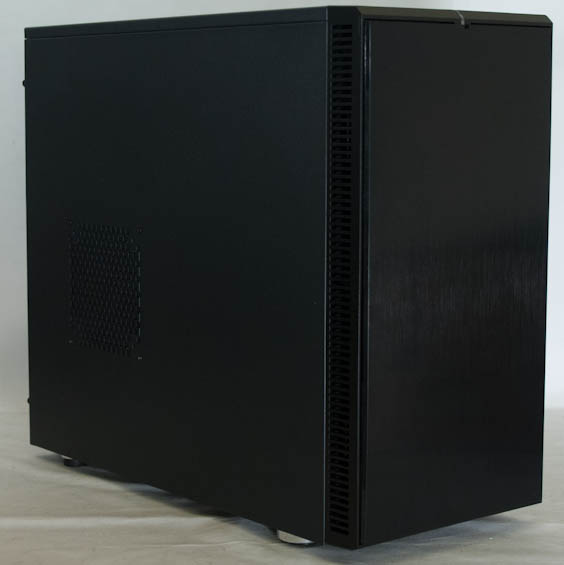
I don't think Fractal Design's engineers were daring enough with the Define R4. This is by no means a bad case, but there are places where technology has improved that Fractal Design could definitely have adopted. For example, SilverStone's Temjin TJ04-E aligns the top fan mounts to the left side of the case in order to improve clearance for increasingly popular 240mm radiators. This is an easy enough change to institute that notably improves the usability of the case. Likewise, switching to hinged side panels allows for clearance for routing the AUX 12V line. Fractal Design could also save some width by introducing cabling channels in the motherboard tray similar to what Corsair did with the Vengeance C70. These aren't changes that are going to dramatically improve the R4, but they're easy ones to implement that make the case more usable without driving up the cost.
Speaking of cost, that's one place where I do think Fractal Design nailed the Define R4. While I wasn't supremely impressed by its thermal performance, I do think it's worth the $10 premium over the NZXT H2, and does a better job acoustically than the $10 pricier Antec P280. $109 is a great price for a case this feature rich and well built, and while the Corsair 550D is a generally better performer, it also has more trouble spots that give me some pause in regards to its longevity. Couple that with an extra $30 on the price tag, and the Define R4 looks a lot better.
Ultimately, I think if I were building a quiet system on a budget for someone, I'd have an awfully hard time finding a better choice than the Define R4. The case absolutely has room for improvement and I wonder if potentially more efficient case fans like SilverStone's AP121 or Corsair's new line wouldn't give us better thermal results, but the $109 price tag is very hard to argue with when you take into account what you get. The R4 isn't a slam dunk, but it's definitely worth your consideration.
Originally published at https://www.anandtech.com/show/6102/fractal-design-define-r4-case-review-evolution-not-revolution (Wayback Machine).