
AZZA Genesis 9000 Case Review: Building It Every Way
- Posted in
- Cases/Cooling/PSUs
- ATX
- AZZA
Conclusion: Good Value, Difficult to Evaluate
It probably makes little sense to suggest a case is both a good value and difficult to evaluate, since one leads into the other. Yet from a purely monetary perspective, AZZA really offers you a heck of a lot with the Genesis 9000. When I unboxed it and began tinkering with it, I didn't yet know just how much it was going to retail for, and I was expecting at least the low $200s. $169 is still a lot of money for an enclosure, but compare it to what else is available and it starts to look a lot more promising. In that ballpark you're looking at Corsair's Obsidian 650D, NZXT's Switch 810, SilverStone's Raven RV-02 and RV-03, and Cooler Master's HAF 932 and X. While I can't speak to the popular Cooler Master entries, I can tell you with certainty that in terms of pure performance and flexibility, I would easily take the Genesis 9000 over the other cases barring maybe the RV-02.
Part of the problem with evaluating the Genesis 9000, though, is that it's such a flexible enclosure and capable of so many different cooling configurations that it's impossible to gauge just what's going to be ideal for it. A standardized testbed can already be fairly shaky to begin with (something I discussed with Corsair's engineers recently), as even just the style of coolers used on the CPU and GPU can radically affect their performance in conjunction with the type of airflow the case employs. SilverStone's FT02, for example, might struggle more with a typical radial cooler on a graphics card, but it works like gangbusters on blower-style coolers. Yet the FT02 and most cases don't feature this much in the way of configurability.
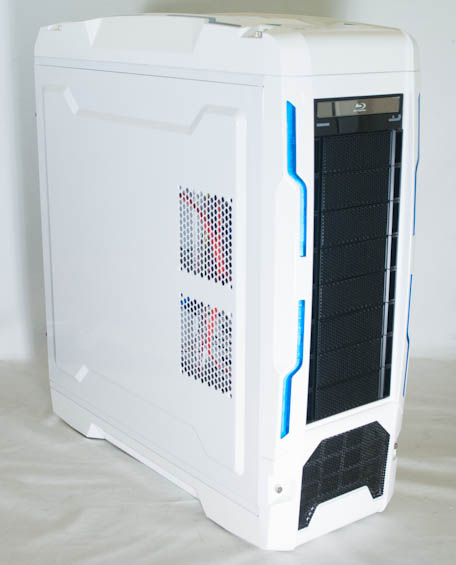
What I can say with relative certainty is that the Genesis 9000 provides decent performance in its default configuration, competitive performance with the motherboard switched to the standard ATX configuration, and has additional cooling potential waiting to be unlocked by the intrepid end user willing to take the time to experiment with it (as well as invest in one or two additional fans). It's easy enough to build in on its own, but can potentially turn into a medium-term project in a hurry.
I can't unilaterally recommend the Genesis 9000, especially with the minor interior damage incurred to the front power supply cover just by removing it. Someone who wants to build it and forget it is going to be better served by an enclosure that has a much clearer design path. Yet the end user who's either interested in watercooling or just wants something to play with is liable to find a lot to like with the Genesis 9000. AZZA did a bang up job with the Genesis 9000 and priced it competitively. If you want a case that performs well and has a lot of room for customization, the Genesis 9000 absolutely gets my recommendation.
Originally published at https://www.anandtech.com/show/6088/azza-genesis-9000-case-review-building-it-every-way (Wayback Machine).