
AZZA Genesis 9000 Case Review: Building It Every Way
- Posted in
- Cases/Cooling/PSUs
- ATX
- AZZA
Noise and Thermal Testing, Stock
Since the AZZA Genesis 9000 has no front intake fans, intake cooling duties are handled largely by the two bottom-mounted 140mm fans. Bottom-to-top cooling can be very effective, but the motherboard isn't rotated ninety degrees here the way it is in SilverStone's more efficient designs, so air travelling through the Genesis 9000 unfortunately just doesn't have a very efficient default path to work with.
I tested the Genesis 9000 in its stock tray orientation (with the motherboard tray flipped and the video card above the CPU) and with the tray oriented in the typical ATX style (with the CPU above the video card); these are listed as "default" and "alt" respectively. The case's fan control also only has two speeds, low and high, and so I tested it in each of these speeds for a combined four different test runs. Ambient temperature around the Genesis 9000 varied between 24C and 25C during testing.
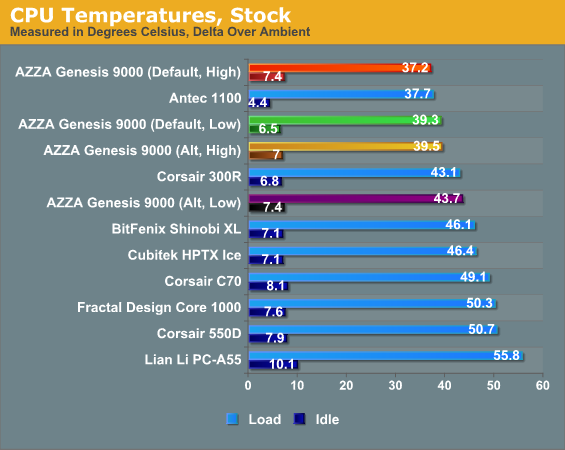
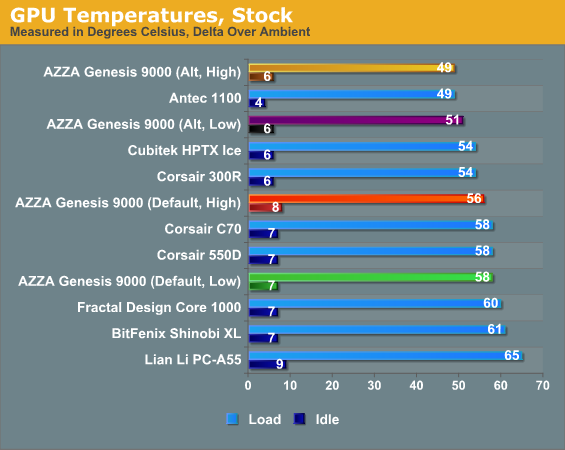
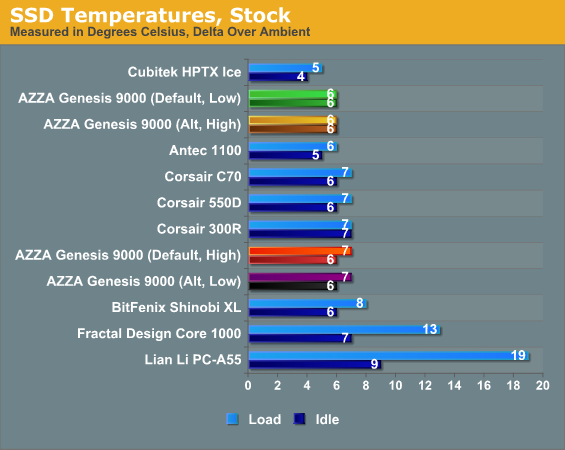
Thermally the Genesis 9000 puts in a solid performance. Unfortunately there's no one-size-fits-all orientation; if you run it in its stock configuration, the graphics card runs hotter but the CPU heatsink gets fed. If you flip the tray, suddenly the graphics card is getting fed but the CPU heatsink is blocked somewhat by the video card. In our non-overclocked configuration, though, we can easily determine that switching between low nad high fan speeds doesn't seem to have much of an effect. This isn't surprising; most cases tend to perform perfectly fine with their fans running low-to-mid speeds and gain very little by pumping up the fan speed.
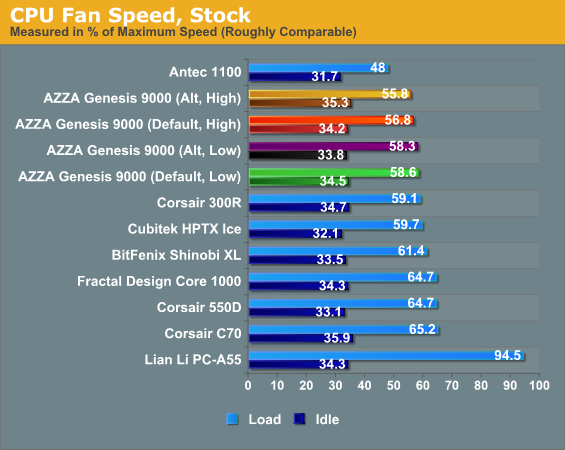
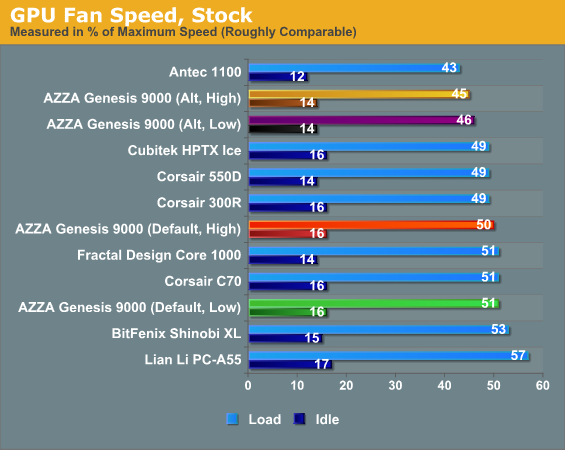
Fan speeds for the most part tell the same story. Depending on the motherboard orientation, you're really feeding one or the other, and I can see this becoming a real problem in a multi-GPU configuration. Under those circumstances you may want to consider installing a 200mm intake fan in the side panel.
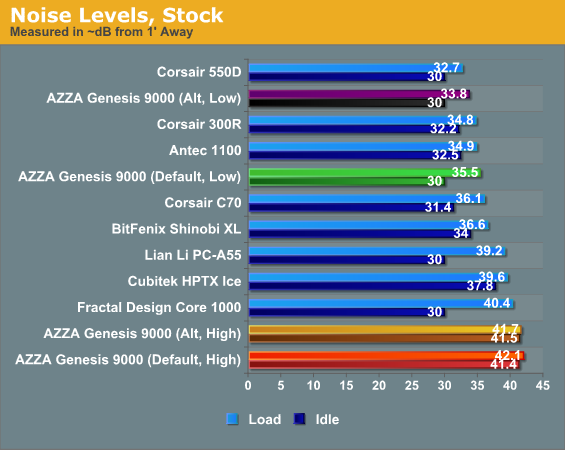
While bumping up the case's fan speed doesn't seem to do much for its thermals, it makes the whole thing nearly unbearable to listen to. There's virtually no reason to run the Genesis 9000 at high speed.
Also note that the standard ATX orientation of the motherboard (listed as "alt") runs a bit quieter. This makes sense when you consider that high performance graphics cards typically draw more power and generate more heat than CPUs do. We're looking at a 95W CPU competing with a 170W GPU; under the circumstances cooling the GPU should probably take priority, and that's why the default orientation may not actually be the right call.
Originally published at https://www.anandtech.com/show/6088/azza-genesis-9000-case-review-building-it-every-way (Wayback Machine).