
NVIDIA GeForce GTX 670 Review Feat. EVGA: Bringing GK104 Down To $400
Synthetics
We’ll also take a quick look at synthetic performance to see if NVIDIA’s choice of clockspeeds and disabling a SMX had any kind of other impact we haven’t anticipated. We’ll start with 3DMark Vantage’s Pixel Fill test.
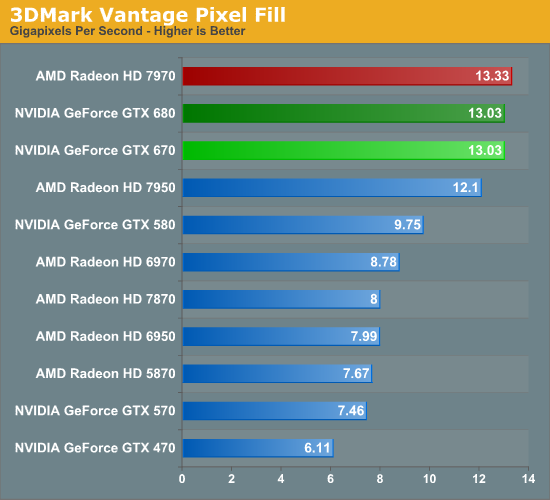
Pixel Fill is said to be memory bandwidth limited, and for good reason. Even with the lower clockspeed of the GTX 670, the fact that it has memory bandwidth equal to the GTX 680 means that it achieves equal performance in this test, confirming that GTX 670 can utilize its memory bandwidth just as well as GTX 680 can.
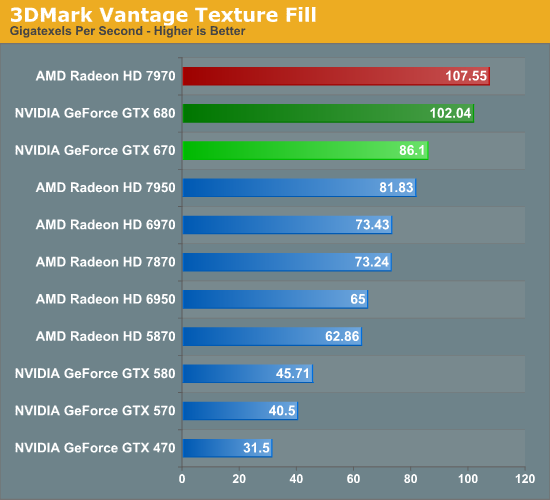
Our second test is 3DMark’s Texel Fill test, which as expected shows a moderate gap between the GTX 670 and GTX 680. Thanks to the loss of an SMX and the lower clocksped the GTX 670 only achieves 85% of the performance of the GTX 680, which thanks to the GTX 670’s more aggressive boost clock is a bit better than what we’d expect from the specifications.
Our third theoretical test is the set of settings we use with Microsoft’s Detail Tessellation sample program out of the DX11 SDK
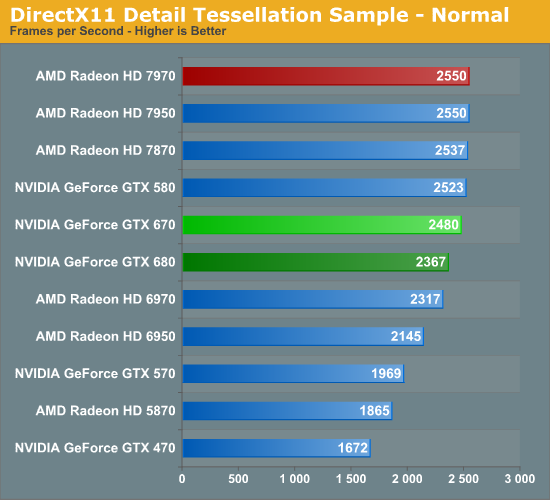
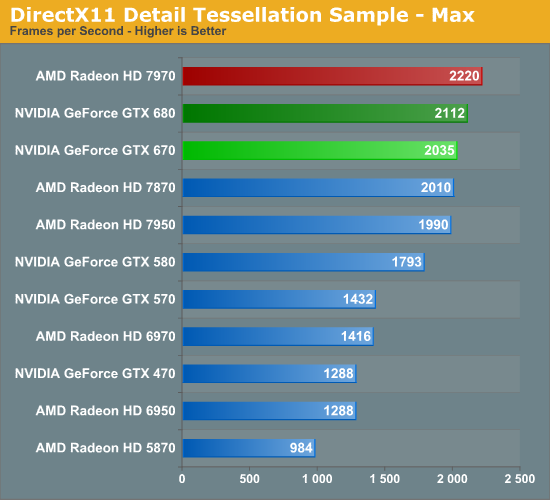
As expected GTX 670 falls behind GTX 680, but again not by nearly as much as we’d expect. The loss of the SMX means GTX 670 lost a Polymorph Engine, but with only a 4% gap with maximum tessellation you’d never be able to tell.
Our final theoretical test is Unigine Heaven 2.5, a benchmark that straddles the line between a synthetic benchmark and a real-world benchmark as the engine is licensed but no notable DX11 games have been produced using it yet.
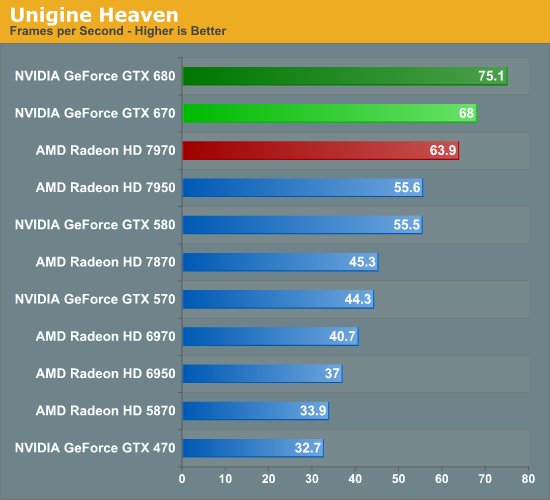
With Heaven the gap between the GTX 680 and GTX 670 once again opens up similarly to what we saw in our compute benchmarks with SmallLuxGPU. This means the GTX 670 falls behind by about 10%, reflecting the shader-heavy nature of this benchmark.
Originally published at https://www.anandtech.com/show/5818/nvidia-geforce-gtx-670-review-feat-evga (Wayback Machine).