
Cubitek HPTX ICE Review: How Far Aluminum Can Go
Noise and Thermal Testing, Stock
The big difference between Cubitek's HPTX ICE and the other cases we've tested since revising the testbed (besides the pricetag) is the building material. Aluminum should in theory allow the HPTX ICE to dissipate heat more efficiently than plastic and steel cases.
Ambient temperature during testing was unfortunately higher than I would've liked, averaging at nearly 26C. California's weather (especially in the bay area) is erratic to say the least, and it's been heating up here even at night. The problem there is that I can't really run the air conditioning or open the windows to cool off the apartment during testing either, since I also have to test acoustics. So keep in mind that while the temperature results listed should still be comparable, the non-adjusted results (fan speeds and acoustics) are going to be at a very slight handicap.
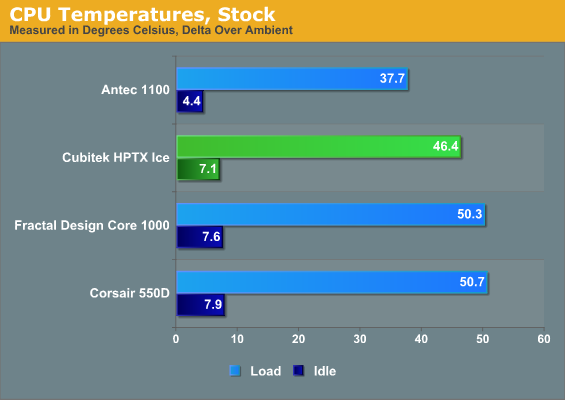
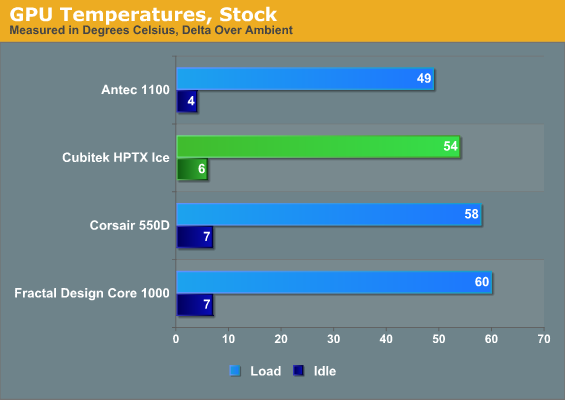
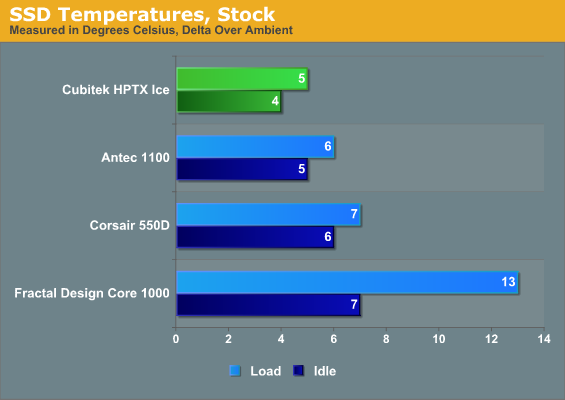
Thermals are generally good, but note the Antec Eleven Hundred's substantial lead in thermal performance at our stock settings. The Eleven Hundred won't go all the way up to HPTX or E-ATX, but it can still handle XL-ATX boards and smaller, offers nearly as much expandability, and is both smaller and lighter despite being made primarily of steel and plastic. You could also buy three of them for the cost of the HPTX ICE.
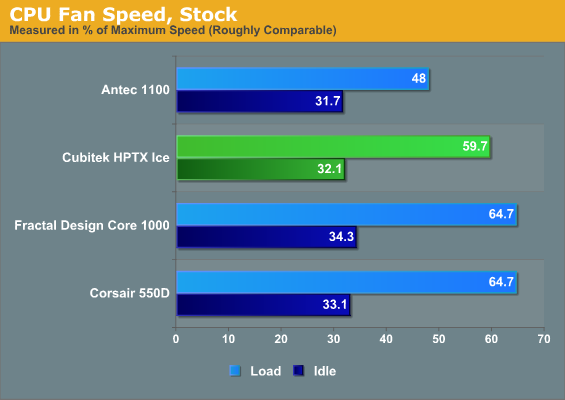
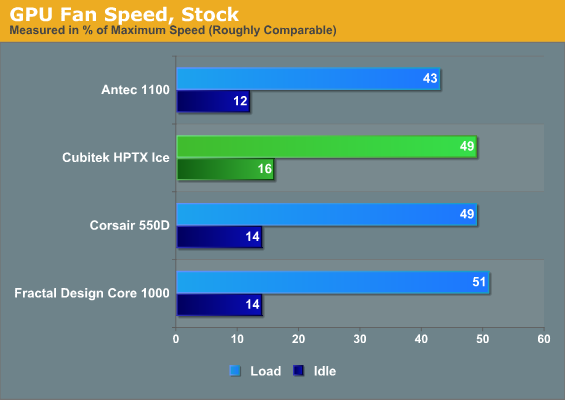
While idle fan speeds are basically comparable, differences in the load fan speeds are big enough to overcome the handicap of a higher ambient temperature. Antec's case is able to keep the CPU and graphics card cooler while leaving much more thermal headroom on the hardware.
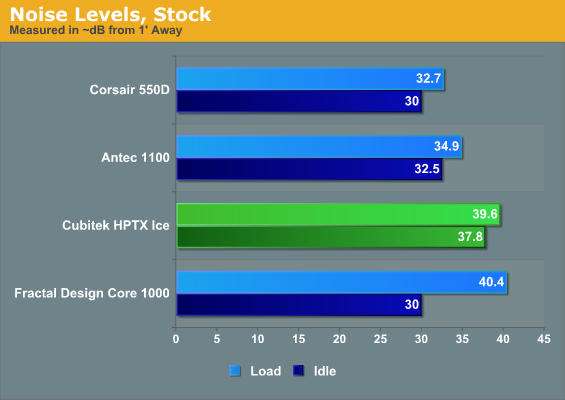
Cubitek rates its fans for relatively low noise, but since there's no fan controller included, all but the 120mm exhaust fan are forced to run at stock speed and...pardon the pun...they blow right past the peak noise level Cubitek specifies for the loudest fan (the front, at 24.45dBA). Antec's case doesn't have a fan control either (in fact none of the cases tested do), but the stock fans are much quieter. Cubitek's fans actually largely drown out the fans on the CPU and the graphics card, which is not a good starting point.
Unfortunately, it gets worse in a way that our graph can't describe: the rattle I had misgivings about is prominent, enough that it was difficult to get a stable noise level reading of the HPTX ICE. It's not just prominent, but actually audible in the other room during testing. The HPTX ICE isn't merely noisy; the noise itself doesn't have a consistent character to it, so it doesn't blend in like regular white noise.
Originally published at https://www.anandtech.com/show/5816/cubitek-hptx-ice-review-how-far-aluminum-can-go (Wayback Machine).