
The Intel Ivy Bridge (Core i7 3770K) Review
- Posted in
- CPUs
- Intel
- Ivy Bridge
Switching gears for the moment we have Minecraft, our OpenGL title. It's no secret that OpenGL usage on the PC has fallen by the wayside in recent years, and as far major games go Minecraft is one of but a few recently released major titles using OpenGL. Minecraft is incredibly simple—not even utilizing pixel shaders let alone more advanced hardware—but this doesn't mean it's easy to render. Its use of massive amounts of blocks (and the overdraw that creates) means you need solid hardware and an efficient OpenGL implementation if you want to hit playable framerates with a far render distance. Consequently, as the most successful OpenGL game in quite some number of years (at over 5.5mil copies sold), it's a good reminder for GPU manufacturers that OpenGL is not to be ignored.
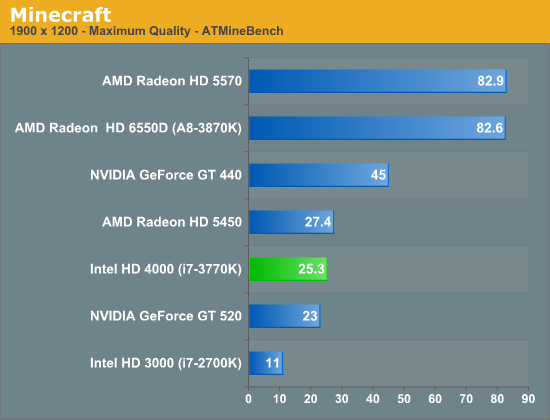
Our test here is pretty simple: we're looking at lush forest after the world finishes loading. In spite of a lack of any kind of shader workload for Ivy Bridge, it's still struggling here. On the one hand this is the single biggest gain over Sandy Bridge we've seen in any of our tests, with Ivy Bridge improving on its predecessor by an incredible 130%, and at the same time it's still only competitive with the entry-level discrete GPUs. Worse, for all of its gains, Ivy Bridge is still only achieving a mere 30% of the performance of Llano here.
Since this is largely a pixel pushing test, we'd expect Llano and Ivy Bridge to be closer than where they are. Given the gains versus Sandy Bridge Intel may still have some ROP bottlenecks that only come out in unusual workloads like Minecraft, but at the same time it's hard to imagine that OpenGL drivers aren't playing a role here. If that's the case, then Intel clearly has some work to do.
Originally published at https://www.anandtech.com/show/5771/the-intel-ivy-bridge-core-i7-3770k-review (Wayback Machine).