
The Intel Ivy Bridge (Core i7 3770K) Review
- Posted in
- CPUs
- Intel
- Ivy Bridge
Total War: Shogun 2 is the latest installment of the long-running Total War series of turn based strategy games, and alongside Civilization V is notable for just how many units it can put on a screen at once. Adding to the load is the use of DX11 features such as tessellation and high definition ambient occlusion, which means it can give any GPU a run for its money.
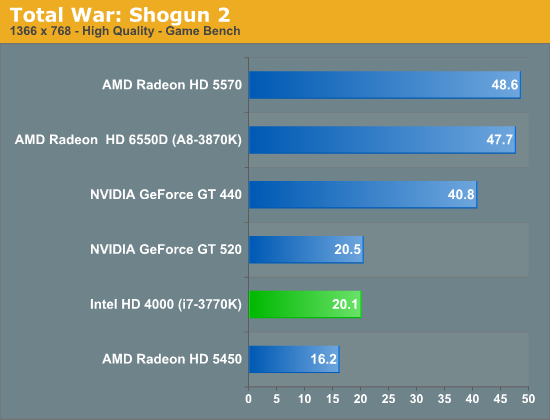
At high quality with Shogun 2's basic DX11 functionality, Ivy Bridge can't quite reach playable framerates. At this point it's closer to the entry-level GT 520 and Radeon HD 5450 than it is AMD's Llano, trailing AMD's iGPU by over 50%.
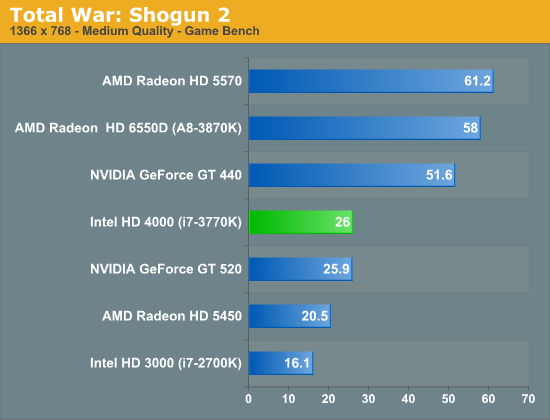
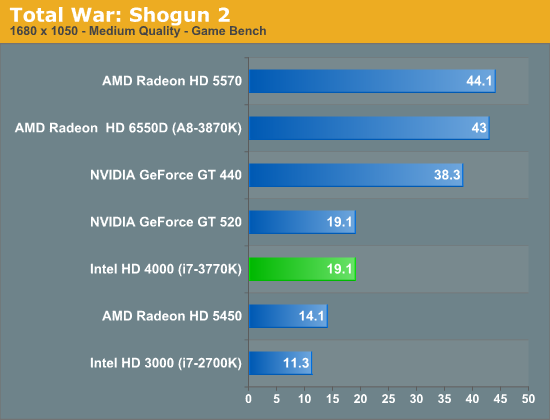
Turning our settings down to medium, and thereby reverting to DX10 functionality, Ivy Bridge picks up some performance. 26fps still isn't good enough to reach the 30fps mark, but at the same time it represents a remarkable improvement for Intel. Ivy Bridge is 61% faster than Sandy Bridge here, which is far greater than the theoretical performance difference between the two GPUs. Nevertheless Ivy Bridge still trails Llano by 55%, keeping Ivy Bridge decidedly in the entry level class of GPUs.
What's interesting here is that this is the first test in our suite that is shader intensive at even lower settings. On paper Ivy Bridge has far more memory bandwidth than GPUs like the GT 520, but only roughly the same amount of shader performance. The fact that the two GPUs are nearly tied is a stark reminder of this fact. Ivy Bridge greatly improves on Sandy Bridge, but it still has quite some distance to go to catch Llano in shader-bound scenarios.
Originally published at https://www.anandtech.com/show/5771/the-intel-ivy-bridge-core-i7-3770k-review (Wayback Machine).