
ADATA XPG SX900 (128GB) Review: Maximizing SandForce Capacity
Random Read/Write Speed
The four corners of SSD performance are as follows: random read, random write, sequential read and sequential write speed. Random accesses are generally small in size, while sequential accesses tend to be larger and thus we have the four Iometer tests we use in all of our reviews. Our first test writes 4KB in a completely random pattern over an 8GB space of the drive to simulate the sort of random access that you'd see on an OS drive (even this is more stressful than a normal desktop user would see). I perform three concurrent IOs and run the test for 3 minutes. The results reported are in average MB/s over the entire time. We use both standard pseudo randomly generated data for each write as well as fully random data to show you both the maximum and minimum performance offered by SandForce based drives in these tests. The average performance of SF drives will likely be somewhere in between the two values for each drive you see in the graphs. For an understanding of why this matters, read our original SandForce article.
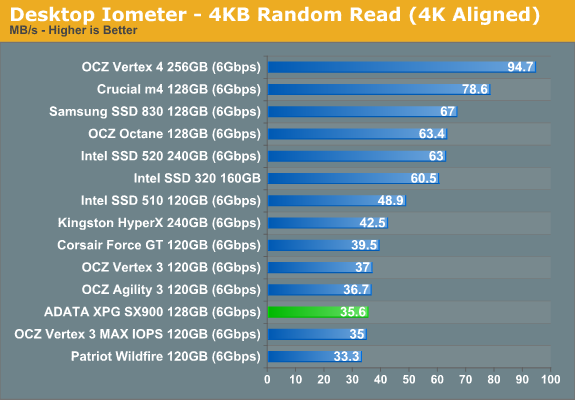
Random read performance has never been a strength of SandForce as even Intel SSD 320 outperforms most SandForce based SSDs. As the graph shows, the SX900 is on-par with other 120/128GB SandForce drives.
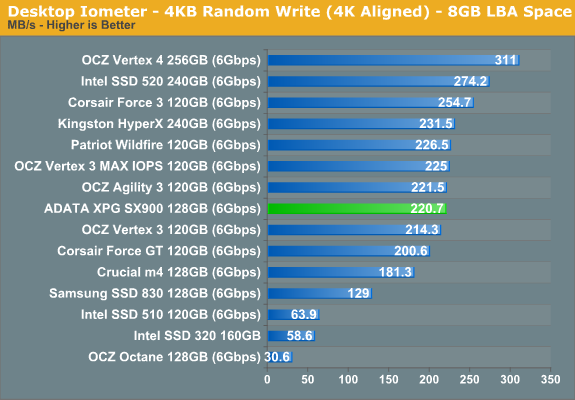
4KB random write performance is no different from other SandForce drives. Only Intel SSD 520 and Corsair Force 3 are noticeably faster, while others fall in the same 215-230MB/s range.
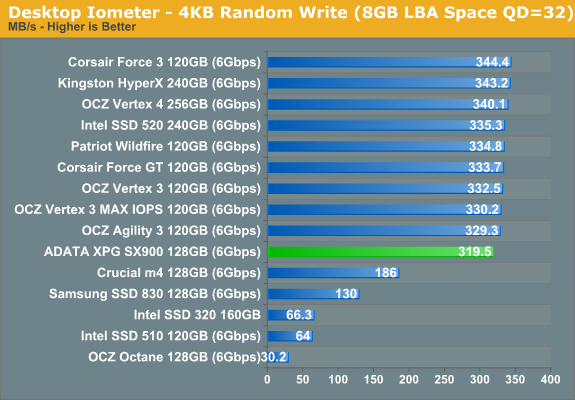
Increasing the queue depth to 32 doesn't change the story. While the SX900 is the slowest SandForce drive in this test, it's less than 5% slower than the majority of SF-2281 drives.
Sequential Read/Write Speed
To measure sequential performance I ran a 1 minute long 128KB sequential test over the entire span of the drive at a queue depth of 1. The results reported are in average MB/s over the entire test length.
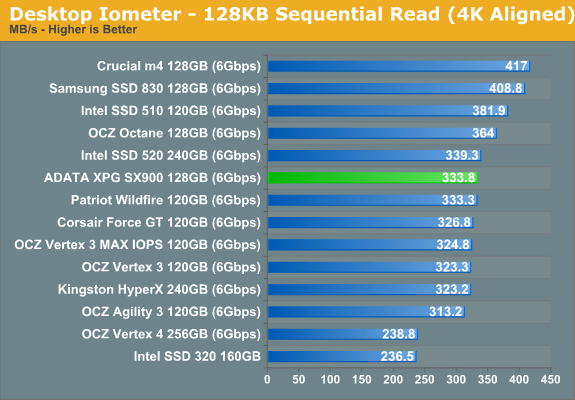
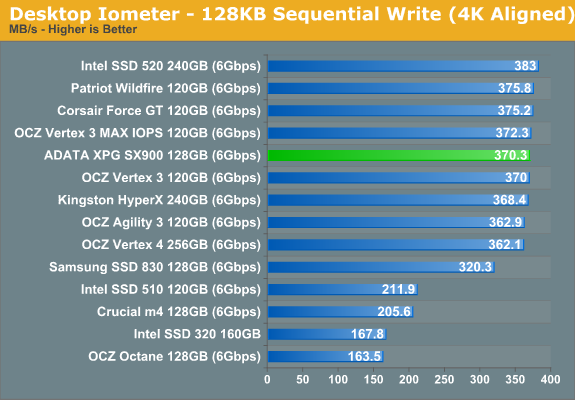
Both sequential read and write speeds are almost the same for all SandForce SF-2200 series SSDs and the SX900 is no exception. This isn't a surprise given that the firmware is essentially the same in all SandForce SSDs, with the exception of the Intel 520 series.
Originally published at https://www.anandtech.com/show/5710/the-adata-xpg-sx900-128gb-review-maximizing-sandforce-capacity (Wayback Machine).