
HP Phoenix h9se: The Pavilion Goes Beyond Thunderdome
Build, Heat, and Power Consumption
As mentioned before, HP has been able to leverage their size to produce a custom chassis that's reasonably small given the performance of the hardware contained within. What exactly does that mean? Let's assume the R&D and chassis design for a new case comes to around $1 million; for a boutique that might only sell 10K units (if that), it could mean at least $100 extra per system. A large OEM on the other hand that can move 100K units would only need to increase the cost of each unit by $10. Basically, economies of scale are very much in favor of the big OEMs (never mind the additional pricing benefits they enjoy for moving large volumes of CPUs, GPUs, etc.) Regardless of the size of company, though, it's the final product that matters. In the case of the Phoenix chassis, the result is a system with some modest thermal headroom and expandability to boot.


Externally the Phoenix looks like a slightly gussied-up Pavilion, but the aesthetic is pleasing. The side window glows from the red LED fan used on the liquid cooler's radiator, while the front has a series of red stripes that glow softly. I'm not a huge fan of glossy plastic, but here HP uses it primarily as an accent and it makes sense. The rest of the shell is a combination of gray plastic and black steel.
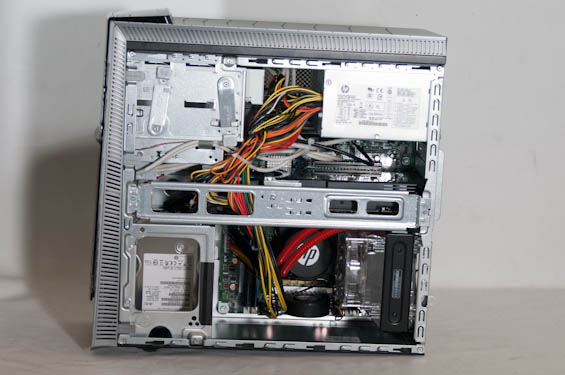
The internal design is about as cramped as you would expect, but HP includes disassembly instructions on the inside of the panel. Note the inverted design; the motherboard is affixed to the left side instead of the right, and the power supply is mounted at the top of the enclosure behind the optical drives. This arrangement paid off handsomely for SilverStone's Temjin TJ08-E enclosure and seems to be the right call for HP. The hard drive cage supports up to two 2.5" SSDs and a single 3.5" HDD.
While the motherboard has two PCIe x16 slots, there just isn't enough space or thermal headroom inside the Phoenix to handle any multi-GPU configurations, let alone power from the power supply. You could potentially use two slower GPUs, but that seems like a step backwards in overall performance potential and ease of use. Running a single GPU shouldn't be a problem, but it's something to keep in mind.
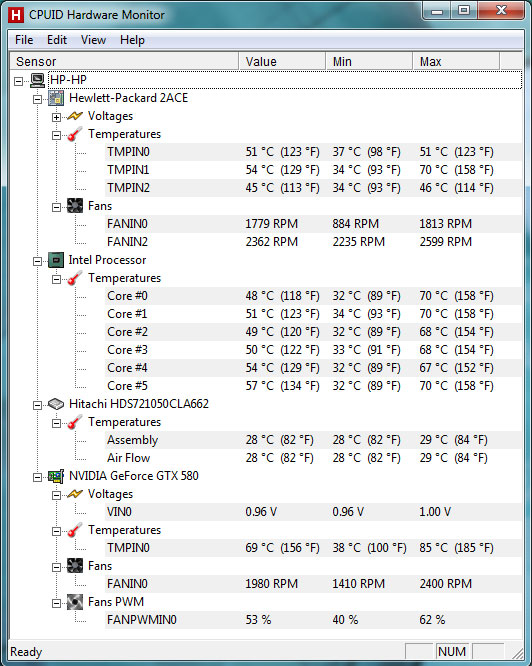
Thermally, HP's cooling system does an adequate job handling this configuration, but I'm not holding my breath for much in the way of overclocking headroom on the i7-3960X. I've generally been unimpressed by closed-loop CPU coolers, but it's still a better choice for shipping than a hefty tower cooler that can stress the motherboard if it's jostled too much. The GTX 580 posts numbers basically on par with what I've come to expect from this type of enclosure design; this is a chassis clearly intended for a specific thermal and power envelope and it meets those needs.
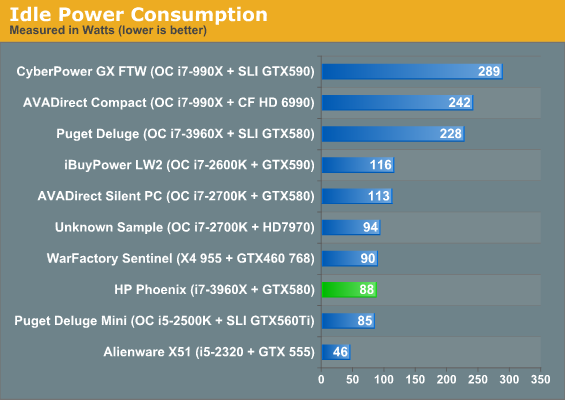
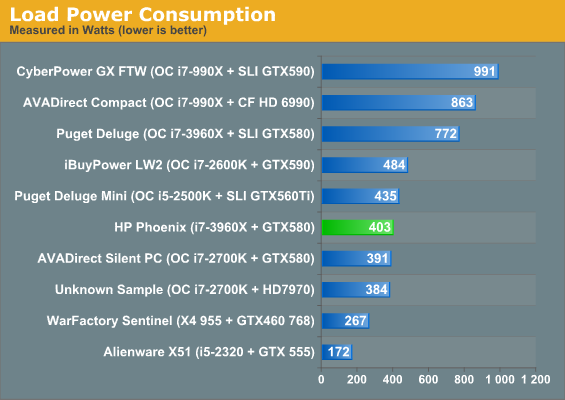
Power consumption for the Phoenix is, all told, pretty good. No one ever accused Sandy Bridge-E of being particularly frugal, but the system at least takes advantage of power-saving technologies on hand.
Originally published at https://www.anandtech.com/show/5605/hp-phoenix-h9se-the-pavilion-goes-beyond-thunderdome (Wayback Machine).