
The Xeon E5-2600: Dual Sandy Bridge for Servers
SQL Server 2008 Enterprise R2
We have been using the Flemish/Dutch Web 2.0 website Nieuws.be as a benchmark for some time. 99% of the loads on the database are selects and about 5% of them are stored procedures. You can find a more detailed description here.
We have improved our testing methodology (read more about it here) and updated the SQL Server, so the results are only comparable to our last Opteron 6276 review (and not comparable to older ones than the latter).
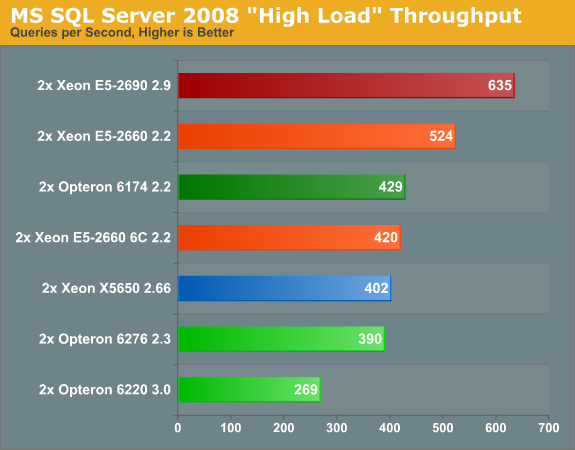
Since performance/watt is an extremely important metric, we follow up with a power measurement:
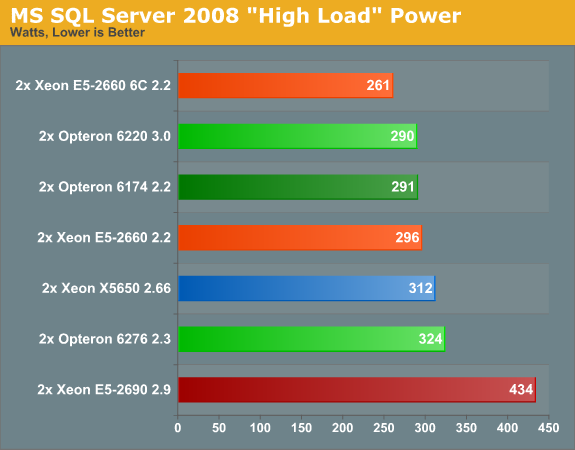
The Xeon E5-2690 is by far the fastest in this discipline, but the difference power consumption compared to the rest of the pack is significant. The Xeon E5-2690 needs 140W more than its slower brother, the 95W TDP Xeon E5-2660. That is 70W extra per CPU. This clearly indicates that the fastest Xeon is running closer to its TDP than the 2.2 GHz version. The Xeon E5-2660 offers more than 20% better performance per Watt than the 135W TDP Xeon.
The Xeon E5-2660 is especially impressive if you compare it with the older Xeon. Despite the lower clockspeed, the new Xeon is capable of outperforming the Xeon 5650 by 30%.
Clock for clock, core for core the Xeon E5 is 23% more efficient at SQL Server workloads than its older brother. Considering that it is pretty hard to extract higher IPC out of server workloads, we can say that the Sandy-Bridge architecture is a winner when it comes to SQL databases.
Finally, let's check out the response times with 600 users sending off a query every second (on average):
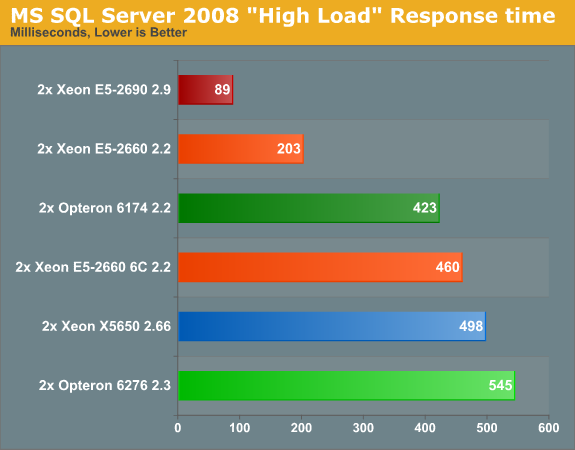
Response times are more or less linear (and low!) when the server is not yet saturated . Once the server is closer to or over its maximum throughput, response times tend to increase almost exponentially. Since the Xeon E5-2690 is capable of sustaining more than 600 users, it can still offer a very low response time. The other CPUs are saturated at this point.
But as we pointed out in our previous article, server benchmarks at 100% are just one datapoint and we should test at lower concurrencies as well. Most people try to make sure that their database server almost never runs at 100% CPU load.
Originally published at https://www.anandtech.com/show/5553/the-xeon-e52600-dual-sandybridge-for-servers (Wayback Machine).